
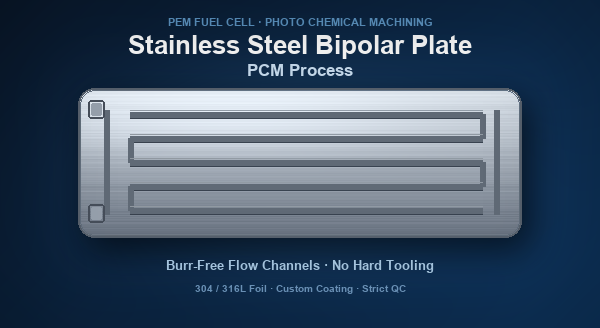
photo chemical machining process
The stainless steel bipolar plate PCM process has become a leading method for fabricating PEM fuel cell flow field plates. As a core component inside fuel cell stacks, PCM-produced bipolar plates combine fine flow channel accuracy, stress-free processing and tooling-less iteration; understanding the process steps helps buyers evaluate cost and quality correctly.
The PCM process consists of several steps: cleaning and coating the stainless steel foil with photoresist, exposing the flow field pattern through a phototool, developing the image, chemically etching away unwanted metal to form the channels, and finally stripping the remaining resist. Raw materials mainly include 304 and 316L stainless steel foil, and thinner foil will change the base cost directly. Because the pattern is transferred optically, no expensive hard tooling is required.
Process control accounts for a large share of bipolar plate cost. Etchant concentration, temperature and line speed determine channel depth, width and edge quality; tighter tolerances demand more controlled processing. Different channel designs and tolerance requirements will lead to obvious price differences. Part size, channel complexity and order quantity also affect the final unit cost. Large volume mass production can achieve significant economies of scale and cut down per-piece cost obviously.
Our factory applies the PCM process to supply stainless steel bipolar plates for automotive hydrogen fuel cells, stationary power and portable fuel cell systems. We support prototype sampling, low volume trial runs and large-scale mass production. Every batch undergoes strict dimension, flatness and leakage inspection to guarantee stable fuel cell stack performance.
When evaluating the stainless steel bipolar plate PCM process cost, buyers should avoid only focusing on low unit price. Poorly controlled etching or rough flow channels may increase stack failure risk and raise long-term operating expenses. It is essential to evaluate cost alongside process precision, corrosion resistance and consistent quality.