photochemical etching
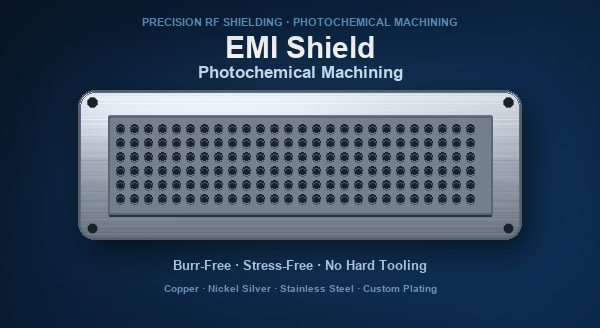
EMI shield photochemical machining has become the go-to method for producing precision RF shielding across consumer, automotive and telecom electronics. As a core protection component that blocks electromagnetic interference, photochemically machined EMI shields deliver fine features, burr-free edges and stress-free metal, balancing shielding effectiveness, dimensional precision and overall production cost.
The total photochemical machining cost for an EMI shield consists of raw material cost, photoresist and etching processing cost, surface plating, dimensional inspection, packaging and logistics fees. Raw materials mainly include copper, brass, nickel silver, stainless steel and aluminum foil, and material type plus thickness will change the base cost directly. Photochemical machining transfers the shield pattern optically and dissolves unwanted metal, requiring no expensive hard tooling — ideal for prototypes and customized designs.
Etching control and plating account for a large share of EMI shield cost. Precise feature size, edge profile and aperture accuracy determine shielding and assembly quality. Different tolerance and plating specifications will lead to obvious price differences. Part size, feature density, tolerance requirements and order quantity also affect the final unit cost. Large volume mass production can achieve significant economies of scale and cut down per-piece cost obviously.
Our factory provides photochemical machining services for custom EMI shields used in consumer electronics, automotive electronics, telecommunications and medical devices. We support prototype sampling, low volume trial runs and large-scale mass production. Every batch undergoes strict dimension, flatness and shielding inspection to guarantee stable electromagnetic compatibility.
When evaluating EMI shield photochemical machining cost, buyers should avoid only focusing on low unit price. Poorly controlled etching or plating may reduce shielding effectiveness and raise device failure risk, lifting long-term operating expenses. It is essential to evaluate cost alongside etching precision, plating quality and dimensional consistency.