Titanium Alloy Laser Cutting Process: Step-by-Step Flow, Core Features & Industrial Applications
Titanium alloys are high-performance engineering materials known for their exceptional strength-to-weight ratio, outstanding corrosion resistance and excellent high-temperature stability, making them irreplaceable in aerospace, medical implants, marine engineering and high-end equipment manufacturing. However, titanium alloys are notoriously difficult to machine with traditional methods: mechanical milling causes severe tool wear and high cutting forces that induce residual stress; wire EDM delivers high accuracy but suffers from extremely low productivity; waterjet cutting produces rough edges and material moisture absorption risks. Modern fiber laser cutting, paired with inert gas shielding, achieves non-contact, high-precision shaping of titanium alloys with tightly controlled thermal impact and no tool wear. It has become the mainstream processing solution for high-performance titanium alloy components, especially for complex geometries and small-to-medium batch production.
I. Complete Process Flow of Titanium Alloy Laser Cutting
Designed for titanium’s high reactivity at elevated temperatures, high hardness and thermal sensitivity, the laser cutting process follows a rigorously controlled workflow with dedicated parameters for each alloy grade and thickness to ensure optimal edge quality, minimal oxidation and low residual stress.
1. Material Preparation & Surface Pre-Treatment
Raw titanium alloy sheets are first inspected for surface condition, flatness and material certification. Surface oil stains, oxide scales and protective film residues are removed through mild cleaning and surface preparation to ensure consistent laser energy absorption. For thin-gauge titanium sheets, special flattening and fixturing preparation is performed to eliminate warping and vibration during cutting, which helps maintain uniform kerf width and edge quality across the full workpiece.
2. Digital Programming & Process Parameter Setup
CAD design files are imported into the CNC laser control system, and cutting paths, piercing sequences and nesting layouts are optimized to minimize thermal accumulation and material waste. Process parameters including laser power, pulse frequency, cutting speed and focal position are pre-configured according to titanium alloy grade, sheet thickness and part geometry. For titanium alloys, parameters are specifically tuned to balance cutting speed with thermal input, avoiding excessive heat buildup that leads to edge embrittlement and oxide layer formation.
3. Workpiece Fixturing & Focal Position Calibration
Titanium workpieces are securely mounted on a precision cutting platform with proper support to prevent thermal distortion. Before production starts, the laser optical path, focal length and assist gas delivery system are fully calibrated. The focal point is precisely positioned relative to the material surface to achieve the narrowest kerf and most concentrated energy input. For thick titanium plates, multi-pass cutting or variable focus strategies may be applied to ensure consistent cut quality through the full material thickness.
4. Inert-Gas-Shielded Precision Laser Cutting
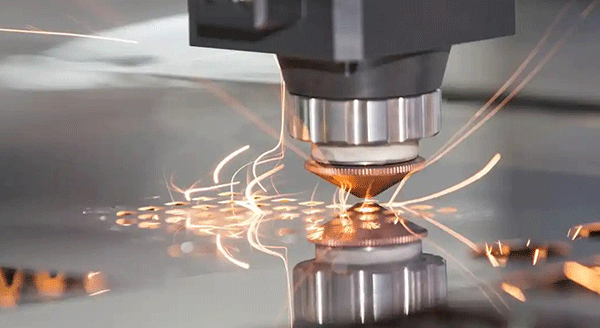
Cutting is performed using high-quality fiber lasers with optimized pulse parameters, with high-purity argon or nitrogen delivered coaxially with the laser beam as both assist and shielding gas. The inert gas blows away molten titanium material from the kerf and, more critically, shields the high-temperature cutting zone from atmospheric oxygen and nitrogen, preventing the formation of brittle oxide and nitride layers that would severely degrade corrosion resistance and fatigue performance. Cutting speed and power are dynamically adjusted to control the heat-affected zone within an acceptable range, typically 20–50μm for optimized thin-sheet processing.
5. Post-Cutting Edge Treatment & Stress Relief
After cutting, parts undergo edge inspection and optional post-treatment. For applications with high fatigue and corrosion requirements, mild edge deburring and oxide layer removal may be performed to eliminate any thin thermally affected surface layer. For high-demand aerospace and medical components, additional stress relief or surface finishing processes can be applied to further improve edge integrity and long-term reliability.
6. Quality Inspection & Protective Packaging
Finished titanium parts undergo comprehensive inspection including dimensional tolerance verification, edge quality assessment, surface condition examination and flatness measurement. Critical components receive 100% visual and dimensional inspection to ensure compliance with design specifications. Qualified parts are packed with protective wrapping to prevent surface scratching and contamination during transit, preserving material integrity and surface quality.
II. Core Technical Features of Titanium Alloy Laser Cutting
Non-contact thermal processing with inert gas shielding gives laser cutting unique technical advantages over traditional titanium machining methods, directly addressing long-standing industry pain points.
1. Non-Contact Processing with Zero Tool Wear
Laser cutting applies no mechanical cutting force to the workpiece, eliminating tool wear, chipping and the high tooling costs associated with machining hard titanium alloys. There is no extrusion force or contact-induced deformation, and the process introduces far less residual stress than traditional stamping and milling. This is particularly valuable for thin titanium sheets and precision structural components where stress-induced distortion would compromise functional performance.
2. Narrow Kerf & High Dimensional Accuracy
Professional titanium alloy laser cutting achieves stable dimensional tolerances of ±0.05mm to ±0.15mm depending on thickness, with kerf width as narrow as 0.1–0.3mm. Supported by high-precision CNC motion platforms, positioning accuracy remains consistent across the entire processing area. The narrow kerf minimizes material waste and enables fabrication of intricate internal features and fine contours that are impractical with conventional cutting methods.
3. Controlled Heat-Affected Zone with Inert Gas Protection
With optimized pulse parameters and dedicated inert gas shielding, the heat-affected zone at the cut edge is limited to a shallow surface layer, and oxidation and nitridation are effectively suppressed. This preserves the titanium alloy’s native corrosion resistance and fatigue strength to the greatest extent possible, which is critical for aerospace and medical components that operate under demanding environmental and mechanical conditions.
4. Design Freedom with No Tooling Cost
Laser cutting requires no dedicated hard tooling. Complex contours, irregular cutouts, lattice structures and custom geometries are all processed directly from digital CAD files. Design modifications only require updating the electronic drawing with no additional mold cost or long debugging lead time. This gives engineers complete freedom to optimize part geometry for strength-to-weight ratio and functional performance, without manufacturing process constraints.
5. Broad Compatibility Across Titanium Grades
The process works reliably with virtually all common titanium alloy grades, including commercially pure titanium, Ti-6Al-4V, beta titanium and high-temperature titanium alloys, with applicable thickness ranging from thin foils to medium-thick plates. Targeted process parameters are configured for each grade to ensure consistent cut quality, making it suitable for diverse application requirements from medical implantable components to aerospace structural parts.
6. Stable Batch Consistency
The entire cutting process runs under fully automatic closed-loop control, with real-time monitoring and dynamic compensation of laser power, cutting speed and focal position. Since there is no physical tool wear, dimensional accuracy and edge quality remain consistent from the first workpiece to the ten-thousandth, with no gradual quality degradation over long production runs.
7. Integrated Multi-Process Capability
In addition to contour cutting, the same laser system can perform surface marking, engraving, micro-hole drilling and scoring in a single clamping. This eliminates secondary positioning errors, improves overall processing accuracy and simplifies the production flow. For complex titanium components with multiple functional features, integrated processing significantly shortens lead times and reduces total manufacturing costs.
III. Core Functional Values & Industrial Significance
Beyond basic shape forming, titanium alloy laser cutting delivers six core functional values that solve long-standing manufacturing pain points and create tangible economic benefits for downstream industries.
1. Efficient Forming of Difficult-to-Machine Materials
Laser cutting provides a high-efficiency, low-wear processing solution for titanium alloys, which are notoriously hard on cutting tools. It avoids the severe tool wear and long machining cycles of traditional milling, greatly improving production efficiency and reducing tooling expenditure for titanium component manufacturing.
2. Complex Lightweight Structure Realization
Laser cutting enables fabrication of intricate lattice structures, weight-reduction cutouts and optimized topological designs that maximize strength-to-weight ratio. This supports the continuous lightweighting trend in aerospace and automotive industries, helping reduce overall product weight while maintaining structural integrity and performance.
3. Small-Batch Customization with Fast Turnaround
Thanks to tooling-free digital processing, laser cutting economically handles small and medium batch customized titanium orders without absorbing expensive mold costs. It can quickly respond to personalized requirements for different shapes, sizes and alloy grades, filling the market gap for high-mix, low-volume high-performance titanium components.
4. Material Property Preservation for High Reliability
With optimized parameters and inert gas shielding, laser cutting preserves the vast majority of titanium alloy’s native mechanical strength, corrosion resistance and fatigue performance. This ensures long-term reliable operation of parts in harsh environments such as high temperature, corrosion and cyclic loading, meeting the strict reliability requirements of aerospace and medical applications.
5. Rapid Prototyping & Agile R&D Iteration
Prototype samples can be delivered within short lead times after drawing confirmation, supporting fast verification of different design, material and thickness options. There is no expensive mold investment, greatly reducing R&D trial-and-error costs and shortening product development cycles, which is especially valuable for fast-evolving high-tech sectors.
6. Total Manufacturing Cost Optimization
Although unit processing cost is higher than high-volume stamping for very large orders, laser cutting eliminates expensive mold costs, reduces secondary finishing operations and achieves high yield for complex geometries. For small and medium batch orders, custom parts and complex structural components, total manufacturing cost is significantly lower than traditional machining processes.
IV. Key Industrial Application Fields
Thanks to its unique advantages in titanium alloy processing, laser cutting serves a fast-growing range of high-tech and industrial sectors.
1. Aerospace & Aviation Engineering
This is the most core and demanding application field. Laser-cut titanium components include structural brackets, engine accessory parts, lightweight lattice panels, heat dissipation grids and fuel system components. High strength-to-weight ratio, good fatigue performance and corrosion resistance meet the strict requirements of aerospace products for weight control and long-term reliability under extreme environments.
2. Medical Implants & Surgical Instruments
Medical-grade titanium alloy laser cutting produces orthopedic implant components, surgical instrument parts, dental prosthetics and implantable device structures. Biocompatible titanium material combined with clean, controllable edge quality complies with strict medical safety standards, supporting applications from orthopedic surgery to minimally invasive medical devices.
3. Marine & Offshore Engineering
Titanium’s exceptional seawater corrosion resistance makes laser-cut titanium parts widely used in ship components, offshore platform equipment, desalination systems and marine chemical facilities. They maintain stable performance for decades in saltwater environments, reducing maintenance frequency and total lifecycle cost.
4. Automotive & Motorsports
In high-performance automotive and motorsport applications, laser-cut titanium components include exhaust system parts, chassis brackets, valve components and battery system structural parts for new energy vehicles. Lightweight titanium construction reduces vehicle weight while maintaining strength and heat resistance, improving overall performance and energy efficiency.
5. Chemical & Environmental Protection Equipment
Titanium’s outstanding acid and alkali corrosion resistance makes laser-cut titanium parts ideal for chemical reaction vessels, heat exchangers, filtration equipment and environmental protection system components. They deliver long service life in highly corrosive process environments, reducing equipment downtime and replacement costs.
6. Precision Instrumentation & Semiconductor Equipment
Precision titanium components produced by laser cutting are used in semiconductor manufacturing equipment, optical instruments and precision test fixtures. Titanium’s non-magnetic properties, dimensional stability and corrosion resistance meet the strict requirements of high-precision equipment environments.
7. Sports Equipment & Premium Consumer Goods
Laser-cut titanium parts are used in high-end bicycles, golf equipment, eyewear frames and wearable devices. Titanium’s light weight, high strength and skin-friendly properties deliver excellent user experience and product durability, enhancing the perceived value of premium consumer products.
Conclusion
In summary, titanium alloy laser cutting breaks through the traditional machining bottleneck of this high-performance but difficult-to-process material, delivering a flexible, efficient and high-precision manufacturing solution through an inert-gas-shielded digital workflow. With core advantages including non-contact stress-free processing, narrow kerf accuracy, design freedom and excellent material property retention, it strongly supports performance upgrades across aerospace, medical, marine and automotive industries, and has become an indispensable processing technology for high-end titanium alloy components.
As global industries continue to demand lighter, stronger and more corrosion-resistant equipment, the market for precision titanium alloy components will keep growing. Looking ahead, advances in ultrafast laser technology and more intelligent process control systems will further reduce thermal impact, improve edge quality and expand application scenarios, providing stronger technical support for product innovation and industrial upgrading across more high-end manufacturing sectors.