
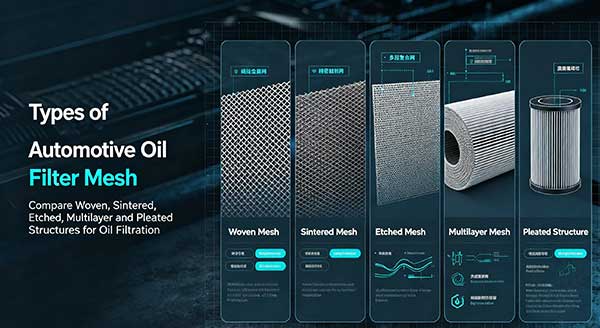
etched oil filter mesh
Automotive oil filter mesh serves as the core filtration medium inside engine oil filters. It traps metal debris, carbon particles and impurities circulating in lubrication oil to protect engine moving parts. Different manufacturing technologies produce several major types of oil filter mesh, each with distinct precision, strength and cost characteristics to match various vehicle working requirements.
Main Types of Automotive Oil Filter Mesh
1. Woven Metal Oil Filter Mesh
Woven mesh is fabricated by interlacing metal wires into a grid structure. Stainless steel wire is the most common raw material.
- Features: Flexible structure, good impact resistance, low cost for large volume orders. Mesh aperture is decided by wire diameter and weaving density.
- Limitations: Aperture uniformity is relatively poor; fine woven mesh may suffer wire offset under high oil pressure.
- Application: General passenger car engine oil pre-filtration, coarse impurity separation.
2. Photo Etched Oil Filter Mesh
Photo etched mesh is produced via photochemical machining on thin stainless steel sheets. Precise micro-holes are formed by selective chemical corrosion.
- Features: Highly consistent hole size, flat surface, fixed hole geometry, no wire displacement. High filtration accuracy and stable performance under fluctuating oil pressure. Can achieve ultra-fine uniform micropores.
- Limitations: Slightly higher unit cost than woven mesh for mass production.
- Application: High-precision filtration, new energy vehicle lubrication systems, high-performance engines, hydraulic oil circuits.
3. Perforated Metal Oil Filter Mesh (Laser / Punch Perforated)
Perforated mesh is made by punching or laser cutting holes on thin metal sheet.
- Features: Robust sheet substrate, strong mechanical strength, anti-collapse, large open area.
- Limitations: Minimum hole size is limited by punching tool or laser kerf; tiny micro holes are not economical.
- Application: Heavy-duty trucks, construction machinery engines, primary coarse filtration for large oil flow.
4. Sintered Metal Filter Mesh
Sintered mesh consists of multiple stacked woven metal layers sintered together under high temperature.
- Features: Multi-layer gradient filtration, high dirt holding capacity, excellent pressure resistance, reusable after cleaning.
- Limitations: Higher cost, thicker thickness, heavier weight.
- Application: Heavy commercial vehicles, high-load industrial engines, extreme working conditions.
Material Options for Automotive Oil Filter Mesh
- 304 Stainless Steel: Standard choice, good corrosion resistance for most engine oil environments.
- 316L Stainless Steel: Superior corrosion resistance, suitable for synthetic oil and severe working conditions.
Comparison Summary
- Woven mesh: Low cost, moderate precision, for coarse filtration
- Etched mesh: High & uniform precision, stable hole, for fine filtration
- Perforated mesh: High mechanical strength, large flow rate, coarse filtration
- Sintered mesh: Multi-layer high dirt capacity, premium heavy-duty use
Applications
These automotive oil filter meshes are widely used in gasoline engines, diesel engines, new energy vehicle gearbox oil filters, hydraulic lubrication systems for commercial vehicles and off-road machinery.
Conclusion
The selection of automotive oil filter mesh depends on target filtration precision, oil flow rate, working pressure and budget. Photo-etched stainless steel mesh is increasingly popular for modern engines requiring consistent fine filtration, while woven and perforated mesh remain economical choices for primary coarse filtration.