
custom encoder disc
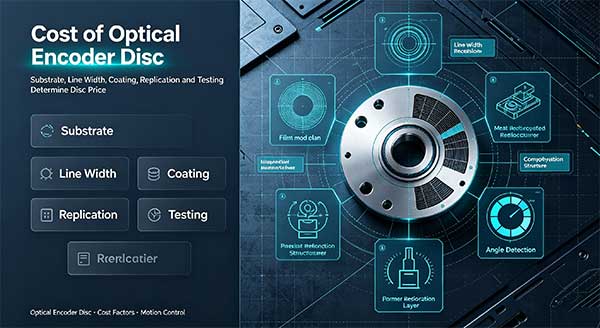
The cost of optical encoder disc varies widely, mainly determined by material selection, line count (resolution), geometric tolerance, manufacturing technology, custom dimensions, order volume and quality inspection standards. Simple low-resolution metal discs are economical, while high-resolution glass encoder discs with ultra-tight tolerances for aerospace or precision robotics come with a much higher price tag.
Key Factors Affecting Optical Encoder Disc Cost
1. Material
Stainless steel is the most common cost-effective option for photo-etched encoder discs. It offers good flatness, stable optical contrast and lower production cost. Glass encoder discs deliver superior resolution and thermal stability but require optical polishing and strict clean-room processing, which greatly raises unit cost. Other alternatives include thin copper alloy or polyester film for miniature low-load applications.
2. Resolution & Pattern Complexity
Higher PPR / CPR means more grating lines on the disc. Fine, dense slits demand tighter line width tolerance and advanced imaging & etching process. Incremental encoder discs with single A/B channels cost less. Absolute optical encoder discs with multi-bit coded tracks require complex multi-ring patterns and push the cost upward significantly.
3. Manufacturing Process
Photo chemical etching is the mainstream process for thin metal optical encoder discs. It supports ultra-thin blanks and precise slit geometry with low tooling cost for custom samples. Laser cutting is suitable for low-quick prototype orders, but per-unit cost is higher for mass runs. Glass encoder discs rely on photolithography and optical coating, which involve expensive equipment and cleanroom operation.
4. Tolerance & Flatness Requirements
Strict dimensional tolerance, flatness, concentricity and edge definition increase rejection rate during inspection. If your project requires sub-micron grating accuracy or low warpage for high-speed rotation, extra calibration and AOI inspection steps will add manufacturing expense.
5. Size & Thickness
Larger outer diameter or ultra-thin substrates (0.03~0.1mm) are harder to handle and prone to deformation, leading to higher scrap rate. Small miniature encoder discs for micro-motors are usually cheaper when produced in bulk.
6. Order Quantity & MOQ
Unit price drops sharply with larger batch sizes. Prototyping orders (1–10 pcs) carry high one-time setup and tooling charges. Mass production over 1,000 pieces can reduce the cost per piece substantially.
7. Post-treatment & Quality Certification
Additional surface finishing, anti-reflection coating, reflective layer, passivation, laser marking, 100% AOI inspection, CE / RoHS certification all add extra cost.
Reference Price Range (Bare encoder disc only, without encoder assembly)
- Low resolution stainless steel etched disc (100–500 PPR, bulk order): $0.3–$2.0 / pc
- Medium precision stainless steel optical code disc (512–1024 PPR): $2–$10 / pc
- High-precision metal encoder disc for servo motor: $10–$50 / pc
- Glass high-resolution optical encoder disc: $50–$200+ / pc
Tips to Optimize Your Budget
- Choose stainless steel photo etching when glass is not mandatory.
- Use standard resolution patterns whenever possible instead of fully custom absolute tracks.
- Relax tolerance specs to the minimum requirement your system actually needs.
- Combine multiple part revisions into one batch to reduce setup cost.
- Communicate MOQ and lead time early with your manufacturer to get volume discounts.
Applications
Optical encoder discs are widely used in servo motors, CNC machine tools, robotics, medical equipment, measuring instruments, automation and aerospace motion control systems.
Conclusion
The optical encoder disc cost is not fixed. Working closely with your manufacturer to balance resolution, material and tolerance is the best way to cut unnecessary expense while maintaining reliable optical signal performance. Photo chemically etched stainless steel encoder discs remain the most popular cost-effective solution for most industrial incremental encoder projects.