

custom microporous filter
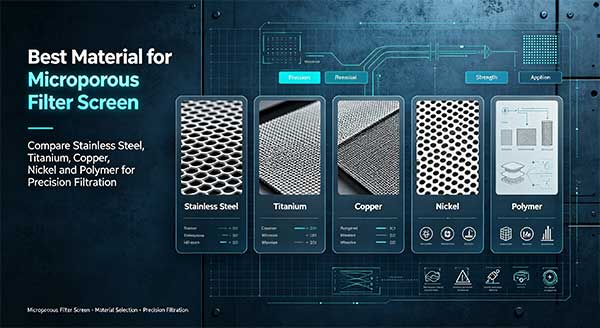
Microporous filter screen is a precision filtration component with tiny, uniform micro holes, commonly manufactured by photo chemical etching, laser cutting or weaving. It separates fine particles in liquid or gas media. Material selection directly affects filtration accuracy, corrosion resistance, temperature tolerance, service life and total cost.
1. 304 Stainless Steel (Most Popular & Cost-Effective)
- Advantages: Good general corrosion resistance, food-safe, easy to etch or laser cut, balanced mechanical strength and affordable raw material cost.
- Limitations: Not suitable for strong acid or heavy chloride environments.
- Typical applications: Coffee filter mesh, automotive oil filter mesh, general industrial liquid filtration, medical pre-filtration.
2. 316L Stainless Steel (Higher Corrosion Resistance)
- Advantages: Superior resistance to chloride, salt water and weak acid; low carbon grade reduces intergranular corrosion; food and medical compliant.
- Limitations: Higher price than 304.
- Typical applications: Beverage filtration, marine fluid systems, chemical medium filtration, medical-grade purification filter mesh.
3. Titanium
- Advantages: Outstanding corrosion resistance in strong acid, alkali and salt environments; high temperature resistance; stable performance without ion precipitation.
- Limitations: High raw material cost, harder to process, expensive for small microporous patterns.
- Typical applications: Severe chemical filtration, new energy fluid filtration, high-end medical equipment.
4. Brass / Phosphor Bronze
- Advantages: Good electrical conductivity, ductile, easy forming, excellent wear resistance.
- Limitations: Poor anti-corrosion performance in acidic medium, easy oxidation.
- Typical applications: Electronic filtration, gas sensing screens, special low-corrosion environments.
5. Nickel & Nickel Alloy (Hastelloy / Inconel)
- Advantages: Extreme resistance to strong acid, high temperature and corrosive chemical media.
- Limitations: Very high material and processing cost.
- Typical applications: Chemical processing, high-temperature gas filtration, aerospace precision filters.
Material Comparison Table
| Material | Corrosion Resistance | Machinability | Cost | Key Notes |
|---|---|---|---|---|
| 304 SS | Good | Excellent | Low | General filtration, food grade |
| 316L SS | Very Good | Excellent | Medium | Salt / weak acid, medical & food |
| Titanium | Excellent | Moderate | High | Strong corrosive media |
| Phosphor Bronze | Moderate | Good | Medium | Conductive, non-acidic environment |
| Nickel Alloy | Outstanding | Hard | Very High | Extreme high temp & corrosive chemicals |
Core Selection Guidelines
- Working medium: For weak acid or salt-containing liquid, choose 316L. For strong corrosive fluid, select titanium or nickel alloy.
- Temperature: High-temperature working environment requires titanium or nickel alloy.
- Food / medical contact: Prioritize food-grade 304 or 316L stainless steel.
- Filtration precision: Thin stainless steel foil is ideal for photo-etched uniform micropores.
- Budget: 304 stainless steel is the best choice for mass production to balance performance and cost.
Summary
For most commercial precision microporous filter screen projects, 304 stainless steel is the best all-round material. Switch to 316L when facing saltwater or weak acid. Titanium and nickel alloys are reserved for extreme corrosive and high-temperature working conditions. Submit your working medium, temperature and drawing specifications to manufacturers for proper material recommendation.
