
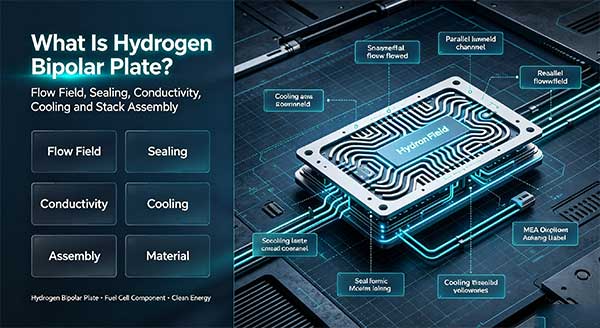
what is hydrogen bipolar plate
A hydrogen bipolar plate, also known as fuel cell bipolar plate, is one of the most critical structural and functional components inside a hydrogen fuel cell stack. It sits between adjacent membrane electrode assemblies (MEA), separating single cells while serving multiple core functions to support electrochemical reactions for power generation.
Each side of a bipolar plate features precisely etched flow channels. One side delivers hydrogen fuel, and the other supplies oxygen or air. The flow field design evenly distributes reactant gas across the surface of MEA, while removing by-product water to avoid flooding, which would block gas diffusion and reduce cell performance.
Core Functions of Hydrogen Bipolar Plate
- Gas distribution: Guide hydrogen and air through fine flow channels, evenly feeding reactants to the reaction area.
- Electrical conduction: Transfer electrons between adjacent single cells, forming the series circuit of fuel cell stack.
- Heat transfer: Dissipate excess heat generated during electrochemical reactions and maintain stable operating temperature.
- Fluid separation: Prevent mixing of hydrogen and air, and stop gas leakage between individual cells.
- Structural support: Reinforce the whole stack and maintain proper compression on the membrane electrode assembly.
Main Material Categories
- Metal bipolar plate: Usually stainless steel, titanium or copper alloy. Thin substrate, high conductivity, compact volume, suitable for automotive and portable fuel cells. Metal plates often need surface coating to improve corrosion resistance and reduce contact resistance. Photo chemical etching is widely used to machine micro flow channels.
- Graphite bipolar plate: Good corrosion resistance, low contact resistance, but heavy weight and brittle. Mainly applied for stationary power generation fuel cells.
- Composite bipolar plate: Mix graphite and polymer resin, balancing weight, corrosion performance and forming capability.
Key Manufacturing Requirements
Hydrogen bipolar plates demand ultra-precise micro flow channels, tight dimensional tolerance, excellent flatness and high surface quality. For metallic bipolar plates, photo etching can form complex flow field patterns in thin sheet metal without mechanical stress, which is ideal for mass production.
Typical Applications
Hydrogen bipolar plates are widely used in fuel cell passenger vehicles, commercial trucks, forklifts, stationary power stations, backup power supplies and portable hydrogen power equipment.