
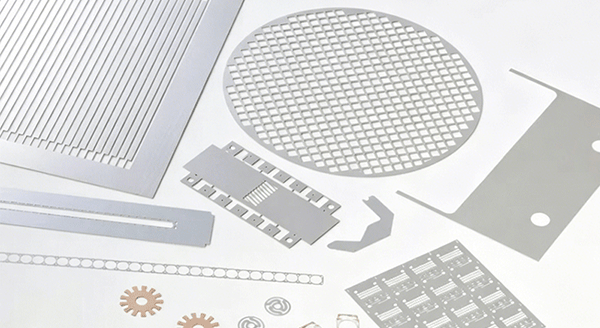
Chemical Etching Metal: Process Steps, Key Advantages & Industrial Applications
Chemical etching metal, also widely referred to as photochemical machining (PCM), is a mature room-temperature cold subtractive manufacturing technology used to produce high-precision planar metal parts. Different from stamping relying on mechanical shearing force, laser cutting relying on thermal ablation, and CNC milling with high costs for micro intricate structures, chemical etching metal removes excess metal materials through controlled liquid-phase redox reactions after photolithography pattern masking. Material dissolution occurs at the molecular level, which fundamentally eliminates common defects such as edge burrs, residual internal stress, work hardening and heat-affected zone oxidation.
This manufacturing method is highly compatible with almost all mainstream engineering metals, including stainless steel, copper alloys, brass, aluminum alloy, titanium alloy and nickel-based alloys, covering thickness from 0.01mm ultra-thin fragile foil up to 2mm medium-thick metal plates. Supported by tooling-free digital customization, micron-level dimensional accuracy, controllable half-etching depth and excellent batch repeatability, chemical etching metal has become an irreplaceable production solution for high-reliability micro-components, deeply deployed in high-end precision manufacturing fields such as semiconductor packaging, medical equipment, aerospace engineering, new energy storage and precision instrumentation.
1. Complete Standard Process Flow of Chemical Etching Metal
The whole production line adopts closed-loop automatic parameter control, with etching solution formula, temperature and spraying pressure adjusted according to metal material hardness, corrosion resistance and workpiece thickness to ensure stable quality from prototype proofing to mass production.
1.1 Metal Surface Pre-Treatment & Deep Cleaning
Raw metal sheets first undergo flatness inspection and comprehensive surface conditioning. Ultrasonic degreasing removes oil stains, fingerprints and organic residues; weak acid pickling strips naturally formed passive oxide films; micro-roughening treatment creates a tiny uniform textured surface on the substrate. This step greatly improves the adhesion between the metal base and subsequent UV-sensitive photoresist layer, effectively preventing pattern peeling, edge distortion and uneven etching depth during chemical reaction.
1.2 Photoresist Coating & UV Exposure Patterning
UV curable dry film or liquid photoresist is evenly coated on the cleaned metal surface. A high-precision photographic negative carrying CAD design drawings is precisely aligned on the workpiece, followed by controlled ultraviolet light exposure. Exposed photoresist undergoes photopolymerization to form a corrosion-resistant protective mask, while unexposed areas remain soluble for later development. For ultra-thin metal foils below 0.05mm, low-energy exposure parameters are adopted to avoid substrate penetration damage.
1.3 Development and Thermal Mask Curing
After exposure, alkaline developer washes away unpolymerized photoresist, accurately transferring the target graphic pattern onto the protective film. The workpiece is then baked at low temperature for curing treatment, which strengthens the bonding force and anti-corrosion performance of the remaining mask, ensuring it will not be eroded or stripped off during long-time spraying contact with ferric chloride-based etching solution.
1.4 Core Controlled Chemical Etching Reaction
This is the decisive procedure determining final part quality. The cured semi-finished product enters a dual-sided automatic spraying etching tank, where prepared acidic etching solution is uniformly sprayed on both sides of the plate. Technicians pre-calculate undercut compensation according to material thickness to guarantee dimensional accuracy after material dissolution. Three core variables — etchant concentration, constant temperature and balanced spraying pressure — are strictly locked for stable reaction speed. Thin foils use low-concentration liquid and short processing cycles to prevent over-etching and wrinkling; thicker plates strictly limit lateral side etching to restore original design dimensions faithfully.
1.5 Resist Stripping, Rinsing and Passivation Protection
Once preset through-cutting or half-etching depth is achieved, residual photoresist is fully stripped with alkaline stripping agent. Multiple rounds of pure water rinsing remove residual chemicals on the part surface. Finally, passivation treatment rebuilds a compact anti-rust passive film on stainless steel, aluminum and other metals to avoid oxidation discoloration and improve long-term corrosion resistance. Optional sandblasting, blackening and sealing can be added to enrich surface texture.
1.6 Dimensional Inspection and Protective Packaging
Finished chemically etched metal parts are fully inspected via optical measuring instruments for dimensional tolerance, edge smoothness, etching depth consistency and flatness. Qualified products are dried and packed with anti-static, anti-scratch and anti-oxidation materials to prevent scratching and deformation during storage and transportation.
2. Core Technical Features of Chemical Etching Metal
2.1 Stress-Free Cold Processing, Full Retention of Metal Native Properties
The entire chemical etching reaction proceeds in liquid environment at normal temperature, without mechanical extrusion impact or high-temperature thermal input. It avoids foil tearing, plate warping and residual stress caused by stamping, as well as edge embrittlement and recast layer defects brought by laser cutting. The original tensile strength, elasticity, electrical conductivity, thermal conductivity and corrosion resistance of metal alloys are 100% preserved, which is critical for elastic shrapnels, ultra-thin conductive foils and fatigue-sensitive safety-critical components.
2.2 Burr-Free Smooth Edges, No Secondary Finishing Needed
Metal removal relies on homogeneous molecular dissolution, producing smooth, rounded and naturally transitional edges without burrs, hanging slag and sharp protrusions. Most chemically etched metal parts can be directly assembled without deburring, grinding and polishing procedures, cutting post-processing labor costs. Meanwhile, it eliminates hidden hazards such as circuit short-circuit, signal interference and equipment abrasion caused by falling metal particles from burrs.
2.3 Micron High Precision & Full-Panel Uniformity
Mature chemical etching technology controls tolerance within ±0.005mm for ultra-thin foils and ±0.02mm for medium plates. All graphic features on the whole sheet are formed simultaneously through chemical reaction, without cumulative positioning errors of point-by-point processing methods. Mass production dimensional consistency exceeds 99.5%, capable of stably manufacturing micro holes, dense filter grids, encoder gratings and ultra-narrow gaps difficult for traditional machining.
2.4 Accurate Half-Etching Integrated One-Step Forming
A unique advantage of chemical etching metal is controllable partial-depth half-etching. Depth tolerance can be locked within ±0.003mm for thin materials, enabling one-piece integrated molding of positioning grooves, bending indentations, step platforms and anti-slip textures. It avoids assembly deviation from secondary machining and improves installation matching accuracy.
2.5 Tooling-Free Digital Customization & Low Iteration Cost
No expensive hard metal molds are required. Complex curves, irregular outlines and variable-density hole arrays can be directly produced from CAD files. Design revisions only need updated photomasks, with no additional mold opening fees and long debugging cycles. Rapid prototyping within 24–48 hours greatly reduces R&D trial-and-error costs for new products and small-batch customized orders.
2.6 Wide Compatibility of Metals and Thickness Range
The process adapts to almost all mainstream alloys: 304/316L stainless steel, beryllium copper, phosphor bronze, brass, aluminum alloy, titanium alloy and nickel superalloys. The applicable thickness spans 0.01mm ultra-thin foil to 2mm thick plate. Targeted etching solution formulas are matched for different metal corrosion resistance, solving the processing difficulty of hard alloys that cause severe tool wear in mechanical cutting.
2.7 Stable Batch Repeatability for Mass Production
Automatic closed-loop production lines monitor and dynamically compensate etchant concentration, temperature and spraying pressure in real time. Without physical tool wear, dimensional accuracy and surface quality remain completely consistent across thousands of batches, effectively avoiding quality drift and meeting strict batch traceability standards for automotive, medical and aerospace industries.
3. Core Functional Values of Chemical Etching Metal
3.1 Precision Microstructure One-Piece Integrated Forming
The most basic function is to convert digital design drawings into physical micro metal components, mass-producing micro filter screens, EMI shielding frames, elastic contact springs, precision gaskets and optical apertures that are inefficient to manufacture via stamping and CNC machining. It strongly supports the miniaturization and high integration trend of modern industrial products.
3.2 High-Cleanliness Components for High-Reliability Scenarios
Burr-free, particle-free and stress-free surfaces meet ultra-high cleanliness requirements of semiconductor packaging and medical devices. Complete retention of metal anti-corrosion performance ensures long-term stable operation in humid, salt spray and weak acid environments, lowering equipment failure rates and improving product safety.
3.3 Agile R&D Iteration and Fast Market Response
Low-cost photomask proofing shortens sample delivery cycles significantly, allowing designers to quickly verify multiple structural schemes. For new energy products, sensor modules and customized electronic components, chemical etching shortens overall launch cycles and enhances market competitiveness.
3.4 Multi-Functional Integration to Simplify Assembly
Multiple functional structures such as through holes, mounting notches, half-etched grooves and elastic cantilevers can be integrated on one workpiece in a single etching step. It replaces multi-piece assembly, reduces product volume and weight, improves structural stability and cuts assembly costs.
3.5 Optimized Total Lifecycle Manufacturing Cost
Although single-piece customized cost is slightly higher than ultra-large batch stamping, chemical etching saves expensive mold investment, reduces secondary finishing and improves thin material yield. For small-medium batches, complex graphic and high-precision parts, the comprehensive cost has obvious advantages. Long service life of stress-free etched parts also reduces later replacement expenses.
3.6 Closed-Loop Green and Environmentally Friendly Production
Modern production lines are equipped with etching solution filtration, regeneration and waste liquid treatment systems. Ferric chloride etchant can be filtered, replenished and recycled repeatedly, reducing chemical consumption and pollutant discharge, complying with global green manufacturing compliance requirements.
4. Main Industrial Application Fields of Chemical Etching Metal
4.1 Electronics & Semiconductor Advanced Packaging
The largest application field, used for stainless steel EMI shielding cans, semiconductor lead frames, beryllium copper connector springs, heat dissipation grids and wafer carrier fixtures. High precision and burr-free edges match miniaturization and high-density chip packaging demands.
4.2 Medical Devices & Life Sciences
Medical-grade 316L stainless steel and titanium etched parts include infusion filter meshes, surgical instrument accessories, cell sieves and biosensor electrodes. Smooth edges prevent tissue scratching and materials withstand repeated high-temperature sterilization, complying with medical biocompatibility standards.
4.3 Aerospace & High-End Equipment
Applied to ultra-thin precision shims, hydraulic micro filter screens, lightweight ventilation grids and sensor diaphragms for aircraft and spacecraft. Stress-free processing retains fatigue resistance and corrosion resistance for long-term stable operation under extreme temperature difference and strong vibration conditions.
4.4 New Energy & Automotive Electronics
Widely adopted for battery current collector meshes, fuel cell flow field auxiliary plates, vehicle sensor springs, battery pack protective nets and automotive precision gaskets. Stable batch quality meets automotive-grade long-term reliability requirements under complex vibration and temperature fluctuation working conditions.
4.5 Precision Instruments & Optoelectronic Equipment
Manufactures optical slits, encoder grating discs, precision diaphragms and light barrier sheets for spectrometers, laser equipment and testing instruments. Micron edge accuracy eliminates optical diffraction deviation and guarantees high-precision detection stability.
4.6 Industrial Filtration & Environmental Protection Equipment
Various etched stainless steel filter elements, hydraulic oil screens and water treatment perforated plates serve chemical industry, food processing and water purification systems. Uniform aperture ensures stable filtration accuracy and anti-clogging performance with strong corrosion resistance for long-term continuous operation.
4.7 Architectural Decoration & High-End Hardware
Custom etched hollow decorative panels, texture logos and partition screens are used for building curtain walls and hotel interior decoration. Delicate etching lines and three-dimensional concave-convex texture improve artistic added value and space grade.
Conclusion
In summary, chemical etching metal, as a mature photochemical cold precision manufacturing technology, perfectly solves the processing bottlenecks of ultra-thin metal foils, complex planar micro-components and high-reliability elastic parts that cannot be well handled by stamping, laser cutting and CNC machining. With core strengths including stress-free cold processing, burr-free smooth edges, micron-level dimensional accuracy, wide material compatibility and tooling-free flexible customization, it provides high-efficiency and high-quality production solutions for electronics, medical treatment, aerospace, new energy and many other high-end industrial sectors.
As downstream industries continuously raise higher requirements for component miniaturization, surface cleanliness and long-term operational reliability, market demand for high-precision chemically etched metal parts will maintain steady growth. In the future, chemical etching metal technology will continue to iterate toward higher etching resolution, more environmentally friendly etching formulas and intelligent closed-loop parameter control, further expanding material adaptability and processing precision, and offering stronger technical support for product innovation and industrial upgrading in global high-end precision manufacturing.