
aluminium foil etching
Current collector acid etching is a phrase that hides a split. A copper collector and an aluminium collector are etched by different chemistries with different gases, different bath behaviour and different post-etch problems, and a supplier who treats “acid etching” as one process will be right about one of them. This page is about the chemistry rather than the geometry: what each metal does in which bath, and what that means for a foil collector.
1. Acid Etching Is Not One Process
The word describes a family, not a recipe.
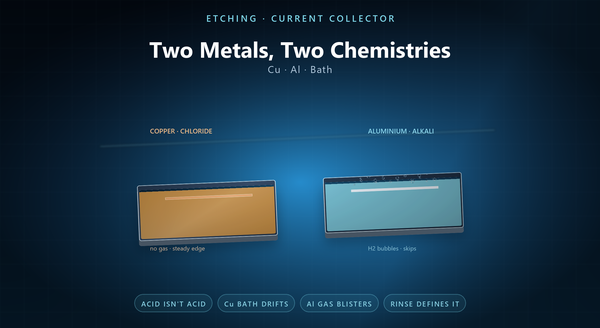
A copper collector is usually etched in a chloride solution — ferric chloride or cupric chloride — which is acidic and works by oxidising the metal and complexing it into solution.
An aluminium collector is more often etched in an alkaline solution, because aluminium is amphoteric: it dissolves in both acid and alkali, and the alkaline route is the one that is industrially convenient and gives the surface the process wants.
So “acid etching” is the correct description of a copper process and an incomplete description of an aluminium one. A collector is also one of the few parts where the bath chemistry is chosen by the metal rather than by the supplier’s preference. A collector is also the part where the metal is thin enough that the bath’s temperature matters more than its strength. That distinction is worth settling before a drawing is written. A drawing that says acid etched for an aluminium part will be quoted by someone who either ignores it or charges for an experiment.
2. Copper: Ferric and Cupric Chloride
Two chloride chemistries dominate, and the difference is how they age.
Ferric chloride etches by reducing ferric to ferrous while oxidising the copper. It is fast, it is forgiving, and its by-product is a bath that loads with copper and slows as it does — so the process drifts in a way that shows up as an undercut change rather than as a rate change.
Cupric chloride etches by reducing cupric to cuprous, and it can be regenerated by oxidising the cuprous back with air or chlorine. That is why it is preferred where the bath has to run for a long time: it is a closed chemical loop rather than a consumable.
A cupric bath that is regenerated badly is worse than a ferric bath that is replaced often, because a partly regenerated bath is a bath with two chemistries in it. For a foil collector the practical difference is drift. A ferric bath also carries its copper into the rinse, which is an effluent question as much as a process one. A ferric bath changes character over a shift; a regenerated cupric bath holds a steadier rate, which matters when the tolerance is a function of etch time.
3. Aluminium: Acid Is Possible, Alkaline Is Usual
Aluminium will etch in acid, and the reason it is usually done in alkali is not chemistry but control.
In acid, aluminium dissolves with hydrogen evolution, and the gas is the problem: bubbles cling to the surface and to the resist edge, and where a bubble sits, no etching happens. The result is a pitted, uneven surface rather than a controlled depth.
In alkali, the same metal dissolves with the same gas, but the bath is easier to control and the surface finish is more uniform, which is why the alkaline route is the standard for a collector.
A collector that is etched in alkali needs a rinse that is genuinely neutralising, because a film of alkali under a coating is a delamination path. A collector that is etched in acid and not rinsed in time is a collector with a continuing reaction. An acid route for aluminium is not impossible; A collector that is etched in acid and then coated without a controlled rinse is a collector with an undefined surface. it is a route where the gas has to be managed by wetting agents, agitation and orientation, and where the process window is narrower.
4. What the Acid Leaves as an Edge
Both chemistries etch isotropically: they remove metal equally in every direction.
That is what produces the taper at the edge, and it is what makes the finished outline smaller than the drawn one. It is also why the undercut is a function of the time in the bath, and therefore of the bath’s own condition.
A bath’s age is also a quality record, and a customer asking for traceability will ask for it. A regenerated bath holds its rate; a loading bath loses it. A bath that is analysed once a shift is a bath whose drift is visible only between shifts. That is why two panels etched in the same week can differ if the bath was not controlled between them.
5. Gas, Bubbles and the Resist
Gas is the least visible and most consequential variable in acid etching of a thin foil.
A bubble that clings to the foil masks the etch, and the defect it leaves is a shallow pit or a skipped area rather than a dimension. On a thick part that is cosmetic; on a collector it is a hole that is not through.
Three things control it: agitation, which is usually the main lever; orientation, because a bubble leaves a vertical surface more easily than a horizontal one; and wetting, because a bath that wets the resist does not hold bubbles at its edge.
A bubble that is trapped under a resist edge produces the defect that looks most like a scratch. A collector etched in a bath that is not agitated is a collector with a distribution of skip defects. That is why thin-foil etching is often done with the foil vertical A foil that lies flat in a bath is a foil with a bubble on its upper face. or with the work moving, and why a “quiet” bath is a bath that produces skips.
6. Bath Control
Three parameters drift, and each has a different signature.
The oxidant’s strength falls as it is consumed, which slows the rate and therefore reduces the undercut. The dissolved metal rises, which changes the viscosity and the diffusion, and eventually changes the surface. And the temperature moves with the reaction, which accelerates everything and makes the first two effects harder to see.
A bath that is controlled on all three is a bath that produces a repeatable edge. A bath that is not cooled also has a thermal runaway in a busy shift, which shows up as a batch of over-etched parts. A bath log is a quality record rather than a maintenance record. A bath that is controlled on strength alone is a bath that produces a repeatable rate and a drifting edge. A bath that is not filtered also carries particulate, and a particle on the resist is a pinhole.
7. After the Etch: Rinsing and the Copper Surface
The post-etch step decides what the surface is, and on copper it is the step that is most often under-specified.
Three things happen in sequence: the rinse removes the bath, the neutralisation stops the reaction in any residue, and the drying decides whether the surface oxidises.
A copper surface that is rinsed and dried in air oxidises quickly, and an oxide on a collector face is a coating adhesion problem. That is why an etched copper collector is often given a passivation or a protective treatment as part of the same line, rather than being left for the coater.
An aluminium surface that is stored after etching will grow its own oxide, and the growth is not always the same thickness. A copper collector passivated on the etch line arrives at the coater with a defined surface. An aluminium collector has the opposite problem in one respect: A copper surface that is handled after rinsing is a surface with fingerprints, and a fingerprint is an adhesion defect. its natural oxide is protective, and the etch removes it, so the surface after etching is more reactive than before.
8. What the Drawing Should Say
A drawing for an acid-etched current collector should state the alloy, the chemistry family the part is qualified for (chloride for copper, alkaline for aluminium), the etch depth or through-feature, the etch allowance to the finished outline, the surface treatment after the etch, and the cleanliness of the delivered part.
It should also state which face is the coating face, and whether that face is allowed to be touched after treatment — because the answer decides the packing.
A drawing that says which treatment follows the etch is a drawing that closes the adhesion loop. The recurring mistakes are a drawing that says “acid etched” for an aluminium part, A drawing that names the chemistry family is a drawing that can be quoted by the right line. a copper collector with no post-etch treatment, an etch allowance copied from a thicker part, a bath control plan that watches strength and not metal loading, and a rinsed-but-not-passivated surface handed to a coater.