

dry film resist foil
Current collector metal photo etching is a name in which one word does most of the work. “Photo” is not decoration; it is the half of the process that decides where the metal goes, and the chemistry only follows the image. On a ten-micrometre foil the image is also the hardest part to hold, because the resist has to be applied to something that behaves like a membrane and still resolve features that are a fraction of its own thickness.
1. Photo Is the Imaging Half
The process has four steps and two of them are imaging.
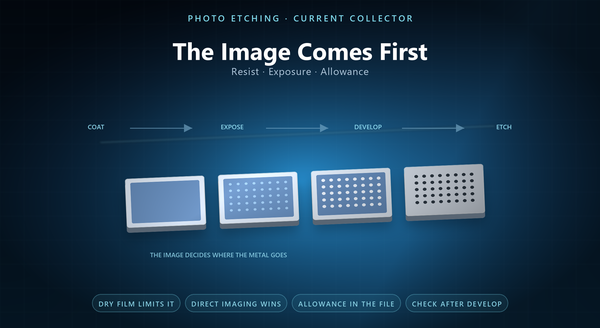
The foil is cleaned and coated with a photoresist. The resist is exposed through a pattern, so that the areas to be etched stay soluble and the areas to be protected cure. The resist is developed, which opens the pattern. And the foil is etched, which removes the metal only where the resist is gone.
Everything downstream of the exposure is a consequence of the image. A photo etch is also the only one of the three routes where the part’s accuracy is inherited rather than produced. A dimension wrong in the artwork is wrong in the part, A photo etch is also a process whose first article is a panel rather than a piece, which hides a single bad feature among many good ones. A dimension that is wrong in the artwork is wrong in the part, A dimension that is wrong in the artwork is wrong in the part, and a defect in the resist becomes a hole. A customer who sends an outline and asks for an etched part has asked for a picture to be made into metal, and the picture is where the tolerances live.
2. Resist on Thin Foil
Two resist families are used, and each has a reason.
A dry film resist is laminated onto the foil. It is uniform, it is thick, and it is easy to handle — which is why it is the default for a foil that has to pass through a machine. Its thickness is also its limit: a thick film cannot resolve a feature smaller than a certain size, because the exposure cannot hold a vertical wall through it.
A liquid resist is coated and dried. It can be much thinner, so it resolves finer features, but it conforms to every defect on the surface and it is harder to apply evenly to a foil that is not stiff.
A resist that is too thick is a resist that will undercut at its own edge, which shows up as a wall that is not vertical. A film that is thick enough to survive handling is a film that limits the smallest hole. On a current collector, the choice is usually made by the finest feature On a current collector, the choice is usually made by the finest feature On a current collector, the choice is usually made by the finest feature in the pattern rather than by preference. A resist that is applied in a way the foil cannot survive is a resist that will not be there at the moment of etching.
3. Film or Direct Imaging
Two ways exist to put the pattern onto the resist.
A phototool is a film with the pattern printed on it, placed in contact with the resist and exposed. It is cheap per panel and it wears: every contact adds a scratch, and a scratch becomes an etched line.
Direct imaging writes the pattern with a laser or a light engine, with no film and no contact. It holds the same file for every panel, it can compensate for distortion in software, and it costs more per panel at low volume.
For a run of a few panels a phototool is the sensible choice. A phototool also has to be stored and inspected, which is a cost that is easy to forget. For a production part with a fine pattern For a production part with a fine pattern and a tight tolerance, direct imaging is usually cheaper in total because it removes the film as a variable. A direct-imaging system can also scale the image for the foil’s own stretch, which a film cannot.
4. The Allowance Belongs in the File
The artwork is not the part. The artwork is the part plus an allowance for the undercut.
Every edge will move during the etch, by an amount that depends on the metal, the chemistry and the time. That movement is predictable enough to be built into the file, and it should be, because a file that is drawn at the finished dimension produces a part that is undersized everywhere.
On a thin foil the allowance is proportionally large — it can be a significant fraction of the drawn feature — which is why a file that was made for a thicker part cannot simply be reused.
An allowance that is uniform is an allowance that can be compensated; one that varies across the panel cannot. An allowance that is not documented is an allowance that will be re-derived by whoever runs the job next. The right way to state it on a drawing The right way to state it on a drawing The right way to state it on a drawing is to give the finished dimension and the allowance separately, so that both can be checked. An allowance that is applied twice is as wrong as an allowance that is forgotten, which is why the file’s provenance matters.
5. Registration for Two-Sided Features
A through-feature needs an image on each face, and the two images have to register.
The registration is set by the tooling: a film and a fixture, or a direct-imaging system that references the same fiducials on both sides. Whatever the method, the number matters more than the method, because a misregistration produces an asymmetric wall and, on a thin foil, a step at mid-thickness.
A single-sided etch also leaves one face as the original foil, which is a surface advantage rather than only a process simplification. A registration check before the etch is a two-minute operation and a scrap avoidance, which is why it belongs in the route card. That is why a two-sided part should carry a registration figure on the drawing, and why a part that does not need to be two-sided should be designed as one-sided. A registration that is assumed is a registration that will be discovered at the first cross-section.
6. What Imaging Defects Become
An imaging defect is invisible until the etch, and then it is a hole or a missing hole.
Three are common. A pinhole in the resist becomes a small etched pit or a through-hole that was not drawn. A scratch in a phototool becomes a line that etches into a slot. And a poorly developed area leaves a resist skim that holds the etch back, producing a shallow region that looks like a depth error.
A development check is cheap because it is optical and non-destructive of the panel’s future. A phototool’s scratches are cumulative, so the film is a consumable with a shelf life of its own. That is why the inspection that matters That is why the inspection that matters is the one after development and before the etch: A developed panel is also the last point at which a defect can be reworked rather than scrapped. after the etch, the same defect is indistinguishable from a design error.
7. Resolution on a Thin Foil
The resolution of a photo etch is limited by the resist, not by the optics.
A resist has an aspect ratio: the thickness it can hold against the feature width. A dry film of a given thickness cannot resolve below a certain width regardless of how good the exposure is, because the developing chemistry cannot clear a deep narrow channel.
On a thin foil that works in the process’s favour: a thin foil allows a thin resist, and a thin resist resolves fine features. A thin resist is also a resist that exposes in less time, which is a throughput advantage as well as a resolution one. A pattern that is imaged at once is also a pattern whose spacing does not drift across the panel. That is why a ten-micrometre foil can carry That is why a ten-micrometre foil can carry a much finer pattern than a hundred-micrometre shim can. The same logic explains why an etch cannot make a feature that is tall and narrow, whatever the artwork says.
8. Why a Pattern Part Suits Imaging
A current collector with a perforated field or a tab array is a pattern, and a pattern is what imaging does best.
An imaged pattern is identical across the panel and across panels, it can be changed by changing a file, and its cost is set by area rather than by feature count. A cut path, by contrast, is traced one feature at a time, so a dense array is expensive for a cutter and cheap for an etch.
That is the real argument for photo etching a current collector: not that it removes burrs, although it does, but that the part is a pattern and the process is a printer.
