
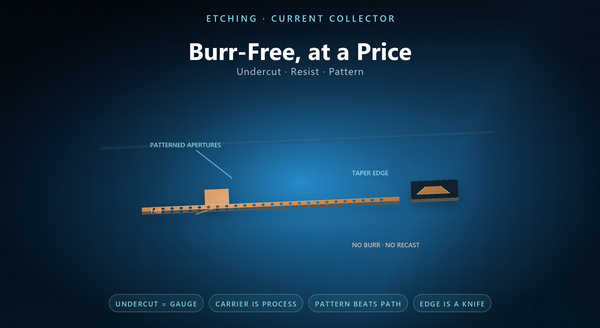
copper foil etching, burr-free current collector
Current collector thin metal etching is the counterpart of the laser page in this family, and the two are not interchangeable. Etching a ten-micrometre foil is not a scaled-down version of etching a hundred-micrometre shim: at that gauge the undercut and the thickness are the same order of magnitude, the resist has to survive on a film that behaves like a membrane, and the edge that comes out is a taper rather than a wall. A foil of that gauge is also the only case where the etch allowance is a large fraction of the part’s own outline. A foil at that gauge is also a foil that cannot be flattened after the fact, so flatness is a process output rather than a finishing step. What etching buys in return is an edge with no burr at all, What etching buys in return is an edge with no burr at all, What etching buys in return is an edge with no burr at all, which in a cell is worth more than it is in most assemblies. A supplier who treats thin foil as a small shim will produce a part whose outline is dimensionally correct and whose edge is not usable.
1. Ten Micrometres Is a Different Process
The geometry of etching is a ratio, and the ratio changes completely when the gauge drops.
On a 100 µm shim, an undercut of 20 µm per side is a modest feature: the wall still has 60 µm of straight section. On a 10 µm foil, the same 20 µm undercut per side consumes the entire thickness before the two sides meet, so there is no straight section at all.
A design that was drawn for a 50 µm shim will lose most of its features at 10 µm, not because the process is worse but because the allowance is proportionally larger. That does not make etching impossible at 10 µm; it makes it a different design problem, where the aperture is set by the artwork minus a large allowance and the edge is a knife rather than a wall. The number that matters is the ratio of undercut to gauge, and it is the first thing to ask about a foil that is new to the process.
2. Undercut and the Knife Edge
The consequence of that ratio is an edge that tapers from the resist line to a thin lip.
Three things follow. The effective outline of the part is not the drawn outline; it is drawn shape minus undercut. The edge has very little cross-section, so it is fragile in handling. And the edge geometry is a function of etch time, so the tolerance on the outline is really a tolerance on the etch.
A knife edge also makes the part hard to measure on a touch probe, which is why optical measurement is usual for these parts. A knife edge also has a burr-free but very thin rim, which is the feature a customer sees first under a microscope. For a current collector that is usually acceptable, because the edge is not a load path. A knife edge also has almost no thermal mass, so it heats and oxidises faster than the face during any subsequent drying or baking. It becomes unacceptable where the edge is welded, which is why the tab is the feature that needs the most careful specification.
3. Resist on Ultrathin Foil
The practical difficulty of etching a thin foil is not the chemistry; it is getting a resist onto a film that behaves like a membrane.
Three problems recur. Lamination wrinkles the foil, and a wrinkle is a place where the resist lifts and the etchant creeps under it. Handling creases the foil, and a crease is a line defect that shows up as an etched slot. And the resist’s own thickness becomes significant relative to the metal, so a thick resist changes how the etchant flows at the edge.
A carrier also lets the foil be processed in a roll-to-roll line rather than sheet by sheet. That is why thin-foil etching is usually done on a carrier — A foil that is handled without a carrier is a foil that will be creased by the time it reaches the bath. the foil is laminated or temporarily bonded to a thicker backing for the process and released afterwards — and why the carrier is part of the process, not an accessory.
4. Burr-Free Is the Real Reason
The reason to etch a current collector rather than cut it is the edge itself.
An etched edge has no burr, on either face, by construction. There is no dross, no recast and no ejection direction, because nothing is melted and nothing is ejected.
That matters because the edge sits next to a separator, and a burr comparable to the separator thickness is a puncture risk. An etched taper is smooth, and a smooth taper is a much lower puncture risk than a ragged burr — even when the taper is optically larger.
A third benefit is that there is no heat-affected zone at all, which matters for a temper-sensitive foil. A second benefit is the surface: an etched and passivated edge has no oxide scale, which matters at the weld. A third benefit is that the same process removes metal uniformly across a large area, which is what makes a dense aperture field practical.
5. What Etching Is Best At
Two current collector features are a natural fit, and they are the reason the process exists in this application.
A perforated collector — a foil with a field of apertures, used in some cell designs to improve wetting or to carry a coating — is exactly what etching does best, because the apertures are a pattern rather than a cut path, and they can be dense and numerous.
A tab array — a wide foil with many tabs along one edge, slit and formed in one artwork — is the second, because the tabs are a pattern too. A laser has to trace each tab; an etch images all of them at once.
A perforated collector is also the case where an etched part beats a laser on both edge and cost, because the aperture count is what a laser charges for. A tab array is also a case where the etch and the slit can share one artwork, which removes a registration step. Both are cases where the part is defined by a pattern rather than by an outline, A pattern that is imaged once is also a pattern that is identical across the panel, which matters when the aperture position is functional. and that is where a batch process beats a serial one.
6. Registration Between the Faces
A through-feature on a thin foil has to be etched from both faces, and the two images have to register.
On a thick part, a small misregistration produces an asymmetric wall and is usually tolerable. On a 10 µm foil, the same absolute misregistration is a large fraction of the thickness, and it produces a step in the middle of the aperture that can look like a defect and can behave like one.
A step at mid-thickness is also a place where a coating can bridge rather than bond. That is why thin-foil artwork is usually designed with a single-sided etch where possible, A registration that is good enough for a 100 µm part is not good enough for a 10 µm one, because the tolerance does not scale with the gauge. and why a two-sided part needs its registration specified as a number rather than assumed from the artwork.
7. Where Etching Loses
Three situations point away from etching, and a supplier should say so.
Large simple outlines at high volume are a die-cutting job: a die shears a foil in one stroke, and an etch consumes chemistry and time per panel.
Very fast turnaround on a single part is a laser job, because there is no resist, no carrier and no bath.
And a design that needs a straight wall rather than a taper — a slot with a defined width at both faces — is better served by a process that can cut rather than dissolve.
An etcher that quotes a million-piece simple outline is quoting a process that will lose to a die on cost.
8. What the Specification Should Carry
A drawing for an etched current collector should state the alloy and temper, the thickness with its tolerance, the pattern with its drawn dimensions, the etch allowance to the finished outline, the edge condition (taper, no burr), the surface treatment, the registration tolerance for any through-feature, and the flatness after release from the carrier.
It should also state which face is the coating face, because the coating adhesion depends on the surface the etch leaves.
A foil that is specified as a pattern and a thickness has said most of what the process needs to know. A drawing that says taper, no burr, and registration is a drawing that has described the process as much as the part. The recurring mistakes are a foil specified with a shim’s tolerances, A drawing that names the etch allowance is a drawing that can be quoted without a sample. an outline specified as a finished dimension without an etch allowance, a two-sided pattern with no registration number, a weld tab treated as an edge rather than a feature, and a volume assumption that ignores the per-panel cost of the process.