
deep chemical etching busbar plate
Current collector deep etch metal sounds like the same process as etching a foil, and it is not. A deep etch is a plate operation: the depth is comparable to the width, the etchant has to reach the bottom of a feature and then leave, and the tolerance conversation is about a sidewall rather than about a remainder. On a battery collector the plate is the busbar or the plate-type collector, and the deep features are channels, pockets and slots rather than apertures.
1. Deep Is a Ratio, Not a Number
“Deep” is not a thickness. It is the ratio of depth to the smallest dimension of the feature.
A hundred-micrometre recess in a wide pocket is a shallow etch, whatever the absolute number. A two-hundred-micrometre slot in a plate is a deep etch if the slot is only a hundred micrometres wide, because the etchant has to travel twice as far as the opening is wide.
That is why a collector’s deep-etch work is specified by aspect ratio rather than by depth, and why a drawing that says “deep etch” without a width and a depth has said nothing the process can act on. An aspect ratio also predicts the outcome better than any other single number, because it is the number the etchant has to overcome. A deep etch also has a minimum width for a given depth, so the drawing’s width is a process decision as much as a design one.
2. Where a Collector Needs Depth
Four plate features recur, and they are the reason a collector plate is etched at all.
A cooling or gas channel in a plate-type collector is a long, deep groove that has to hold a fluid and stay within a depth tolerance.
A pocket is a recess that takes a busbar, a weld pad or a sensing element.
A through-slot is a deep feature that goes all the way through, and its difficulty is that a deep slot has to be etched from both faces.
And a manifold is a large deep cavity that distributes a fluid into many smaller features.
All four are millimetre-scale, which is why they belong to a different page from the foil work. A plate also carries the features that a foil cannot: a device needs somewhere to bolt, seal and conduct, and that somewhere is a plate. A plate collector is also the version of the part where the deep features and the flow field are designed together.
3. Why Deep Is Different
Three things change when the feature gets deep, and all three are transport problems.
The etchant has to reach the bottom, which means the fresh chemistry has to displace the spent chemistry in a narrow channel. In a deep feature that exchange is slow, so the bottom etches more slowly than the top.
The by-product has to leave, which is harder in a deep feature, so the bottom can also be masked by its own reaction products.
And the resist has to survive a long exposure to the bath, which is a different requirement from surviving a short one.
That is why deep etching is as much about flow and time as about chemistry. A deep etch is also the case where the panel’s position in the bath matters most, because the flow that refreshes a deep feature is the flow the tank provides. A deep feature is therefore a flow specification in disguise, which is why two etchers with the same chemistry can deliver different depths. A deep etch also needs the tank to keep the by-product moving, which is a mechanical question about the machine.
4. The Sidewall Shows the Taper
In a shallow etch the taper is a detail. In a deep etch it is the feature.
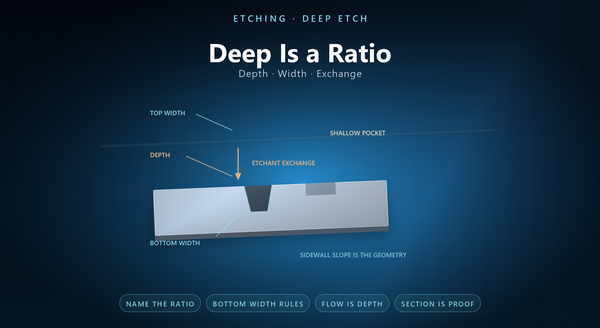
Because the etch is isotropic, a deep feature has a sidewall that slopes inward at roughly a constant angle, so the bottom of a deep channel is narrower than its opening by twice the depth times the tangent of that angle.
That has three consequences. The bottom width is a different number from the top width, and the drawing has to say which one is functional. The depth is limited by the width, because at some point the two sidewalls meet and the feature stops deepening. And a deep feature’s floor is not flat in the way a shallow one’s is, because the flow that limits the bottom also varies across it.
That is why a deep-etch drawing is usually specified by the bottom width and the depth, with the top width as a consequence. A sidewall that leans by a few degrees is invisible on a shallow feature and is the whole geometry on a deep one. A deep channel also has a floor whose width is the design intent, and a drawing that gives the top width has given the wrong number. A deep feature that is drawn with a wall instead of a taper has been drawn as a milled part.
5. Two Sides and the Meeting Point
A through-slot in a plate is etched from both faces, and the two fronts have to meet.
Where they meet, there is a step unless the two etches are perfectly matched. That step is a witness line in the middle of the sidewall, and it is the feature an inspector looks for first on a deep through-slot.
On a plate the step is usually tolerable, because the slot is not a sealing surface. A through-slot also has to be etched from both faces within the same registration, which makes it the deep feature most sensitive to tooling. A blind deep feature avoids the meeting point entirely, at the cost of a slower etch and a depth that has to be timed. A blind feature also has a floor that is the last thing to be reached, so its depth is the most sensitive to the etch rate. On a deep blind feature it is not, which is why a blind deep feature is usually etched from one side and the depth is achieved by time.
6. Long Etch, Long Exposure
A deep etch runs for hours, not minutes, and that changes what the resist has to do.
Three things follow. The resist has to adhere for the whole time, because a lift at hour two ruins the part. The resist has to resist undercut at its edge for the whole time, which is why a deep etch often uses a thicker or a laminated resist. And the bath has to hold its rate for the whole time, which is why a deep etch is usually run in a regenerated bath rather than a consumed one.
A deep etch also produces more dissolved metal, which changes the bath and the effluent load. A resist that is chosen for a deep etch is chosen for adhesion and toughness, not for the smallest feature it can resolve. A long etch also consumes more etchant, which is why a deep-etch line is usually built around regeneration. A resist that is tough enough for a deep etch is not the resist that resolves the finest aperture on the same plate, which is the trade.
7. Measuring a Deep Feature
Depth in a plate is easier to measure than depth in a foil, and the measurement that matters is still the section.
Three methods are used. A depth gauge or a profilometer, which gives the depth at a point. An optical measurement from above, which gives the top width and, with focus variation, an approximate depth. And a cross-section, which gives the sidewall angle, the bottom width and the meeting point in one image.
For a deep feature the section is usually the acceptance method, because the three numbers that matter are all in it. A depth gauge on a deep channel measures the deepest point, which is the least useful number if the floor is not flat. A section also shows whether the two sidewalls are symmetric, which a depth measurement never will. A section taken at the wrong place shows a feature that has already changed, which is why the section position is part of the acceptance.
8. What the Drawing Should Say
A drawing for a deep-etched collector plate should state the plate thickness and alloy, the depth with its tolerance, the bottom width and the top width with the one that is functional, the sidewall angle if it is specified, whether the feature is blind or through, the floor flatness, and the measurement method.
It should also state the flow requirement where the feature is a channel, because a deep channel that is dimensionally right and hydraulically wrong is still a failure.
The recurring mistakes are a deep etch specified by depth alone, A drawing that names the aspect ratio is a drawing that can be refused honestly when it exceeds the process. A drawing that names the flow requirement is a drawing that lets a channel be judged as a channel. A drawing that names the aspect ratio and the measurement method is a drawing that can be quoted and then held. a bottom width specified without a top width, a blind feature drawn as a through feature, a through-slot with no meeting-point tolerance, and a resist chosen for resolution when the job needed it for endurance.