
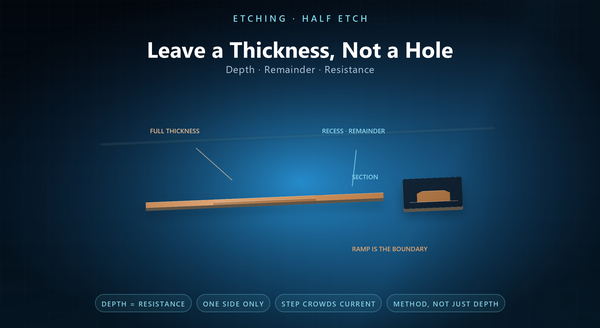
half etched foil tab
Current collector half etch metal is the part of the process where the goal is not to make a hole but to leave a thickness. On a foil collector that thickness is usually the current path, so a half-etch is a resistor adjustment disguised as a cosmetic step: thinning a tab to weld it, recessing a pad, or creating a step that the assembly needs. Getting the depth right is the whole job, and on a ten-micrometre foil the tolerance conversation is different from any other half-etch work.
1. What Half-Etch Does on a Collector
Four uses recur, and each wants a different thing from the depth.
A tab is often thinned so that it can be folded, or so that a weld can be made through it without expelling too much metal.
A weld pad is sometimes recessed so that the weld sits in a defined pocket rather than on a proud surface.
A step is created where a collector of one thickness has to meet a busbar of another.
And a recess is made to take a coating, a sensor or a spacer, where the coating thickness has to end at a defined line.
None of those needs a through-feature. All of them need a depth, and the depth is where the difficulty is. A collector is also a part where a recess is often invisible in the finished cell, which is why a half-etch is the feature a drawing forgets first. A half-etch is also the only etch feature that has a second surface to protect, because the unetched face is part of the part. A recess that is deeper at one end than the other is the failure mode that a single depth measurement cannot see.
2. Half of Ten Micrometres
On a ten-micrometre foil, a “half etch” leaves five.
That is the number that matters, because resistance is inversely proportional to the remaining thickness: a five per cent depth error is a five per cent resistance error in that region, and a five per cent resistance error in a tab is a five per cent error in where the current goes.
So a half-etch specification on a collector is not a cosmetic tolerance. It is an electrical one, and it should be written in the same conversation as the resistance budget rather than in a separate one. A foil that is thinned where the current is highest is a foil that is thinned in the wrong place, and that is a design error rather than a process one. A tab that is thinned to fold is a tab whose resistance rises in the region that carries the whole current. A weld pad that is recessed too deeply is a pad with too little metal left to absorb the weld.
3. How Depth Is Set
Depth in a half-etch is set by time in the bath, all other things being equal, which means it is a process-time tolerance rather than a tool tolerance.
Three things move it. The etch rate, which changes with chemistry, concentration and temperature. The local flow, which changes with panel position and with the density of nearby features. And the resist, because a thicker resist edge holds the etchant back for the first part of the etch.
That is why a half-etch depth is usually specified with a tolerance that is wider than a through-feature tolerance, and why the depth is verified on a coupon rather than assumed from the time. A bath that is analysed once a shift can produce two depths in one day, and neither of them is the one on the drawing. A depth that is set by time is a depth that inherits every variation the bath has. A depth that is set by time is also a depth that cannot be corrected once the panel is in the bath.
4. One Side or Two
A half-etch can be made from one face or from both, and the choice changes the profile.
A one-sided half-etch leaves a recess with a sloped wall and a flat floor, and the opposite face stays untouched — which is usually what a collector wants, because the untouched face is often the coating face.
A two-sided half-etch removes from both faces and meets in the middle, which halves the time but makes the remaining thickness harder to control and leaves a less flat floor.
That is why a collector half-etch is usually one-sided, and why the drawing should say which face is recessed. A one-sided half-etch also leaves a single clean reference face, which is what a depth measurement needs. A two-sided half-etch is also harder to inspect, because the floor is a function of both faces. A two-sided half-etch is also a two-sided registration problem, which is the last thing a foil needs.
5. The Step Boundary
The boundary of a half-etched region is a step in thickness, and a step in thickness is a step in resistance.
Two consequences follow. Current crowds at the boundary, because it takes the shortest path into the thinner region; a boundary that runs across a current path is therefore a hot spot in waiting. And the boundary itself has a slope, because the etch is isotropic, so the transition is a ramp rather than a wall.
A good design keeps the step parallel to the current flow where possible, and gives the ramp enough length that the thinning is gradual. A boundary that runs along a coating edge is also a boundary that the coating will follow, which is usually wanted and occasionally not. A ramp also changes the effective width of the conductor, which is a number the electrical model has to include. A ramp that is longer than the design assumed is a resistance that is lower than the design assumed.
6. Measuring Depth on a Foil
Depth on a thin foil is harder to measure than depth on a plate, and contact methods are the wrong tool.
Three methods are used. A non-contact optical or confocal measurement, which gives the floor position relative to the unetched face. A cross-section, which is destructive and definitive and also shows the ramp. And a weight or a resistance measurement on a coupon, which is an indirect check but is the one that correlates with the electrical property.
Because the depth is small in absolute terms, an optical method needs a reference on the same panel, not a nominal zero. A coupon that is measured by weight needs the same area as the part, or the comparison is a ratio rather than a depth. A coupon that is measured by resistance needs the same boundary shape, because a step dominates the reading. A weight check is only useful if the panel area is known, which is a drawing question rather than a lab question.
7. Where Half-Etch Loses
Three situations argue against half-etching a collector.
If the remaining thickness is a large fraction of the current path and the tolerance cannot be held, a mechanical thinning or a different lamination is usually better, because it is a controlled operation rather than a timed one.
If the depth variation across the panel matters — which it does whenever the region is wide — a process that controls depth mechanically will beat one that controls it by time.
And if the design needs a sharp step rather than a ramp, etching cannot provide it, because the isotropic etch always produces a slope.
A supplier who quotes a wide, tight-tolerance recess on a ten-micrometre foil is quoting a part that will be inspected by resistance and will fail on distribution rather than on average. A design that needs a precise remainder is a design that should be checked against the current budget before it is checked against the process. A remainder that is specified without a method is a remainder that will be argued about at first article. A remainder that is specified with a coupon is a remainder that can be accepted without a cross-section.
8. What the Drawing Should Say
A drawing for a half-etched collector should state the foil thickness, the remaining thickness with its tolerance, which face is recessed, the lateral extent of the recess with its own tolerance, the boundary treatment (ramp, and its length), the measurement method, and the resistance or weight check on a coupon if the depth is functional.
It should also state whether the recess is a weld pad, a fold line or a coating pocket, because the three want different boundary shapes.
The recurring mistakes are a half-etch specified by depth alone without a measurement method, A drawing that names the remainder as a range rather than a nominal plus tolerance is a drawing that an etcher can hold. A drawing that names the face and the method is a drawing that two suppliers can quote the same way. A drawing that shows the ramp as a radius rather than a note is a drawing that will be closer to the part. a recess on the coating face, a boundary drawn across a current path, a tolerance copied from a thicker part, and a coupon taken from a different panel.