
battery foil laser cutting service
Current collector metal laser cutting is a category rather than a single job, because a collector family contains four very different parts: a foil outline, a tab array, a plate or busbar, and a perforated field. The same machine can cut all four, but they do not cost the same, they do not fail the same way, and two of them are usually better served by another process. This page is about choosing between them and about how a laser price is actually built. A customer who knows which of the four they are asking for gets a better answer than one who sends a picture and asks for a price. The four also differ in how much of the part is cut and how much is left, which changes both the scrap value and the handling.
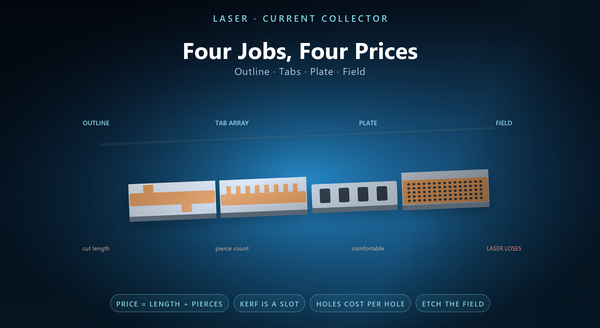
1. Four Kinds of Laser Job
The first job is an outline: a foil cut to a shape, with a few tabs or notches. It is mostly cut length and very few pierces.
The second is a tab array: a wide foil with many tabs along one edge. It is the same kind of work as an outline, but the tab roots carry the tolerance, and the number of tabs sets the pierce count.
The third is a plate: a busbar or a plate-type collector, one to three millimetres thick, with slots and pockets. This is conventional laser cutting and it is where the process is most comfortable.
The fourth is a perforated field: a foil or a plate with hundreds or thousands of apertures. This is the job where a laser is usually the wrong tool, because the cost scales with the number of holes rather than with the outline.
2. How a Laser Price Is Built
A laser quote is mostly a function of two numbers: the length of cut and the number of pierces.
Cut length sets the time, because the head travels at a feed rate for the whole path. Pierce count sets the number of times the process has to stop, start and establish a cut, which is why a thousand small holes costs more than one long outline of the same total length.
Three more numbers modify the result: the thickness, which changes the feed rate and the number of passes; the tolerance, which may force a slower speed or a second operation; and the material, because copper and aluminium reflect differently and cut differently at the same thickness.
That is why two parts of the same weight and the same outline can quote very differently, and why a quote that is given per kilogram is a quote that has not been thought about. A quote also carries a setup, which is why ten pieces and ten thousand pieces of the same outline have different unit prices but the same first-hour cost. A quote also carries a risk allowance for the thin end, which is why a foil quote is often higher per metre than a plate quote.
3. The Thickness Ladder
Four thickness bands behave differently, and it is worth knowing which band a part is in before asking for a price.
At ten to twenty micrometres the foil is thinner than the focal spot of many machines, and the difficulty is handling rather than cutting.
At fifty to a hundred micrometres the foil can be cut cleanly, and the difficulty moves to burr and to keeping the part flat.
At half a millimetre to a millimetre the process is at its most comfortable, and the tolerance is mostly a machine question.
At one to three millimetres the cut is slower, the kerf is wider, and the heat input starts to matter for flatness and for the edge.
A supplier who quotes all four bands at one rate has either not cut the thin end or not cut the thick end. A thickness is also the number that decides which machine the job goes on, and therefore which tolerance is realistic. A thickness that is stated without a tolerance is a thickness that will be argued about at inspection.
4. The Cut Is a Slot
A laser cut removes material, so every cut is a slot with a width rather than a line.
On a foil that matters more than on a plate, because the kerf is a larger fraction of the part. A cut that is nominally on the outline removes half a kerf from the part and half from the scrap, so the drawn outline and the finished outline differ by half a kerf unless the path is offset.
That is why a laser drawing should state whether the path is on the outline or compensated, A kerf that is not accounted for is a systematic error, and a systematic error is the easiest kind to design out. A kerf also sets the minimum feature, because a slot narrower than the kerf cannot be cut at all. and why a part that was designed for a zero-width cut arrives slightly small.
5. Holes Dominate the Cost
A perforated field is the case that separates laser from etching in economic terms.
A laser has to pierce and trace every aperture, so the time is proportional to the number of holes. An etch images the whole field at once, so the time is proportional to the panel area. As the hole count rises, the two curves cross.
That crossing point is not a fixed number, but it is easy to locate for a specific part: if a quote is dominated by the hole count rather than by the outline, the part is a candidate for etching.
The same logic explains why a tab array of ten tabs is a comfortable laser job and a tab array of two hundred tabs is not. A hole count is also the number a customer can change most easily, by making the field coarser or by moving the pattern to an etch. A hole that is smaller than the kerf is not a hole, which is the other reason the thin end and the perforated field are different jobs.
6. Where Etching Wins
Three part types are usually better etched, and a laser shop should say so.
A dense perforated field is the clearest case, for the reason above.
A burr-free requirement on both faces is the second, because an etched edge has no burr at all, and a laser edge does.
And a very thin foil at high volume is the third, because a die or an etch scales with area and a laser scales with time.
None of those is a criticism of laser; they are the boundaries of a process, and stating them is what lets a customer trust the cases where laser is right. A shop that can say which of the four jobs it should not take is a shop whose other answers are worth more. A boundary also has to be stated in the units the customer is thinking in, which is parts and weeks rather than process names.
7. Edge Quality by Service
The edge a laser produces is judged differently depending on what the edge does.
An outline edge that sits inside a pouch is judged on burr height and on flatness.
A tab edge is judged on the root, because a notch at the root concentrates current.
A weld edge is judged on cleanliness, because an oxide from the cut is a weld defect.
A coating edge is judged on whether the coating can be applied over it without a void.
One edge specification cannot serve all four, which is why a collector drawing should describe the edge per region rather than once for the whole part. A region-based edge note also makes inspection possible, because each region gets its own method. A region-based note also lets a supplier price the edge it is actually asked for, rather than the worst edge on the part.
8. What to Send for a Quote
A quotable request for a laser-cut collector has seven items: the alloy and temper, the thickness, the outline with the tab geometry, the number and size of any apertures, the tolerance on the functional dimensions, the edge requirement per region, and the annual quantity with its batch sizes.
It should also state which dimension is functional, because that is the dimension the process will protect if it has to choose.
The recurring mistakes are a drawing with no hole count, A request that names the four numbers the price depends on is a request that can be answered in a day. A request that names the batch size is a request that can be scheduled rather than guessed. A request that names the edge per region is a request that can be priced without a meeting. a tolerance that applies to every dimension equally, an edge note that says “deburr” without a limit, a quantity given as a weight, and a request that asks for both a dense perforated field and the lowest price.