
copper foil laser cutting, current collector burr
Current collector thin metal laser cutting is a service that is easiest to sell and hardest to deliver, because the material is the problem. A current collector is a foil — copper on the anode side, aluminium on the cathode side — and in most cell designs it is between six and twenty micrometres thick. A collector is also the part where a cut edge enters the cell, so its quality is an electrochemical question as well as a mechanical one. That is thinner than the focal spot of many industrial lasers, That is thinner than the focal spot of many industrial lasers, and it is thin enough that the cutting process competes with the foil’s own stiffness. A supplier who has only cut sheet metal will find that the same machine, the same gas and the same parameters do not transfer, and that the useful process window is much narrower than the machine’s specification implies.
1. What a Current Collector Is
A current collector is the metal that carries electrons between the electrode coating and the tab.
Three shapes appear. A continuous coated foil that is slit to width and cut to length. A foil with tabs cut into its edge, which is where the current leaves. And a thicker busbar or plate that collects from many tabs.
A foil that is coated on both sides is cut before coating in most processes, because coating then cutting would damage the coating at the edge. The thickness is set by the cell design and by the resistance budget, The thickness is set by the cell design and by the resistance budget, The tab is also the feature that makes the collector a cut part rather than a slit roll, and it is where most of the cutting quality argument happens. not by the cutting process — which is why a cutter has to work at the thickness the design chose, rather than the other way round.
2. Why the Thin Range Is Hard
Four things make thin foil harder to laser than thick sheet, and they compound.
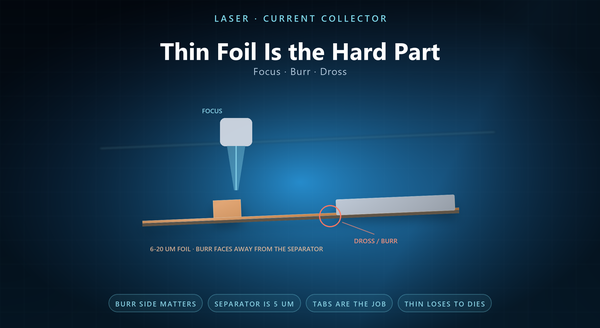
The first is focus. A focused beam has a waist of tens of micrometres, and a foil of 8 µm sits inside that waist rather than being cut through it, so the energy density at the material is lower than the machine’s rating suggests.
The second is heat conduction. In a thin foil the heat has nowhere to go but sideways, so the heat-affected zone spreads relative to the cut width and the edge can distort before it separates.
The third is dross. A thin foil has no mass to hold the molten edge, so the ejecta can reattach on the underside as a droplet rather than being blown clear.
A thin foil also has a burr that is a much larger fraction of the thickness than on a thicker sheet. The fourth is handling. The fourth is handling. A foil that thin will flutter, wrinkle or lift under a gas jet, A foil that is cut on a conveyor without hold-down is a foil whose cut line moves with the gas flow. and a moving workpiece produces a cut that wanders.
3. Burr Is Not Cosmetic Here
In most sheet metal work a small burr is an appearance issue. In a cell it is an assembly and safety issue.
A burr on a current collector edge sits inside a stack that contains a separator only a few micrometres thick. A burr that is comparable to the separator thickness is a puncture risk during assembly or during the first cycles, and a puncture is an internal short.
A burr that is 5 percent of a 200 µm sheet is 10 µm; the same fraction of an 8 µm foil is 0.4 µm, and the tolerance is not scaled the same way. That is why current collector edges are usually specified That is why current collector edges are usually specified with a burr height on one side A burr that faces the separator is a defect that no amount of edge quality elsewhere can compensate for. and a defined burr direction — the burr must face away from the separator, or not exist.
A laser cut edge has a burr that is a function of the dross and the assist gas, and controlling it is a process window problem rather than a parameter setting.
4. Dross, Recast and Oxidation
Three edge features matter beyond the burr, and each has a cause.
Dross is re-solidified metal on the exit side, and it is the main source of a burr on thin foil. It is controlled by gas pressure, focus position and speed, and it is the first thing to look at when a cut looks ragged.
Recast is a thin layer of metal that melted and re-solidified without being ejected. It has a different microstructure from the foil, and on a copper collector it can oxidise quickly.
Oxidation is the third, and it matters most at the tab: a tab that is welded needs a clean surface, and an oxide layer from the cut is a weld defect waiting to happen.
A dross droplet on the exit side is also a particle that can end up inside the cell. That is why a laser-cut collector is often cleaned That is why a laser-cut collector is often cleaned or the tab is cut with a different process than the body. A recast layer also changes how the edge behaves in the electrolyte, which is a chemistry question rather than a mechanical one.
5. Tabs and the Weld Zone
The tab is the functional part of the collector, not the edge.
A tab is where the current is collected and where the cell is welded to a busbar. That makes three properties matter: the tab’s geometry, because it sets the current density at the joint; the tab’s edge, because a notch at the root concentrates current; and the tab’s surface, because the weld needs clean metal.
A tab that is cut in the same pass as the body has to be drawn as a feature, not left as the remainder of an outline. A laser cut tab can meet all three, provided the cut is made with the tab as the priority A tab root that is nicked is a current concentrator and a place where a fatigue crack starts. rather than the body outline. A process that is optimised for the long straight edges will often produce a tab root that is not good enough.
6. Where Laser Wins
Laser is the right process in three situations, and they are worth stating plainly.
A laser also allows a collector design to be changed without a new tool, which is worth more in a development programme than in production. Thicker collectors — the busbar plates and the heavier foils used in larger cells — A prototype that changes format twice is a prototype where tooling cost dominates, which is why laser wins there even at a higher piece price. are a comfortable laser job, because the material has enough mass to cut cleanly.
Large formats and low volume favour laser, because there is no tooling and the artwork is a file. A prototype cell format that will change twice is a laser job.
And complex outlines that would need several die operations favour laser, because the beam can follow any path the file describes.
7. Where Laser Loses
Two situations point away from laser, and a supplier should say so.
Ultra-thin foil at high volume is usually a die-cutting or an etching job, because a die produces a sheared edge with a controlled burr direction and a repeatable height, and because the per-part cost falls with volume in a way that laser time does not.
Shapes that need a burr-free edge on both sides — some separator-adjacent designs — are also better served by etching, because an etched edge has no burr at all, at the cost of a taper.
A laser shop that quotes an 8 µm foil at a million parts is quoting a process that will lose to a die on cost and to an etch on edge quality.
8. What the Specification Should Carry
A drawing for a laser-cut current collector should state the alloy and temper, the thickness with its tolerance, the outline and the tab geometry, the burr limit with its side and its direction, the dross and recast limits, the surface cleanliness at the weld zone, and the flatness.
It should also state the assembly context: what is on the other side of the edge, and how close it comes. That single fact decides whether a burr is a defect or a disaster.
A spec that leaves the burr direction open is a spec that will be met on the easy side. The recurring mistakes are a collector specified by thickness and outline only, A drawing that names the burr side and the burr direction is a drawing that a laser shop can hold to. a burr limit with no side, a tab designed as an afterthought to the body, a weld zone specified as “clean”, and a process chosen for the sample rather than for the volume.