
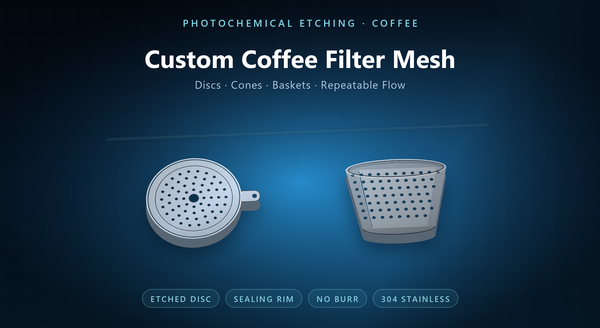
stainless steel coffee filter mesh
Custom coffee filter mesh is a metal filter built to a brew method rather than to a catalogue size: a disc for a basket, a cone for a pour-over, a cylinder for a moka pot, a screen for espresso. The mesh decides what reaches the cup. Too open and the brew carries fines and turns muddy; too tight and the bed stalls, channels and extracts unevenly. Between those limits sit aperture, open area, material, form and finish, and this page works through them for the parts a coffee equipment maker actually orders.
1. What a Metal Coffee Filter Has to Do
A coffee filter does two jobs at once. It retains the particles that would make the cup gritty, and it passes liquid fast enough that the bed drains evenly. Paper resolves the first job completely and the second badly, because it also holds back oils and fines that carry much of the body and aroma. Metal keeps those compounds and returns them to the cup, which is why a reusable filter tastes different rather than simply worse.
The metal filter also has to survive use. It is cleaned, sometimes scrubbed, often left wet, and it sees hot water and coffee at an acidity that is mild for stainless steel but not for every alloy. It has to hold its shape when the bed is stirred or tamped, and it has to seal against its holder so that liquid cannot bypass the bed entirely.
Those requirements are why the specification starts with the brew method rather than with a mesh count.
2. Aperture Follows the Brew Method
Every brew method sets a different balance between retention and flow. A pour-over drains under gravity through a bed that the water has to cross, so the filter must pass a high flow at low pressure. Espresso is the opposite: the puck itself provides the resistance, and the screen is there to support it and to keep the finest particles out of the cup. A moka pot pushes water through under steam pressure, and cold brew leaves the grounds in contact for hours, where flow matters less than clarity.
Aperture is therefore chosen against the grind and against the cup the customer wants. Finer apertures give a cleaner cup and slower flow; coarser ones give more body and faster drainage, at the risk of silt. Open area carries the flow the aperture restricts, which is why a finer aperture is usually paired with a higher open area rather than accepted as a slower filter. The useful conversation is not which mesh is standard but which aperture, at which open area and thickness, produces the cup the product is designed around.
Because retention is not a single number for a metal filter, sampling is the honest way to settle it. Three apertures, brewed side by side with the same dose and grind, tell a product team more than any table.
3. Etched Mesh or Woven Cloth
Woven cloth is the traditional answer and remains the right one for large, simple areas. It is inexpensive per square metre, it conforms to a shaped basket, and it can be framed or spot-welded into a holder. Its weaknesses are the cut edge, which frays unless it is finished, and the aperture, which varies slightly across the roll and shifts when the cloth is stretched over a form.
Etched mesh is cut from solid sheet, so the aperture is exactly what the artwork specifies, the panel is flat and stiff, and the cut edge cannot unravel. The same etch can produce the perforated field, the rim, the locating tabs and the lifting handle in one part, which removes a frame, a bonding step and a tolerance stack. For discs and cones that must fit a specific holder, that integration is usually worth more than the material saving of cloth.
The trade is area cost. Etching removes metal and time, so a large basket is cheaper in woven cloth with a frame, while a small precise disc or a cone with an integral rim is cheaper and better in etched sheet.
4. Forms: Discs, Cones, Baskets and Screens
Most orders fall into four shapes. A disc sits in a basket or a portafilter and is the simplest part: a perforated field, a rim that seals, and often a tab for lifting it out while hot. A cone is the pour-over form, and it can be etched flat and formed, or made in segments and joined.
A basket is a cylinder or a truncated cone with a base, and it is usually formed from a flat blank or welded from a developed pattern. An espresso screen is a shallow disc with a fine field and a reinforced edge, because it is handled, knocked out and washed repeatedly.
What these forms share is that the sealing feature matters as much as the aperture. A rim that does not seat lets liquid bypass the bed, and no aperture choice can compensate for bypass. The drawing should show the sealing face, its flatness and the surface it mates with, not only the perforated area.
5. Material and Food Contact
Coffee equipment is a food-contact product, and that narrows the material list quickly. Austenitic stainless steel, 304 and 316L in particular, is the usual choice: it resists the acidity of coffee, it does not need a coating, and it can be passivated after forming so the surface is clean and stable. Copper and brass appear in some traditional equipment, but they need a food-safe finish and they tarnish.
Coatings are best avoided on the filtration surface. A non-stick or decorative coating can wear at the edge, and a worn coating is both a appearance problem and a contamination question. Where a coating is needed elsewhere on the product, it should stop short of the perforated field. A clean, passive surface also slows the polymerisation of coffee oils that eventually blinds a filter.
Documentation is a market question rather than a process one. Where the buyer’s market asks for a food-contact declaration or a material certificate, that belongs in the enquiry, because the answer changes what is ordered, not how the part is etched.
6. Edge, Seam and Fit
The edge of a coffee filter is handled every day, so it should be smooth and free of burr. Etching leaves a clean edge by nature, but forming, trimming or a welded seam can reintroduce a sharp line, and a sharp rim on a part that is rinsed by hand is a complaint waiting to happen.
Cones and baskets often need a seam. A welded seam has to be dressed and passivated, and it must not create a crevice where grounds lodge and turn rancid. Where the geometry allows, a seamless formed part is preferable, even at a higher forming cost.
Fit is the other half of performance. The part has to locate in its holder without rattling, seal at the rim, and come out without tools. A rim that is too tight will not seat on a slightly oval holder, and one that is too loose will rattle; both are drawing decisions rather than shop preferences. Those are tolerances on the rim and the locating feature, and they are worth stating on the drawing instead of leaving them to the forming shop.
7. Cleaning, Clogging and Service Life
A metal filter clogs differently from paper. Fines wedge into apertures and oils polymerise on the surface, and both reduce flow over time. The remedy is mechanical: a backflush, a brush, and occasionally a soak. A filter that cannot be cleaned back to its original flow is a filter that will be replaced early, and that is a product failure regardless of how well it brewed on day one.
Two design choices help. Electropolishing smooths the aperture walls and the surface, so grounds release more readily and the part looks better after washing. Thickness matters too: a deeper aperture holds more fines before it blinds, while a thin wall clears faster.
It is tempting to answer a muddy cup with a finer aperture. That usually trades silt for stalling, and the better fix is often the bed, the grind or the open area rather than the hole size.
8. Prototype to Volume, and Order Notes
Etching has no hard tooling, so a prototype run of three apertures costs a fraction of a tool and arrives in days rather than weeks. Samples that arrive flat also confirm the forming: a cone that springs back after forming will not seat, and that is cheaper to find on a prototype than in a production lot. Once the aperture and the form are fixed, the same artwork runs for volume, and the cost per part falls with panel utilisation rather than with a new investment.
An order should state the brew method and the target cup, the aperture with its tolerance, the open area, the sheet thickness, the diameter or the formed geometry, the rim and sealing feature, any tab or handle, the finish and passivation, and the packing that keeps the parts from denting. A drawing that gives a mesh count borrowed from woven cloth, with no aperture tolerance and no sealing face, leaves the supplier to guess at the two things that decide whether the product works.