
How to Laser Cut Metal: Complete Process, Tips & Best Practices
Laser cutting has become one of the most widely adopted digital fabrication methods for metal components. Many designers, workshop operators and procurement teams want to understand how to laser cut metal properly to achieve clean edges, stable dimensional accuracy and minimize waste. Laser cutting metal relies on high-energy concentrated laser beams to melt or vaporize metal materials following programmed trajectories. Compared with stamping, shearing and plasma cutting, it supports complex shapes without custom molds, making it suitable for rapid prototyping, small-batch customization and mass sheet metal production. This guide systematically explains the full workflow, key technical points, material selection, common problems and practical optimization advice for metal laser cutting.
Step 1: Prepare Digital Design Files
The whole laser cutting workflow starts with drawing preparation. Designers create 2D outlines using CAD software and export files in DXF or DWG formats, the standard file types recognized by laser control systems. Before importing files into equipment, design verification is essential. Check minimum hole sizes, internal fillets, narrow gaps and reserved tolerances. Sharp inner corners easily cause overburning; overly small features may lead to incomplete cutting. For thin metal sheets, avoid dense clustered patterns to reduce thermal deformation. All unreasonable structures should be adjusted at the design stage to lower the risk of defective products.
Step 2: Select Metal Materials and Raw Sheets
Different metals behave differently under laser heat, which directly affects cutting quality. Carbon steel delivers stable cutting performance with low slag when oxygen is used as auxiliary gas. Stainless steel requires nitrogen cutting to obtain oxidation-free bright edges. Aluminum alloy has high thermal conductivity, demanding higher laser power and optimized focus settings. Copper, brass and spring steel need stricter parameter control to avoid thermal deformation and material performance loss. Operators should select metal sheets with consistent thickness, flat surface and clean surface without heavy oil contamination. Dirty surfaces will cause unstable laser absorption and poor cutting continuity.
Step 3: Material Positioning and Equipment Setup
Place metal sheets flat on the laser cutting worktable. Thin sheets must be fixed firmly to prevent shifting under auxiliary gas impact. Operators set critical parameters according to metal grade and thickness, including laser power, cutting speed, focal height, gas type and gas pressure. Nitrogen is preferred for stainless steel, aluminum and elastic metal parts requiring high surface quality. Oxygen is commonly used for carbon steel to improve cutting efficiency and penetration for thicker plates. Improper focus position is one of the top causes of rough edges and unpenetrated cuts.
Step 4: Execute Laser Cutting
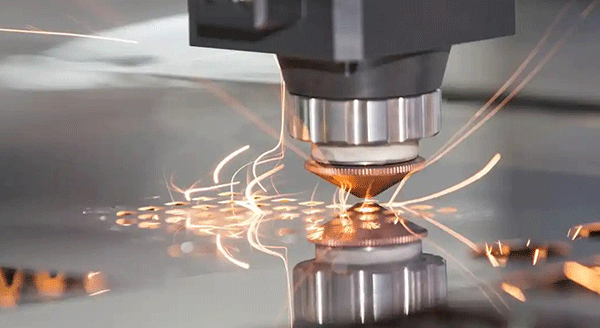
After parameter confirmation, import graphic data and set reasonable cutting sequences. Optimize cutting paths to reduce repeated heating on local areas, especially important for ultra-thin metal sheets prone to warping. The focused laser beam rapidly heats target areas until the metal reaches melting or vaporization temperature. High-pressure auxiliary gas blows away molten metal residues and forms continuous cutting seams. The whole process is non-contact; no cutting tool touches the workpiece. During operation, real-time monitoring helps spot abnormal sparks, unpenetrated sections or excessive slag in a timely manner.
Step 5: Sorting, Deburring and Post-Processing
Once cutting completes, separate finished parts from scrap frames. Most laser-cut metal parts carry minor slag or burrs, especially thick metal workpieces. Deburring, tumbling or grinding can smooth cutting edges according to assembly requirements. Customers can choose additional surface treatments including passivation, sandblasting, blackening and bending. Strict dimensional inspection using optical measuring instruments ensures finished parts match drawing tolerances before packaging.
Key Tips to Improve Metal Laser Cutting Quality
- Control thermal influence. For thin sheet metal, disperse dense patterns and avoid long continuous cutting paths to prevent bending and torsion.
- Match parameters with material thickness. Do not use the same set of parameters for 0.1mm foil and 6mm thick steel plates.
- Optimize nesting layout. Reasonable arrangement of parts improves material utilization and balances heat distribution across the sheet.
- Reserve sufficient fillets for all inner corners to eliminate burning traces and stress concentration.
- Keep raw material surfaces clean. Oil, oxidation layers and dust interfere with laser energy absorption and result in unstable cutting.
Common Defects and Solutions When Laser Cutting Metal
Unpenetrated cuts usually stem from insufficient power, wrong focal position or insufficient gas pressure. Rough edges often appear due to mismatched cutting speed. Excessive slag is frequently seen on carbon steel cut with unsuitable oxygen pressure. Thin sheet warping is mainly caused by uneven heat accumulation and unreasonable cutting order. Spring steel parts may suffer local annealing if laser heat is too high, resulting in reduced elasticity. Most defects can be avoided through design optimization and precise parameter calibration.
Typical Applications for Laser Cut Metal Parts
Mastering how to laser cut metal enables production of a wide range of industrial components: EMI shielding sheets, conductive spring shims, precision gaskets, filter meshes, mechanical brackets, automotive sensor parts, new energy battery components, medical instrument accessories and decorative metal panels. Laser cutting supports flexible customization, meeting demands from prototype verification to large-scale batch manufacturing.
Conclusion
Learning how to laser cut metal covers design optimization, material matching, parameter debugging and standardized post-processing. Every stage interacts closely to determine final part quality. Reasonable drawing rules, suitable auxiliary gas selection and controlled thermal input help manufacturers achieve smooth edges, accurate dimensions and stable batch consistency. As fiber laser technology continues advancing, laser cutting will remain a primary solution for custom metal fabrication across electronics, automotive, medical, aerospace and precision machinery industries.