
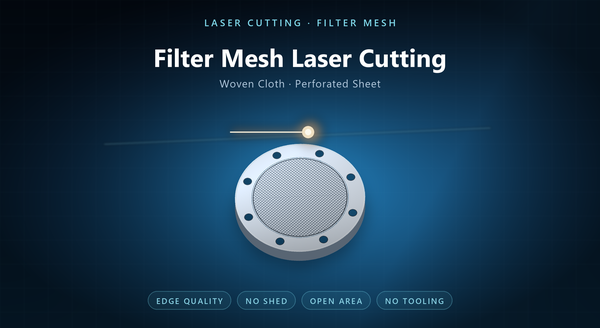
woven wire cloth laser cutting
Metal laser cutting for filter mesh turns woven wire cloth or perforated sheet into the discs, panels, baskets and strainers that make a filter. The cut is the easy part to describe and the hard part to get right, because a filter is judged by what it lets through, and a cut edge that sheds a wire or a sliver of dross has changed what the filter does. This page covers what laser cutting does on filter media, where the edge is the risk, and how to specify a filter part so the mesh performs rather than merely fits.
1. What Filter Mesh Is
Three materials carry most of the work.
Woven wire cloth is the classic: a lattice woven from wire, supplied by mesh count and wire diameter, with an aperture that follows from both. It is flexible, it drapes, and it is the cheapest way to get a large open area in a fine aperture.
Perforated sheet is the rigid alternative: a solid sheet with a punched or etched pattern. It holds shape on its own, it supports a load, and its aperture is exactly what the tool made.
Sintered and laminated mesh are the third, where several layers or a mesh-plus-support are bonded into one sheet. They are cut like a solid, but the edge exposes the layers, which matters for a filter that must not delaminate.
The material decides how the cut behaves, which is why the enquiry should start with which of the three is being quoted. A filter’s behaviour is set by the medium, not by the housing, and the cut has to preserve the medium at the edge.
2. What the Laser Cuts
The laser makes the outside shape: discs for a cartridge end, rectangles for a panel, developed patterns for a basket or a cylinder, and the tabs or frames that hold the mesh in its housing.
It also makes the large openings: a centre hole, a mounting slot, a cut-out that clears a boss. Those are contours like any other. A perforated sheet can also carry a logo or a flow arrow, cut in the same pass as the outline.
What it does not make is the filtration aperture. The mesh count or the perforation pattern sets that, and it comes from the material supplier rather than from the cutting program. A drawing that asks for a specific aperture in woven cloth is asking for a cloth, not a cut.
That division is the single most useful thing to establish early, because it decides who is responsible for the number that the filter is specified by. For a basket, the developed shape also has to account for the seam allowance where the edges meet.
3. Cutting Woven Cloth Is Different from Cutting Sheet
A woven cloth is a lattice, so the beam meets wire, gap, wire. The cut advances by severing one wire at a time, which changes the edge and the process.
The edge becomes a row of wire ends rather than a smooth line. Where the outline crosses the weave diagonally, the ends stick out as a saw-tooth whose height scales with wire diameter and pitch. That matters for a filter because a protruding wire end can shed into the medium it is meant to protect.
The cloth also moves. It has no stiffness of its own, so it lifts under assist gas and can drift between supports. Tensioning it flat, or cutting it on a carrier, is what keeps the outline true; without that, a disc comes out oval.
Stack cutting is possible and is usually a bad idea here, because the lower layers cut with a different focus and gas condition and their edges fray differently from the top.
Perforated sheet has none of these problems. It cuts like any thin sheet, and its edge is clean. The comparison in a quotation is therefore not like for like unless the material is stated. A disc cut from coarse cloth can also curl at the rim, which a fine cloth does not.
4. The Edge Is the Risk
For most laser-cut parts, the edge is a cosmetic or assembly question. For a filter it is a functional one, in two ways.
First, shedding. A wire end, a dross bead or a sliver of recast can detach and travel downstream. In a hydraulic or fuel circuit that is a contamination event; in a potable water or food application it is a compliance event.
Second, sealing. A filter disc usually seats against a housing or is bonded into an end cap, and a ragged edge does not seal. The same wire ends that shed also create leak paths past the seal.
The remedies are process control rather than inspection: cut parameters tuned for the cloth, a support that keeps the weave from moving, a clean edge treatment, and a downstream clean. Inspection then verifies the result rather than finding the problem. A filter that passes an incoming inspection but sheds in service was inspected for the wrong property. The same edge that sheds can also snag in an ultrasonic clean and tear.
5. Aperture, Open Area and What Changes Them
The filter’s performance numbers are aperture and open area, and neither is set by the cut.
Aperture comes from the cloth or the perforation. Open area comes from the aperture and the pitch. If the part is a disc, the cut changes the total area, not the open area per unit.
That has a practical consequence for drawings: open area should be specified as a percentage of the material, and the cut edge should be specified separately for its quality. Mixing the two into one callout is how a supplier ends up accepting a cloth that meets open area but sheds at the edge.
Where the part is a basket or a cylinder, the developed pattern is a cut decision, and the open area of the finished part depends on how the edges are joined. That belongs in the drawing too. Where the part is a strainer with a large opening, the opening is a cut feature and its edge condition matters as much as the field. A drawing that carries only a mesh count leaves the edge, the open area and the cleanliness to the shop to interpret in its own favour.
6. Materials
Stainless steel — 304 and 316L — is the default for filtration: it resists the media, it is available in fine wire, and it can be cleaned. 316L is chosen where chlorides or higher temperature rule out 304.
Brass and copper appear where solderability or a specific galvanic requirement leads, and in some fuel and water applications. Aluminium is used for air and light-duty filtration, and it is soft enough that the cut edge deforms under handling.
Nickel alloys appear in high-temperature and aggressive chemistry, where the cost is justified by the duty.
The wire diameter matters as much as the alloy: a fine cloth cuts with a smaller, cleaner edge than a coarse one, and a coarse cloth needs a different cut strategy to avoid a ragged line. The cloth’s own cleanliness matters too: a mesh that arrives with oil or dust will not pass a filter cleanliness check however well it is cut.
7. Prototype to Volume
Laser cutting has no tooling, so it fits the front of a filter program: a first article for a housing, a disc in a new diameter, a basket for a trial. The turn is days.
At volume the route changes. A disc in a fixed diameter is cheaper punched or die-cut, and a very fine mesh may be etched in a panel if the geometry allows. The sensible programme keeps laser for the variants and the sizes that will never repeat. The volume route also changes the packing, because a punched disc can be nested tighter than a laser one.
The handover should be written down, because a laser-cut edge and a die-cut edge are not the same: the fray, the burr direction and the cleanliness differ, and a filter qualified on one may not pass on the other. A filter qualified on a punched disc should not be assumed to pass on a laser one without a re-test.
8. Inspection and Order Notes
Inspection covers the outline, the aperture of the cloth itself, the open area, the edge condition (protruding wire ends, dross, recast), flatness for a disc that must seat, and cleanliness.
An order should state the media (woven cloth with count and wire diameter, or perforated sheet with pattern), the outline and its tolerance, the edge acceptance, the clean and packing requirement, and the quantity.
The recurring mistakes are a mesh specified without wire diameter, an aperture asked for in woven cloth, an open area callout with no edge requirement, and a disc designed to seat without a flatness limit. A cloth batch certificate alongside the cut report is worth having, because the aperture number traces to the cloth.