
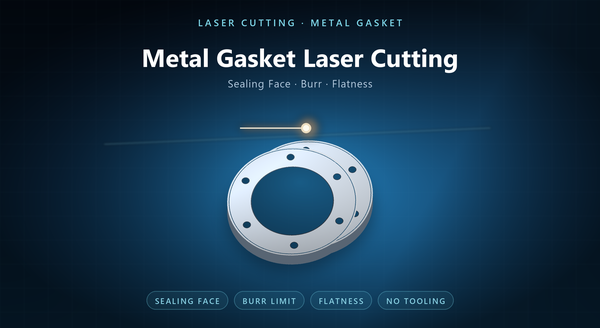
spiral wound gasket metal ring
Metal laser cutting for metal gasket work is the cutting of sealing rings, profile gaskets and the metal components of composite gaskets from thin sheet. The part looks simple — a ring with bolt holes — and the quality that decides whether it works is not the outline but the sealing face: the burr, the flatness and the surface that has to compress against a flange without leaking. Laser cutting is a good route for gaskets because it needs no die and holds a profile well, but it leaves an edge that has to be specified rather than assumed.
1. What a Metal Gasket Is
A metal gasket seals a joint between two flanges, a head and a block, or a cover and a housing, by being compressed between them. It works by a combination of contact stress, conformability and, in many designs, a coating or a soft layer that fills the surface finish.
The metal part takes several forms. A solid metal ring is the simplest: a flat annulus, often with a raised or profiled sealing bead. A spiral wound gasket uses a metal winding strip plus solid outer and inner rings, and those rings are cut parts. A multi-layer steel (MLS) gasket is a stack of thin embossed layers, each cut to the same profile. A jacketed gasket wraps a soft filler in a metal jacket.
In every case the laser is cutting a flat profile, and the gasket’s performance is set by the profile, the material, the thickness and the face condition. The design intent is always the same: a joint that stays tight through thermal cycling, with the gasket yielding so the flange does not. A gasket too hard to conform will leak at a rough flange, and one too soft will extrude under load.
2. What the Laser Cuts
The laser makes the ring: outer diameter, inner diameter, bolt holes, and any locating tabs, notches or lugs. It also makes profile gaskets — the irregular shapes that follow a port, a cover or a manifold — which are exactly the parts a die cannot justify at low volume.
It can cut several gaskets into one sheet and nest them, which matters because a ring wastes a lot of material if it is cut alone. Nesting a ring inside another ring is normal, and a good layout can halve the material cost of a small gasket. A profile gasket with tabs is one part; without tabs the same gasket is three parts and an assembly step.
What it does not do is form the sealing bead. An embossed or coined bead needs a press, so a gasket that relies on one is either bought as a formed part or made in two steps: laser-cut blank, then formed.
That distinction belongs at the enquiry: a flat ring and an embossed ring are different products even when the drawing looks the same from above.
3. Why Laser Cutting
Gasket geometry changes often. A flange is revised, a port moves, a bolt pattern changes from four to six, and each of those is a new profile. A die would be remade every time; a laser program is edited.
Laser also cuts thin sheet without distorting it and holds a concentricity between the inner and outer diameter that a gasket needs, because the two contours are cut in one setup from the same datum.
The alternatives each have a place. A die is cheaper per part at volume and can coin a bead in the same stroke. Waterjet cuts thick or heat-sensitive material without a heat-affected zone but is slower and leaves a rougher edge. Photo etching leaves no burr and is good for very thin, very fine profiles. A die for a profile gasket is a die for one profile, so a family of port shapes means a family of dies.
For thin metal gaskets in modest quantities, laser is usually the practical middle. Laser also handles the one-off: a single gasket for a legacy machine, cut from sheet stock the same week.
4. The Sealing Face Is the Quality
A gasket leaks at the face, so the face is where the quality lives.
Burr is the first issue. A burr on the sealing face holds the gasket off the flange, creating a leak path, and it also damages the mating surface when the joint is tightened. Laser cutting leaves dross on the exit face, so which face is the sealing face is a drawing decision, and if the dross side is the sealing side, a deburr is mandatory.
Flatness is the second. A ring that bows will not seat evenly, and the bolt load will close one side and leave the other open. Thin sheet is not naturally flat; the rolling stress and the heat of the cut both contribute.
Surface condition is the third. A gasket with a soft coating or a graphite facing needs a clean, oil-free base to bond to, and a cut edge with oxide or handling oil will not bond. A gasket is compressed once and then left for years, so any defect at the face has a long time to work. A burr also raises the local bolt load, which can crack a brittle flange over time.
5. Materials
Soft iron and low-carbon steel are traditional for solid metal gaskets: they conform well and they are cheap. They rust, so they are usually oiled or coated.
Stainless steel — 304, 316 and 316L — is chosen for corrosion resistance and for higher temperature. It is harder to conform, so it is used where the flange is stiff and the load is high, or as the rings of a spiral wound gasket.
Copper and brass appear in automotive and heat-exchanger gaskets, where thermal conductivity and conformability both matter. Aluminium is used for light-duty and air applications.
Graphite and fibre laminates are cut as composite sheets: the laser cuts the profile, and the edge has to be checked for delamination and for a burnt binder. Thickness availability often decides the material more than the corrosion argument does.
6. Thickness and Compression
Gasket thickness is a material property, not a cut property, and it is set by the compression the joint needs. A thinner gasket needs a flatter flange; a thicker one conforms more but takes more load.
That means thickness should be specified as a gauge with a tolerance, and verified by measurement. A drawing that asks the laser to hold thickness has asked the wrong process.
What the laser controls is the profile and its position: the concentricity of the inner and outer diameters, the bolt circle, and the width of the sealing land between them. A narrow land is a feature that has to be cut accurately, because it is what carries the contact stress. The land width and the bolt circle are the two features a leak path most often follows.
7. Prototype to Volume
Laser cutting fits the front of a gasket program: a trial gasket for a new flange, a profile for a manifold that may change, a small build for a leak test. The turn is days.
At volume the route changes. A standard ring in a fixed size is cheaper stamped or die-cut, and the die can coin a bead at the same time. The sensible programme keeps laser for the profiles and the sizes that will not repeat. Laser also covers the sizes a die cannot: very large rings, or a ring too small to justify tooling.
The handover should be written down, because a laser-cut gasket and a stamped one are not identical: the burr direction, the edge condition and the residual stress differ, and a joint qualified on one may not seal on the other. A gasket qualified on a stamped ring should not be assumed to seal as a laser-cut ring without a leak test.
8. Inspection and Order Notes
Inspection covers the profile, the concentricity, the bolt circle, the land width, flatness on the sealing face, burr on the sealing face, and the surface condition where a coating or facing will be applied.
A leak test on a sample is the functional check, and it is worth agreeing who performs it.
An order should state the material and temper, the gauge and its tolerance, the profile drawing, the sealing face and its burr limit, the flatness limit and its datum, any coating or facing, and the packing that keeps a thin ring flat.
The recurring mistakes are a burr limit omitted because the part is “just a gasket”, a flatness figure with no datum, an embossed bead assumed from a flat drawing, and a sealing face not named. A first article that records burr on the sealing face and a flatness trace is worth more than a report that says the ring was checked. A drawing naming the sealing face, the burr limit and the flatness datum is short, and it removes most of the argument.