
reusable shielding gasket
Photo chemical machining for EMI shielding gasket is usually argued on first-build performance, and most gaskets are lost on the second build. A shielding gasket is a consumable that the assembly treats as a part: it is compressed, opened for rework, closed again, cleaned, and expected to conduct as well as it did on day one. The metal inside the gasket is the part that survives that treatment; the elastomer is the part that does not. Etching matters here because it is the flatness, the groove depth and the edge that decide how many cycles the assembly gets before the seal and the contact both drift.
1. A Gasket Is a Consumable
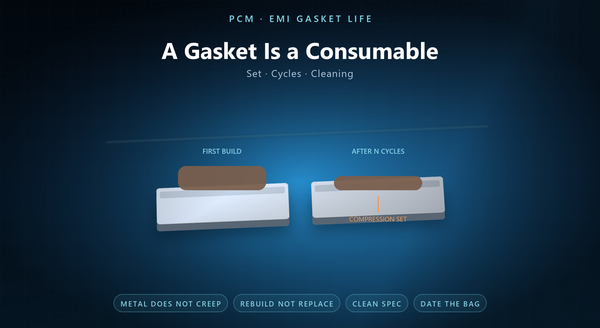
A gasket is designed to be deformed, which makes it the one component in a shield that is expected to degrade.
Two things degrade. The elastomer takes a compression set: after enough time under load it stops returning to its original height, and the force it applies falls. The metal part fatigues, corrodes at its plating, or loses flatness after being handled.
The assembly usually notices the second one first, because a contact resistance that drifts upward is easier to measure than a seal that is slowly failing. A gasket replaced on a schedule is cheaper than one replaced after a failure. That is why gasket replacements are often triggered by an EMC failure rather than by a leak. A gasket treated as a part is one expected to last the life of the product, and it rarely does; the mismatch between that expectation and the physics is where most field returns come from.
2. Compression Set Is the Clock
Compression set is the permanent deformation left after the load is removed, expressed as a percentage of the original deflection.
It is driven by temperature, time, and the ratio of deflection to height. A gasket compressed to half its free height at a high temperature will take a set faster than one compressed by a fifth at room temperature, and the difference is not linear.
For a shielding gasket the consequence is direct: set reduces the force available at the specified compression, so the contact resistance rises and the seal pressure falls, both without any visible change.
A metal component does not take a compression set in the same sense — it can be bent past its elastic limit, but it does not creep the way an elastomer does. A set that is never measured cannot be managed. Set is measured after a specified time at a specified temperature, Set is measured after a specified time at a specified temperature, so a datasheet number is not the number in the application, and a gasket over-compressed to hit a gap will set faster than one allowed a thicker section — which is why groove depth is a life decision. That asymmetry is the useful design fact on this page.
3. The Metal Outlives the Elastomer
In a mesh-over-foam gasket the metal mesh and the foam have very different lives.
The foam takes the set; the mesh keeps its shape. That means a gasket can be rebuilt — new foam, same mesh — if the mesh is still clean, flat and plated.
An etched mesh is well suited to that, because its geometry does not depend on the weave staying tight and its edge does not fray with handling. A carrier frame is even more obviously reusable: it is a flat part whose only wear is at the tabs and at the plating.
A rebuild is only possible if the drawing says which part is which. The design implication is worth stating: The design implication is worth stating: a gasket designed for rebuilds should separate the consumable from the durable, and should say which is which on the drawing. A mesh cleaned a hundred times is still the same mesh provided its plating survived, while a frame handled a hundred times is a frame whose tabs have been bent a hundred times.
4. Opening and Closing
Every rework cycle is a mechanical event for the gasket.
The lid comes off, the gasket is exposed, the assembly is cleaned, the lid goes back. Each of those steps adds a small amount of damage: a nick at the edge, a bend at a tab, a scratch through the plating.
Etching helps in a specific way here: a burr-free edge does not catch on the housing when the lid slides back on, and a flat frame does not need to be forced into place. Both reduce the damage per cycle, which raises the number of cycles.
A half-etched fold line or a lift tab also helps, because it gives the technician a place to work that is not the sealing surface. The number of cycles a gasket survives is therefore a design variable rather than a material property, and a gasket that has to be pried out with a tool is a gasket that will be damaged on removal.
5. Cleaning and Solvents
A reused gasket gets cleaned, and cleaning is where a plating quietly disappears.
Aqueous cleaners are usually benign to tin and nickel; solvent cleaners attack some elastomers and can lift a thin plating at a scratched edge. Ultrasonic cleaning is the most effective and the most damaging, because it removes loose plating from exactly the places that were already marginal.
The metal part should therefore carry a cleaning specification: which cleaners are acceptable, whether ultrasonic is allowed, and what the plating thickness is before cleaning rather than after.
An etched part has an advantage that is easy to overlook: no burr means no crevice for cleaner to be trapped in, and no burr means no scratch source during cleaning. A cleaning step that is not specified is a cleaning step that will be improvised. A cleaner that removes the plating has removed the conductive path, A cleaner that removes the plating has removed the conductive path, not just the finish, so the specification should name the solvent, the temperature and the dwell time.
6. Storage and Ageing
A gasket that is stored badly ages before it is used.
Elastomers take a set under their own weight if they are stacked, and they ozone-crack if they are stored near a motor or in sunlight. Metal parts do not, but their plating can tarnish, and a tarnished contact is a contact that has to be cleaned before it is used.
That is why a flat, individually bagged or carded gasket is worth the packing cost, and why a kit that ships as a loose bag is a kit whose parts have already started their clock.
For an etched frame, flatness in storage is a process requirement that continues after the process ends. A gasket stored flat in a card is still flat a year later and one stored in a coil is not, and a bag with no date is a bag of unknown age.
7. When to Replace
Three signals say a gasket is done, and they are worth writing into the maintenance procedure.
The first is a measured loss of compression: the same screw torque no longer produces the same gap.
The second is a contact resistance that has drifted beyond the limit at the working compression.
The third is visible damage: a nick at the sealing line, a bend at a tab, or plating worn through to the base metal at a contact point.
Replacing the elastomer while keeping the frame is often possible; replacing the frame while keeping the elastomer almost never is, because the frame is what locates everything. A log of cycles per station turns a guess into a schedule. A replacement interval based on cycles is easier to administer A replacement interval based on cycles is easier to administer than one based on a resistance measurement, and the frame should be inspected at the same interval because a bent tab is as disqualifying as a set elastomer.
8. Specifying for a Service Life
A drawing for a reusable gasket should carry the compression range, the maximum compression set allowed, the groove depth and its datum, the plating thickness, the acceptable cleaning methods, and the number of cycles the design assumes.
It should also say which part is the consumable, so that a rebuild is a rebuild rather than a re-qualification.
Inspection for a reused part is different from inspection for a new one: flatness, groove depth and plating thickness matter more than a dimensional check of the outline, because those are what the next cycle depends on.
The recurring mistakes are a gasket specified only for first build, The drawing should also state a storage life, because a gasket ages in the bag. A service-life drawing is a different document from a first-build drawing and should say so, A service-life drawing is a different document from a first-build drawing and should say so, and a rebuild kit should list frame, elastomer and screws separately. The recurring mistakes are a gasket specified only for first build, a cleaning method that strips the plating, a groove depth that has no datum so a rebuild cannot reproduce it, and a kit that is packed loose so the parts age in the bag.