
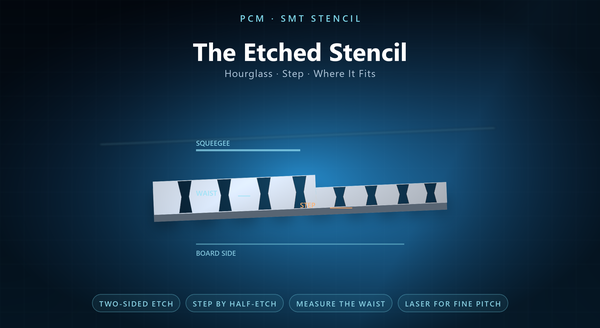
step stencil etching, stencil aperture wall profile
Photochemical machining for SMT stencil is not a challenger to laser cutting any more, and it does not need to be. Laser won the fine-pitch work because it can put a near-vertical wall exactly where the design wants it. Etching kept the jobs where the wall profile does not decide paste release — coarse apertures, step stencils, fast simple boards — and where its own profile is an advantage rather than a compromise. This page is about that boundary, stated plainly, because a supplier who claims etching is better everywhere is telling a buyer something they will discover at first article.
1. Where the Etched Stencil Still Fits
An etched stencil is made by imaging the aperture pattern in a resist on both faces and dissolving the metal through.
It was the standard method before laser, and it is still used for three things: low-cost stencils for coarse boards, step stencils where a local thickness change is wanted, and quick prototypes where the artwork already exists as a film.
Laser is used for fine-pitch production, for apertures that need a vertical wall, and for anything where the stencil is the yield-limiting part. The two routes coexist because they solve different problems.
That is the boundary this page draws. The useful question for a buyer is not which process is better, The useful question for a buyer is not which process is better, but which aperture on the board sets the stencil’s difficulty — and whether that aperture is in etching’s comfortable range. The two processes also fail differently at first article, which is a useful way to tell which one was used: an etched stencil that is too fine fails by short deposits, a laser stencil that is too coarse fails by bridging.
2. How an Aperture Etches
The pattern is imaged on both faces, and the etchant removes metal from each side until the two cavities meet.
The result is an hourglass: wider at the entry face, narrower at the mid-thickness waist, and wider again at the exit face. That profile is not a defect; it is what a two-sided etch does, and it is repeatable.
Three numbers describe it. The surface aperture is what the resist defined. The waist is the minimum, and it is where paste flow is limited. The taper is the difference between them over the thickness.
The waist is the number to quote, not the surface. Because the wall is not vertical, Because the wall is not vertical, the drawing has to say which face is measured, and the two faces are not interchangeable: the face against the board is the one that controls release, and the face against the squeegee is the one that controls fill. A two-sided etch is also self-limiting in a useful way: it cannot undercut the resist by more than the etch depth allows; and the waist is usually the number a paste-release model would use, and usually not the number on the drawing.
3. What the Wall Does to Paste Release
Paste release is governed by the area ratio and by the wall’s shape.
At a coarse aperture the area ratio is generous, and the hourglass is irrelevant: the paste releases from the board face whether the wall is vertical or not. This is where etching is comfortable.
At a fine aperture the area ratio drops, and the wall profile starts to matter. A waist narrower than the drawn aperture reduces the effective area, and a taper that narrows toward the board holds paste at the exit.
That is why the honest statement is a range rather than a limit: etching holds the coarse half of a board’s apertures well, and the fine half is where laser earns its premium. A stencil with an area ratio of 1.5 is comfortable in either process and one at 0.6 is comfortable in neither, and the taper direction matters as much as the magnitude because the entry has to be wider than the exit for fill and release to agree.
4. What Etching Is Still Good At
Three jobs, and they are worth knowing because they are not obvious.
A step stencil is the first. A board with both fine-pitch and coarse parts wants a thinner region and a thicker one, and etching produces the step by half-etching the sheet before the apertures are cut. That is a natural fit, and the same process that makes the step makes the apertures.
A stencil for a coarse board is the second. If the finest aperture is comfortable, an etched stencil costs less and arrives faster, because there is no laser time per hole.
A prototype stencil is the third. A design that is still moving wants an artwork change rather than a re-cut with new parameters, and that is what etching gives. A stepped stencil is also the one case where etching can beat laser on cost at a fine pitch, and a prototype is usually the first part a programme buys and the one whose lead time matters most.
5. What Etching Should Not Take
Two jobs should go to laser, and a supplier should say so.
Fine-pitch production is the first. Apertures at the bottom of the area-ratio curve need a wall that releases, and an hourglass does not. Selling an etched stencil into a 0.3 mm pitch board is selling a first-article failure.
Nano-coated or high-end stencils are the second. Those products are bought for release performance, and the release comes from a smooth, near-vertical wall plus a coating; etching’s profile works against the first half of that.
A supplier who declines those jobs is more useful than one who quotes them, because the second one costs the buyer a build. A declined job is a reference rather than a lost sale when the buyer intends to keep making the board, and an etched stencil on a fine board hides its failure until printing, which is the most expensive place to find it.
6. Step Stencils by Half-Etch
The step is the one place where etching does something laser does not do as easily.
The sheet is half-etched in the region that has to be thinner, and the apertures are cut after. The step boundary can be any shape the artwork draws, including a curved boundary around a connector.
Two details matter. The step depth is a separate tolerance from the aperture, and it is measured from the original face. And the step boundary should not cross an aperture, because a half-etched aperture is neither a good thick aperture nor a good thin one.
A stepped stencil also needs the step map on the drawing, not a verbal instruction, because the map is the file. A step half-etched before the apertures also etches slightly differently in the thin region, which the step map should account for, and the step is how a stencil gets two paste volumes without two stencils.
7. Material, Thickness and Electropolish
Etched stencils are made in 304 and 316L stainless, in the same gauges as laser ones.
Thickness is chosen against the finest aperture, as it is for any stencil, and the etch narrows the waist slightly relative to the drawn aperture, which is one more reason the drawing should state the measurement face.
Electropolishing is common after etching, and it does two things: it removes the etch residue and it rounds the entry edge slightly. It does not turn an hourglass into a cylinder, and a buyer should not expect it to.
A nano-coating can be applied to an etched stencil, but a coating on a profiled wall is a smaller improvement than a coating on a vertical one. A 304 sheet etches slightly faster than a 316L one, which matters only at the finest aperture, and electropolish changes the aperture slightly, so the optical dimension belongs after the polish.
8. Choosing, and What to Put on the Drawing
The choice is made per board, not per supplier.
If the finest aperture on the board is comfortable, etching is cheaper and faster. If the board carries a fine-pitch device, laser is the safer route, and the stencil should be quoted that way.
A mixed board is a judgement call: some suppliers etch the coarse region and laser the fine one, which is a legitimate hybrid for a board that has both.
A drawing should state the alloy and gauge, the aperture pattern with the reduction from pad size, the measurement face, the step map and depth if any, the finish, the frame or tension, and the fiducials. It should also state the finest aperture, because that number is what decides whether the stencil should be etched at all.
The recurring mistakes are an etched stencil specified for a fine-pitch board, A quote should name the process, because a stencil quoted as laser and delivered as etched is a different part, and the finest aperture is the one number that lets a supplier decline early and save everyone a build. The recurring mistakes are an etched stencil specified for a fine-pitch board, a step depth without a datum, an aperture measured on the squeegee face, and a drawing that never names its finest aperture.