
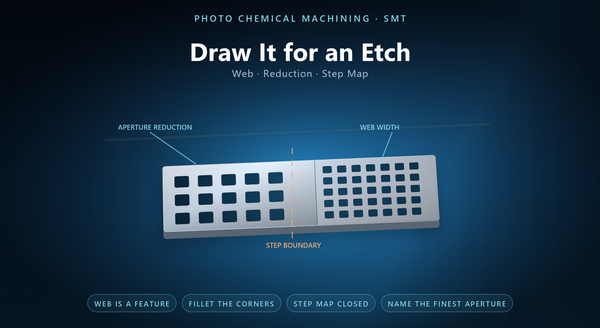
stencil web width
Photo chemical machining for SMT stencil asks the designer for a drawing that a laser shop would not ask for. A laser cuts what the file says, so the file can be generous with slivers; an etch removes metal from both faces at once, so every gap has to be wide enough to let the chemistry through and every web has to be wide enough to survive being undercut from both sides. Most etched-stencil failures that are blamed on the process are really a drawing with a 30 µm web on it.
1. The Drawing Is Different
An etched stencil is a two-sided process, and the drawing has to account for that.
Two consequences follow. The first is that the aperture is specified with a measurement face, because the entry and the exit are not the same size. The second is that gaps — the metal between two apertures — are a feature with a minimum, because the etch attacks them from both sides.
A laser drawing can treat the web as whatever is left over. An etched drawing has to treat the web as a designed feature, with a width and a tolerance.
A web rule is the one DFM item that CAM software cannot check. That is the first thing a DFM review should check, That is the first thing a DFM review should check, because it is the cheapest thing to fix at the drawing stage and the most expensive thing to discover at first article. A laser drawing can be edited quickly after a first article; an etched drawing that breaks a web rule needs a new artwork and a new etch, so the review belongs before the file is sent.
2. Aperture Reduction and Area Ratio
Aperture reduction is the difference between the pad and the stencil opening, and it is chosen for paste volume rather than for the process.
For an etched stencil the reduction interacts with the taper. If the board face is the measured face, the reduction applies there; if the squeegee face is measured, the waist is smaller than the drawing says.
The waist also sets how much paste the aperture can hold, which is a volume argument the designer has to make. The area ratio is the governing number, The area ratio is the governing number, and it is computed on the wall that actually releases. For an etched stencil that means the board-face aperture, not the waist, because the paste leaves from the board face — but the waist limits how much paste reached the aperture in the first place.
That double role is why an etched stencil should be designed with a smaller reduction than a laser one at the same pad: the waist is already doing part of the volume reduction that the designer would otherwise do in the drawing. A reduced aperture also narrows the waist faster than it narrows the board face, so the designer’s lever is the pad-side aperture and the waist follows.
3. Web Width and Pitch
The web is the metal between apertures, and on an etched stencil it is a design feature with a minimum width.
The minimum is set by the etch: a web narrower than roughly the sheet thickness is undercut from both sides until it is thin, and a web much narrower than that can disappear locally or become a sliver that folds during handling.
That is why an etched stencil’s pitch is not a free choice. Two apertures at a 0.4 mm pitch with a 0.3 mm aperture leave a 0.1 mm web, which is comfortable in a 0.1 mm sheet and marginal in a 0.2 mm one.
A designer who needs a tighter pitch has one lever: reduce the aperture or thin the sheet. Both are decisions that belong on the drawing, not in the shop. The minimum is not a hard cliff: a web exactly at the limit will pass a first article and fail the third, because the bath drifts between lots, and designing in margin is cheaper than controlling the bath more tightly.
4. Aperture Shape and the Etched Wall
The shape of the aperture matters more on an etched stencil than on a laser one, because the wall is already not vertical.
A rounded rectangle releases better than a sharp rectangle on an etched wall, and a home plate — a rectangle with one end narrowed — helps at fine apertures by giving the paste a breakaway line.
Sharp internal corners are the enemy: a 90° corner in a resist image etches to a rounded corner anyway, so drawing a sharp one only invites a tolerance argument at inspection.
The fillet size is itself a public statement of process capability. A fillet at every internal corner is therefore not a cosmetic choice; A fillet at every internal corner is therefore not a cosmetic choice; it is a statement about what the process can hold. A home plate gives the paste a direction to break, which is worth more on an etched wall than on a vertical one, and the same reasoning applies to teardrops at slot ends: the etch rounds them anyway, so draw the radius you want.
5. Where a Step Boundary May Run
A step is made by half-etching one region before the apertures are cut, and the boundary is the one feature that has no laser equivalent.
Three rules govern it. It must not cross an aperture, because a half-etched aperture is neither a good thick one nor a good thin one. It should avoid running along a row of apertures, because the transition etches unevenly near the boundary. And it should be placed where the board changes from coarse to fine, so the step is doing work rather than following a convenient line.
Where the step sits often decides whether the board is workable or merely printable. The step map belongs on the drawing as a closed region, The step map belongs on the drawing as a closed region, with the depth and the datum face. A verbal instruction is not a map. A boundary that follows a row of apertures also puts the thinnest metal where the most paste is needed, and the depth belongs on the drawing with its datum because a step measured from the wrong face is a step that measures wrong.
6. Large Openings and Long Slots
An etched stencil handles a connector cut-out or a large window differently from a laser one.
A large opening is easy to etch, but the metal removed leaves a thin frame around it, and that frame has to be stiff enough to keep the stencil flat. A stencil with a big window and a narrow border around it will sag.
Long slots are the other case: a slot is a good etchant channel, so it etches faster and widens more than a small aperture nearby. A drawing that mixes a long slot with fine apertures should expect the slot to be the loosest feature on the part.
That is a reason to keep slots short where possible, and to place them away from the fine-aperture region. A tie bar also stiffens the frame around a window, which is the difference between a flat stencil and a sagging one, and it can brace a large window A large window can be braced by leaving a tie bar across it at no cost in the artwork, and a long slot is the first place a stencil tears because the etch leaves it thinnest at its ends.
7. Markings, Fiducials and Tooling Holes
Three features that are not apertures but that the drawing has to place.
A part number is usually etched as a shallow legend, which means it is a half-etch feature with its own depth. A fiducial is a through-feature that the printer’s camera sees, so its contrast matters: a filled or open shape is better than a thin outline. A tooling hole is a through-hole whose position relative to the apertures is the registration, so it has to come from the same artwork.
All three are cheap to add at the drawing stage and awkward to add later, because each one is a change to the file rather than to the process. A legend that ends up on the step boundary looks mottled, so keep it off. A legend too small to read after plating should have been a barcode, A legend too small to read after plating should have been a barcode, and fiducials are worth keeping clear of the step boundary because the half-etch changes how they look.
8. The Drawing That Gets Quoted
A drawing that can be quoted without a phone call carries seven things: alloy and gauge, aperture pattern with the reduction stated from the pad, the measurement face, the minimum web and where it occurs, the step map if any, the finish, and the fiducials with the tooling holes.
It should also state the finest aperture on the board, because that number decides whether the stencil should be etched at all.
The recurring mistakes are a web thinner than the sheet, A drawing that states the web minimum also tells the supplier which apertures are marginal, which shortens the conversation. The recurring mistakes are a web thinner than the sheet, an aperture specified at the squeegee face, a step boundary drawn across apertures, a sharp internal corner with a tolerance on it, and a drawing that leaves the finest aperture to be discovered by the supplier.