

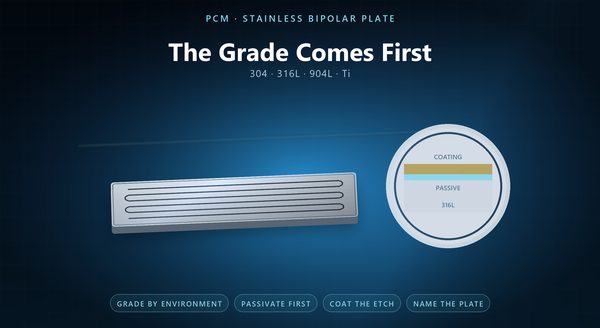
stainless steel flow field plate
Photochemical machining for stainless steel bipolar plate is a material decision before it is a process decision. The plate is the most repeated part in a stack, so its material is chosen for cost per unit area, for formability at thin gauge, and for whether a coating will adhere to it — and stainless wins on all three, which is why most etched plates in production are 304 or 316L rather than titanium or a coated aluminium. Etching then has to be compatible with that choice: it must not leave the surface in a state that the coating cannot cover or the electrolyte can attack.
1. Why Stainless Is the Default
Three properties put stainless ahead for an etched plate.
It is available in thin, flat, accurate strip, which is what a fine flow field needs. Aluminium is lighter but softer and harder to keep flat; titanium is more corrosion resistant but several times the price and harder to etch.
It etches predictably. The chemistry is well understood, the resist adheres, and the resulting surface takes a passivation step without special handling.
It can be coated. Nitride and carbon-based coatings are deposited on stainless at production scale, and the substrate is stable enough at deposition temperature not to distort the flow field.
A material that is stable at coating temperature is a material that can be coated without a rework loop. None of that makes stainless the best material in every respect; None of that makes stainless the best material in every respect; it makes it the one with the fewest unknowns at the volume a stack needs. A stamped aluminium plate is cheaper per kilogram and dearer per part once the die and the flatness are counted, and stainless survives cleaning and stack assembly without a protective atmosphere; the material also sets the etch process window, because a stabilised grade behaves differently from a low-carbon one.
2. The Grades and What Separates Them
Four stainless grades appear in plates, and the differences are about corrosion margin rather than about strength.
304 is the cheap default: adequate for a benign coolant circuit and for demonstration stacks, but marginal in a fuel-cell environment where the potential and the pH both move.
316L is the standard choice for the anode side and for anything that sees the electrolyte: the molybdenum addition raises the pitting resistance, and the low carbon keeps the weld and the heat-affected zone from sensitising.
316Ti is a stabilised variant for higher-temperature duty, and 904L appears where chloride or fluoride levels are high enough that 316L pits.
Titanium is used where the corrosion requirement overrides the cost, and it behaves differently in the etch: slower, with a different passivation behaviour. The difference between these grades is often a few percent of alloying element and a large difference in pitting potential, and the grade is also a supplier question: not every etcher stocks 904L, and a rare grade lengthens the lead time.
3. The Environment Is Not Atmospheric
A bipolar plate does not corrode the way a kitchen sink corrodes, and treating the two as the same material problem is the most common specification error.
Inside a stack the plate sees an acidic environment, a controlled potential that can be anodic to the alloy, elevated temperature, and often fluoride from the membrane. Each of those moves the corrosion mode: pitting rather than uniform attack, crevice attack under a gasket, and transpassive dissolution at the high end of the potential range.
A coupon test also misses the crevice, which is where a gasket failure begins. That is why a grade that looks over-specified by an atmospheric standard That is why a grade that looks over-specified by an atmospheric standard is often the minimum inside a stack, and why the corrosion test a plate is qualified against is an electrochemical one rather than a salt-spray one. A salt-spray result says nothing about a plate that will sit at 0.8 V in an acidic environment, and the membrane is the source of the fluoride, so the plate’s corrosion story depends on the stack chemistry as much as on the alloy.
4. What the Etch Does to the Surface
Etching removes metal and leaves a surface that is chemically different from the parent strip.
Two things change. The etch residue sits in the grain boundaries and in the etch texture, and it has to come off in the strip and the rinse or it interferes with the passive film. And the surface roughness changes, which changes both the wetted area and how a coating nucleates.
Passivation after etching is therefore not a cosmetic step: it removes the residue and regrows the chromium oxide that the etch disturbed. A plate that is coated without it is a plate with an adhesion problem waiting to happen. A plate etched and then left to sit before coating grows a different oxide from one coated the same day, and the etch texture is where a coating pinhole becomes a corrosion site, because it is the thinnest point.
5. Plate Type Changes the Grade
A stack has more than one kind of plate, and they are not the same material problem.
An interconnect sees both the fuel and the oxidant, so it carries the full potential range and needs the higher grade.
A coolant plate sees a water-glycol circuit, which is a different chemistry, and it can often be a lower grade.
The plate type also decides which face is coated, which changes the etch requirement. An end plate is thick, is not etched in the same way, and is usually a different alloy entirely.
Specifying one grade for “the plate” without saying which plate is a mistake that shows up as a corrosion failure at the wrong end of the stack. A coolant plate can often be a thinner gauge as well because its pressure duty is lower, while an end plate is usually machined rather than etched, which puts it in a different supply chain.
6. The Coating Interface
Most production plates are coated, and the etch is the surface the coating grows on.
An etched surface is matte and textured rather than polished, which generally improves adhesion. It also has a different oxide thickness from a rolled surface, which affects how the first monolayers of a coating form.
The coating has to be continuous over the etch texture, which is why the surface preparation before deposition matters as much as the etch itself, and why a plate that is etched well but rinsed badly coats badly.
A coating on an etched plate also has to survive the same potential excursion as the substrate; a coating that is a barrier but not conductive is not a solution. A coating applied to a contaminated etch will pass a tape test and fail in the stack, and the coating thickness has to be chosen against the etch roughness rather than against a polished coupon.
7. Material Cost and Utilisation
Stainless is a material cost in a way that a stamped aluminium plate is not, and the arithmetic is about utilisation.
The plate is thin and the flow field is dense, so the material cost per plate is dominated by the sheet price and by how many plates fit on a panel. A design with a poor nesting can cost more in material than in processing.
Scrap is the second term: a plate that is etched and then rejected for flatness or a coating defect has consumed its material, its etch and its coating, so the yield of the whole chain matters more than the yield of any one step.
That is why plate programmes track panel utilisation as a cost driver rather than as a detail. A programme that tracks material per kilowatt rather than per part usually finds the nesting saving, and a rejected plate is a material loss as well as a processing loss, which is why flatness is inspected early.
8. Specifying Material on the Drawing
A plate drawing should carry the grade by designation with its standard, the thickness and its tolerance, the surface finish before coating, the passivation requirement, and the flatness limit.
A drawing that states the plate type also lets the etcher choose the gauge. It should also state the corrosion or electrochemical qualification It should also state the corrosion or electrochemical qualification that the plate is bought against, because “316L” alone does not define a corrosion performance — the surface state and the passivation do.
And it should say which plate in the stack it is, because that determines which grade is adequate.
The recurring mistakes are a grade chosen by habit rather than by environment, A drawing that names the grade and its standard can be bought from more than one mill, and the plate type belongs in the title block rather than in a note. The recurring mistakes are a grade chosen by habit rather than by environment, a passivation step omitted because the coater “will handle it”, a finish specified on a rolled-surface basis rather than an etched one, and a drawing that does not distinguish the interconnect from the coolant plate.
