
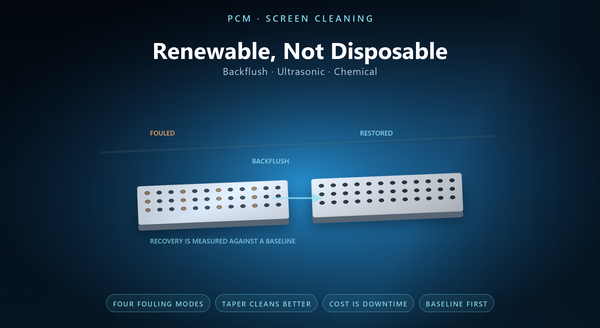
screen fouling recovery
Photo chemical machining for micro hole filter screen produces a part that is meant to be cleaned rather than replaced, and that changes what the part has to be. A disposable filter is judged once, on its first cycle. A renewable screen is judged on the hundredth cycle, after it has been backflushed, soaked, sonicated and dried a hundred times — and the design choices that make it clean well are made at the etching stage, long before anyone tries to wash it.
1. Renewable, Not Disposable
A metal screen is chosen over a paper element for one of two reasons: it survives the chemistry, or it can be cleaned.
The first is a material argument and it is settled by the alloy. The second is a design argument and it is settled by geometry: whether the pores can be reached, whether the support lets the flow reverse, and whether the cleaning method the customer will actually use can reach the fouling.
A screen cleaned on a schedule is cheap and one cleaned when it complains is expensive. A screen that is chemically immortal and geometrically un-cleanable is a screen that gets thrown away A screen that is chemically immortal and geometrically un-cleanable is a screen that gets thrown away — which defeats the reason it was specified. A screen that is cleaned well is one whose cleaning was designed into the etch, and it is the cheapest part to clean and the most expensive to clean badly.
2. Four Ways a Screen Fouls
Four mechanisms account for almost all fouling, and each responds to a different cleaning method.
A surface cake is a layer of solids sitting on the upstream face. It is the easiest to remove and it responds to a reverse flow.
Pore plugging is solids lodged inside the apertures. It responds to backflush only if the plug can be pushed out the way it came in, which is why a tapered aperture is easier to clean than a straight one.
Adsorption is a film — oil, protein, polymer — that bonds to the surface and narrows the aperture without filling it. It needs a chemical or a surfactant, not a flow. A cake is removed by reversing the flow and a plug by pushing it back, which are not the same operation, and a film that has bonded is removed by neither, which is why the ladder exists; a scaling deposit can seal a pore so completely that no flow-based method reaches it.
Scaling is a crystalline deposit that grows in the pore and can bond to the metal. It needs a chemistry that dissolves it, and it can be irreversible if it grows past the point where the chemistry can reach.
3. The Cleaning Ladder
Cleaning is a ladder, and each rung costs more and damages more than the one below.
Backflush is the first rung: reverse the flow, ideally with a pulse rather than a steady stream, and lift the cake off. It costs almost nothing and it is the rung that should be tried first and often.
A cleaning method that is not written down is improvised, and improvised cleaning is how plating disappears. Ultrasonic cleaning is the second: Ultrasonic cleaning is the second: cavitation lifts material out of the pores. It works on plugging and on some films, and it is the rung that damages thin screens and loose plating if it is overdone. A pulse is more effective than a steady reverse flow because it lifts rather than pushes, and ultrasonic cleaning also loosens particles in places they should not leave, which is why it comes last on sensitive parts.
Chemical cleaning is the third: a solvent, a surfactant, a chelant or an acid, chosen against the fouling rather than against the metal. It is the rung where a wrong choice removes the screen’s plating rather than its dirt.
Thermal cleaning is the fourth: burn-off in a furnace, used for carbonaceous fouling. It is the most effective on the hardest fouling and it is also the rung that can anneal a temper or distort a thin screen.
4. Designing for Cleaning
Cleanability is designed, and five choices decide it.
Open area is the first: a screen with more open area has more margin before a partial blockage becomes a problem, and it fouls more slowly per unit of dirt.
The aperture profile is the second: an etched aperture tapers, and a taper that is wider on the upstream side lets a plug be pushed back out rather than driven deeper.
The land width is the third: a narrow land traps cake at its edges, while a slightly wider land lets the flow sweep it.
The support is the fourth: a support that can be backflushed, and whose lands do not sit directly behind the screen’s lands, lets the reverse flow reach the whole field.
Access is the fifth: a screen in a housing that has to be disassembled to be cleaned is a screen that will be cleaned less often than it should be. A taper is free in an etched aperture and is the single most useful cleaning feature, while a screen that must be removed to be cleaned is cleaned on a schedule nobody set.
5. What Cleaning Costs
Cleaning is not free, and the cost is not only the labour.
Each cycle consumes water, chemical and time. Each cycle also consumes some of the screen: ultrasonic cleaning erodes plating at the edges, chemical cleaning can pit a sensitised alloy, and handling bends a thin screen.
That is why the right question is not “can it be cleaned” but “how many cycles at what recovery”. A screen that cleans to 95 percent for fifty cycles is a better product than one that cleans to 99 percent for five. A high open area also cleans back to a usable state in fewer cycles, the dominant cost of cleaning is usually downtime rather than water, and a screen that survives a hundred cleanings is worth more than one that filters better for five.
6. Measuring Recovery
Recovery is measurable, and it should be, rather than assumed.
The simplest measure is the restored pressure drop at a reference flow, compared with the same screen when new. A recovery of 90 percent means the clean drop is 10 percent above the original — which is a different statement from “it looks clean”.
A second measure is the recovered open area, by a flow test or an optical count, which separates a surface cake from pore plugging.
A third is the number of cycles to a stated loss of performance, which is the number the maintenance planner actually needs.
A recovery test on a screen that was never baselined measures two unknowns. None of these requires a laboratory, None of these requires a laboratory, but all of them require a baseline — a recorded clean pressure drop on a new screen, before it is ever put into service. A baseline recorded once saves an argument every quarter, and a recovery figure without a baseline is an opinion about appearance.
7. When to Replace
A screen is finished when cleaning no longer restores it, and there are three signs.
The first is a clean pressure drop that has risen permanently above the baseline. That is a sign that the fouling has become structural — scale in the pore, or a plating that has been removed.
The second is visible damage at the aperture edges, which is where ultrasonic and chemical cleaning attack first.
The third is a change in the filtrate: a screen that has lost apertures passes particles it used to hold, and the first sign is often a downstream filter loading faster.
Replacing on evidence rather than on a calendar is the whole point of measuring recovery. A screen replaced on evidence has a known cost per litre filtered while one replaced on a calendar has a guess, and a screen cleaned too hard loses its edge before it loses its aperture.
8. Specifying a Cleanable Screen
A drawing for a renewable screen should state the aperture with its measurement base, the open area, the land width, the aperture profile, the support with its alignment, and the cleaning methods that are acceptable and those that are not.
It should also state the baseline: the clean pressure drop at a reference flow and temperature, because without it recovery cannot be measured.
And it should state the chemistry the screen will see, because that decides whether a chemical rung is available at all.
A baseline and a cleaning scope are the two lines that turn a screen into a maintained part. The recurring mistakes are a screen specified for filtration only, The recurring mistakes are a screen specified for filtration only, A drawing that names the cleaning method protects the plating from the wrong one, and listing unacceptable methods is as useful as listing acceptable ones. The recurring mistakes are a screen specified for filtration only, a cleaning method chosen without reference to the plating, a support that cannot be backflushed, no baseline pressure drop recorded, and a replacement interval set by the calendar rather than by recovery.