
screen integrity test
Photo chemical machining for microporous filter screen becomes a different subject once the screen enters a sterile process. In a laboratory the question is what the screen retains. In a sterile process the questions are what the screen survives, what it can be cleaned of, and how anyone proves either of those things after the two-hundredth cycle. A metal screen is not a membrane, and the whole advantage — and the whole difficulty — comes from that difference.
1. A Screen Is a Reusable Barrier
A polymer membrane is a single-use sterile barrier: it arrives sterile, it is used once, it is discarded. A metal screen is a reusable one, and reusability moves the burden from the supplier’s certificate to the user’s validation.
That shift is the reason a sterile user asks different questions. Not “is it sterile on arrival” but “can it be made sterile, repeatedly, and can that be proven”. Not “what does it retain” but “does it still retain what it did, after everything the process has done to it”.
A screen in a sterile line is a component of a validated process rather than a purchased part. The screen’s job in this world is The screen’s job in this world is to be a barrier that survives being a barrier many times. A membrane is bought with a certificate and a screen with a validation plan, and the shift from certificate to validation is the cost of reusability, paid once.
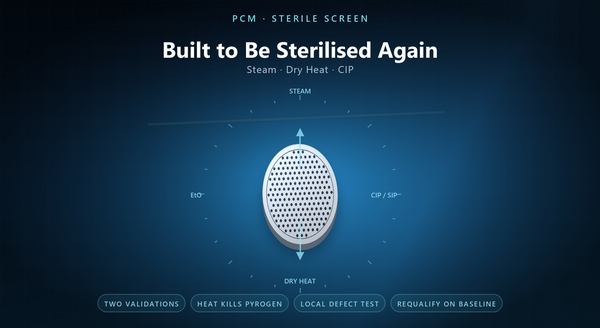
2. Five Sterilisation Routes
Five routes are common, and each one interacts with a metal screen differently.
Steam sterilisation in an autoclave is the default: saturated steam under pressure at a specified temperature and time. It is gentle on stainless and hard on anything that traps air, which is why the screen’s support and housing have to be steam-penetrable. A housing that traps air will fail a steam cycle however good the screen is, and gamma is indifferent to stainless but unforgiving to a thin gold or nickel layer.
Dry heat is the route that also depyrogenates, at much higher temperature and for much longer. It is the route that a metal screen takes better than almost any other material.
EtO needs aeration time, and a screen with a support behind it takes longer to aerate than a bare sheet. Ethylene oxide is a surface sterilant that needs humidity and aeration. It is compatible with the metal and is often chosen for a housing that contains polymers the screen does not.
Gamma irradiation is a dose-based process that is indifferent to the metal but not to its plating, and not to any polymer in the assembly.
Clean-in-place and sterilise-in-place are not sterilisation routes in themselves but flow-based processes: a caustic wash, an acid wash, a rinse and a steam or chemical sanitisation, all without disassembly.
3. What Kills a Membrane Does Not Kill a Screen
The failures that end a membrane’s life are largely irrelevant to a metal screen — and that is the argument for the metal.
A membrane hydrolyses, oxidises, or compresses and loses its pore structure. A stainless screen does none of those things at steam temperature. It also does not shed fibres, which is why it is chosen in clean processes at all.
What does affect a metal screen is different. Thermal cycling expands and contracts the screen and its housing at different rates, which is a fatigue load at the clamp. A plating can be attacked by a cleaning chemistry. And an etched edge is a thin section that can erode over many cleaning cycles.
The metal wins on the chemistry and loses on the mechanical detail, which is exactly where the specification has to be written. A metal screen also does not shed, which is why it appears in processes that count particles, and a plating that survives the chemistry can still fail the thermal cycle because the two stresses are different; the expansion mismatch is a clamp design problem.
4. Cleaning and Sterilisation Are Two Validations
These are two different validations, and programmes that conflate them fail audits.
Cleaning validation asks whether a defined cleaning procedure removes the product residue, the cleaning agent and the bioburden to a stated limit. It is a chemistry and a rinse question, and it is proven by residue testing and by rinse-water analysis.
Sterilisation validation asks whether a defined cycle achieves the required sterility assurance. It is a heat, humidity and time question, and it is proven by biological indicators and by physical parameter records.
The two validations also have different owners, and the handover is where documents get lost. A screen can pass one and fail the other, A screen can pass one and fail the other, and the usual failure is cleaning: a screen with a dense pore field and a support behind it has a lot of surface, and a lot of places for residue to sit. A residue test that passes on the screen can fail on the support behind it, and a cleaning validation is a document with a worst case in it, usually the dirtiest product.
5. Depyrogenation Is the Metal’s Advantage
Endotoxin is the reason dry heat matters, and it is the one place where a metal screen is clearly better than a membrane.
Endotoxin is not alive; it cannot be killed. It has to be destroyed by heat, and the temperatures and times required are far beyond what a polymer can take.
A stainless screen can go into a depyrogenation oven. A polymer membrane cannot, and is therefore protected by being made in a controlled environment rather than by being treated afterwards. A dry-heat oven is a large capital item, which is why the route is chosen for a line rather than for one screen, and a screen that can be depyrogenated is one that can be recovered where a membrane cannot be.
For a user, that means a metal screen can be recovered from a contamination event that would scrap a membrane — provided the housing it sits in can take the same cycle.
6. Integrity Testing a Screen
Integrity testing is the practice of proving, before use, that the barrier is intact.
For a membrane the tests are well established, and most of them are based on a wetting liquid and a gas. For a metal screen the same principles apply, and the practical differences are that a metal screen wets differently, and that a screen’s failure mode is a local defect rather than a general degradation.
That local failure mode is the important one: a screen does not fail everywhere at once, it fails at one pore or one edge, and the test has to be sensitive to a single defect rather than to an average.
A visual check at the clamp is worth more than a second numerical test. A bubble-point or diffusive-flow test on the assembly, A bubble-point or diffusive-flow test on the assembly, plus a visual inspection at the clamp and the edge, covers most of what a screen can do wrong. A local defect is invisible to an average-based test, so the method matters more than the number, and a wetting liquid that does not wet stainless will give a false pass, which is why the wetting agent belongs in the method.
7. Reuse and Requalification
Reuse is where a reusable screen earns its cost and where most programmes get into trouble.
Three things change with cycles. The pore field erodes slightly, especially at the etched edge, which moves the integrity result. The plating thins at the highest-flow area, which changes both corrosion resistance and cleanability. And the clamp area work-hardens, which changes the sealing behaviour.
None of those is a reason not to reuse; they are reasons to define a requalification interval and to measure against a baseline. A screen with a recorded initial integrity result, and a defined maximum acceptable drift, can be reused with evidence. One without is reused on hope. An interval without a baseline is an interval with no meaning, and a screen reused fifty times has fifty histories, with the baseline being what makes them comparable.
8. Specifying a Sterilisable Screen
A drawing for a screen in a sterile process should state the alloy and finish, the aperture with its measurement basis, the open area and ligament, the support and its steam or flow path, the clamping method, the cleaning chemistries that are acceptable, the sterilisation routes that are acceptable, and the integrity test method with its acceptance limit.
It should also state what is measured at requalification, and the interval.
A requirement worth writing down is what the customer will test rather than what the supplier hopes. The recurring mistakes are a screen specified with membrane assumptions, The recurring mistakes are a screen specified with membrane assumptions, A drawing that names the sterilisation routes also tells the coater which plating to avoid, and listing unacceptable chemistries is as useful as listing acceptable ones. The recurring mistakes are a screen specified with membrane assumptions, a housing that cannot be steam-penetrated, a cleaning method validated on the screen but not on the support, a dry-heat route assumed without checking the plating, and a reuse policy with no baseline to measure against.