

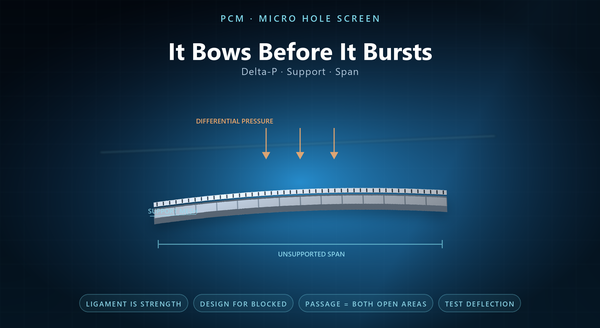
screen burst test
Photochemical machining for micro hole filter screen is usually discussed as an aperture problem, and the part usually fails as a structural one. A screen with dense micro holes is a plate with a large fraction of its area removed, and every hole is a stress concentration and a place where the plate can bow. The questions that decide whether the screen survives are therefore not about pore size but about differential pressure, support and the shape of the load.
1. A Perforated Plate Is Not a Plate
The first thing to accept is that a fine screen has very little continuous metal left.
At a 30 percent open area, seventy percent of the sheet is still metal — but it is metal in a lattice of narrow ligaments, and the ligaments are what carry the load. Their width, not the sheet thickness alone, sets the strength.
That is why two screens of the same thickness and the same material can differ by a factor in pressure capability: one has broad lands between small holes, the other has narrow ligaments between large ones.
A thickness needed for strength may be a thickness that cannot hold the required aperture. The consequence for design is direct: The consequence for design is direct: strength is bought with ligament width, and ligament width competes with open area. A screen with 40 percent open area has the strength of a lattice and a lattice is judged by its narrowest member, so ligament width is the number to quote in a strength conversation and it is usually absent from the drawing; a screen is also a plate whose stiffness falls faster than its open area rises, which is the trap in tuning it.
2. Bow Before Burst
A micro hole screen under pressure almost never fails by tearing first.
It bows. The centre deflects, the ligaments at the centre take more load, the bow increases the exposed area on the pressure side, and the deflection accelerates. Failure, when it comes, is usually a tear at the periphery where the screen is clamped, or a fatigue crack after many cycles of bowing.
That sequence matters because it means the useful acceptance test is a deformation test rather than a burst test. A screen that bows visibly at the working pressure has already lost its function, even if it has not broken.
A screen clamped too tightly tears at the clamp and one clamped too loosely bypasses. The visual signature is also the field signature: The visual signature is also the field signature: a bowed screen changes the gap it sits in, and the bypass around its edge is the actual filtration failure. A bowed screen also leaks around its edge, so the filtration failure looks like a bypass rather than a tear; cycling matters as much as the peak, because a screen that bows a little a million times will crack, and the tear usually starts at a clamp point, which makes the clamp part of the structural design.
3. Differential Pressure Is the Load
The number that matters is not the system pressure; it is the difference across the screen, and it is usually much larger than people assume.
A clean screen has a small drop. A partially blocked screen has a large one, and the worst case for the design is not the clean condition but the dirty one — the moment before the maintenance interval, or the moment after a process upset.
That is why a screen should be specified against a differential pressure that includes a blocked condition, and why the bypass or relief arrangement is part of the screen design rather than an accessory.
A maintenance interval set by pressure drop is evidence and one set by calendar is hope. A screen designed for its clean-condition drop is A screen designed for its clean-condition drop is a screen that will bow the first time the process misbehaves. A blocked screen can see a multiple of its clean drop and that multiplier is the design case, a screen with no relief path becomes a pressure vessel wall it was never designed to be, and a relief valve set above the working differential is cheaper than a thicker screen.
4. Four Ways to Support It
Support is the answer to the strength problem, and there are four common forms.
A coarser backing mesh is the cheapest: a large-aperture woven or etched mesh behind the fine one takes the load and passes the flow. It adds thickness and a second part to handle.
A perforated support plate is stiffer and more precise: a plate with large holes, aligned or offset, behind the screen. It costs open area at the support’s land, which the flow sees.
Ribs or a formed profile stiffen the screen itself, by folding it into a shape that resists bowing. Ribs are a forming step and change the flow path.
A support that is also the filter’s structural member has to be specified together with the housing. Pleating is the high-area answer: Pleating is the high-area answer: the screen is folded into a large developed area, which lowers the pressure per unit area and gives the stiffness of the fold. A backing mesh is a second part with its own tolerance so the assembly has two flatness problems, a support plate should have its lands offset from the screen’s unless a dead zone is wanted, and pleating is the only strategy that raises area and stiffness at once.
5. The Same Open-Area Trade
Every support strategy spends open area somewhere, and the designer has to decide where.
A backing mesh costs a fraction of the area at its own lands. A support plate costs more, because its lands are wider. Ribs cost area only where they run. Pleats cost little area but a lot of volume.
The mistake is to specify the screen’s open area and the support separately, because the flow sees the product of the two. A 40 percent screen on a 50 percent support is a 20 percent passage, and that is the number the pump cares about. A 20 percent passage may be perfectly adequate provided somebody calculated it and wrote it down, and a support chosen by habit costs area the flow needed.
6. Support Changes the Flow, Not Just the Strength
Adding support does not merely hold the screen; it redistributes the flow.
A support plate with lands that line up with the screen’s lands creates dead zones, and a support with offsets creates a cross-flow that improves distribution. Neither is visible from the screen drawing.
That is why the support should be designed with the screen rather than bought afterwards, and why a flow test on the assembly is worth more than a calculation on the screen alone. A support plate also changes the clean pressure drop, which is the number the customer notices first, a well-supported screen can use a finer aperture because the span is smaller, and a support that is bonded rather than clamped adds a bond line that is a failure mode of its own.
7. How to Test It
Three tests cover the structural question, and they should be named on the drawing.
A pressure-drop versus flow curve, on the assembly, clean and at a stated blockage. It is the test that shows what the pump will see.
A deflection test at the working differential pressure, measured at the centre of the unsupported span. It is the test that catches bow before it becomes a field problem.
A burst test is the least useful of the three and the one most often asked for. A burst or proof test at a multiple of the working differential, A burst or proof test at a multiple of the working differential, to confirm the margin rather than to predict the failure. A pressure-drop curve is also the cheapest way to detect a support assembled wrong, a deflection test needs a datum and the datum is the unsupported span rather than the whole part, and a proof test on a sample is not a proof of a lot, so the drawing should say what is tested per lot.
8. What the Drawing Should Say
A drawing for a micro hole screen should state the aperture with its measurement basis, the open area, the ligament width, the thickness, the unsupported span, the working and blocked differential pressures, the support (type, open area, alignment), and the test that proves it.
It should also state the clamping method at the periphery, because that is where the tear usually starts and where the bow is restrained.
The recurring mistakes are a screen specified by pore size alone, A drawing that names the span also names the support, because the span is what the support defines, and a screen with a stated blocked differential can be maintained on evidence rather than on guesswork. The recurring mistakes are a screen specified by pore size alone, a pressure rating quoted as a system pressure rather than a differential, a support chosen after the screen was designed, an open area quoted for the screen but not the passage, and a burst test used as the only structural proof.
