
appearance boundary sample
Photo chemical machining for micro mesh screen is judged by eye long before it is judged by a gauge. A screen is a visible surface, so the first person to reject one is usually an industrial designer holding it at arm’s length, not a metrologist with a micrometer. That makes appearance a specification problem rather than a taste problem — and the specification has to be written in a way that two people, in two factories, can agree on.
1. The Eye Comes First
A screen has two lives: the measured one and the seen one.
The measured life is aperture, pitch, open area, thickness and flatness. The seen life is whether the pattern looks even, whether the edge looks deliberate, and whether anything on the surface catches the light the wrong way.
Both lives are real, and they fail independently. A screen can be perfectly on dimension and look wrong, because a single blocked hole in a regular field is visually obvious. A screen can look perfect and be out of tolerance by an amount nobody can see.
A screen inspected at the wrong distance is inspected against the wrong standard. The mistake in most programs is The mistake in most programs is to specify the first life numerically and the second one with adjectives. A designer and a metrologist can both be right about the same screen and the drawing has to decide which one signs, and the seen life is the one that reaches a customer because nobody measures a phone before looking at it.
2. Four Viewing Variables
Appearance is not a property of the part; it is a property of the part plus the way it is looked at. Four variables decide what a person sees.
Distance: a mesh that reads as a smooth surface at 300 mm reads as a field of holes at three metres, and the reverse.
Lighting: a diffuse light shows the pattern; a raking light shows every scratch and every variation in surface finish.
Angle: a screen viewed straight on hides the taper of the etched wall; viewed at an angle, the wall becomes visible and the pattern changes tone.
Background: a dark background behind a bright mesh shows open area, a bright one shows the land.
Raking light is the only way to see a land variation and it is the light nobody writes down. An acceptance standard that does not name all four An acceptance standard that does not name all four is not a standard, it is an opinion with a tolerance. A diffuse light and a raking light are two different inspections so a supplier asked for both should quote for both, and a background that changes the apparent open area is a background that hides defects.
3. A Defect Taxonomy
Six defect families cover almost every screen rejection, and naming them makes the conversation short.
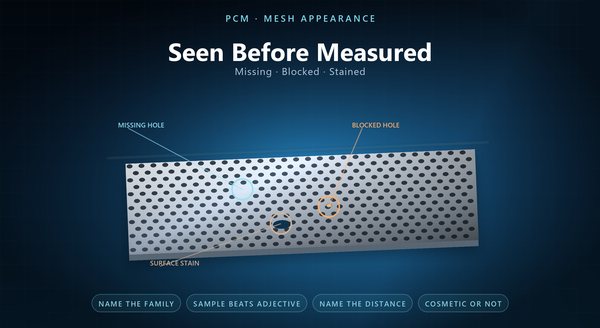
A missing hole is a hole that did not etch; it is usually a resist defect and it reads as a dark dot in a bright field.
A blocked hole is a hole that etched but is plugged by residue or a foreign particle; it reads as a bright dot in a dark field.
A double or merged hole is two apertures that joined; it is an undercut or a resist resolution problem and it is the most visually obvious of the six.
A land variation is a change in the width of the metal between holes, which reads as a patch or a band of different tone.
A surface stain is a residue, a water mark or a fingerprint, and it is the defect most often caused after the etch rather than by it.
An edge defect is a nick, a burr from a secondary operation, or a border that is not concentric with the field. A taxonomy also lets a supplier count defects by class, which is how a process improves, and a defect with no name tends to be argued about rather than fixed.
4. Samples Beat Adjectives
The specification should be a physical boundary sample, not a sentence.
A boundary sample is a part, agreed by both sides, that shows the worst acceptable condition: one missing hole in a stated area, a land variation no greater than a stated width, a stain no darker than the sample. Everything worse than the sample is a reject.
Three rules make samples work. They must be made from the same process and the same material, so they are achievable. They must be re-made when the design changes, because a sample for a 0.3 mm pitch does not describe a 0.2 mm one. And there must be two: one for the supplier, one for the customer, both signed.
A sample is a language rather than a number. A photograph is a poor second best, A photograph is a poor second best, because colour management varies between screens and printers. A number (“no visible defect”) is the worst, because it cannot be measured and cannot be argued. A sample harder than the process can hold guarantees a shortage of parts, and two signed samples settle the argument about what the sample was; a photograph is a poor second best and a number is the worst.
5. Where the Defects Come From
Each family has a cause, and knowing the cause is what turns a rejection into a process change.
A missing hole comes from a resist that did not develop or a film that had a pinhole; the fix is in the imaging, not the etch.
A blocked hole comes from an incomplete rinse or a particle that landed before plating; the fix is in the rinse and the cleanroom discipline.
A merged hole comes from over-etching or from an artwork that was drawn too close to the resolution limit.
A land variation comes from an uneven etch, which is a bath or a flow problem, or from a resist that varied in thickness.
A stain comes from drying, handling or a rinse that left residue.
An edge defect comes from singulation, from packing, or from a secondary forming step. A blocked hole that appears after plating is a plating problem for which the etch is usually blamed, and a land variation that runs in one direction is a flow problem while a random one is a resist problem.
6. Cosmetic or Functional
Not every defect is cosmetic, and the distinction has to be made per screen rather than per defect.
A blocked hole in a speaker screen is cosmetic until there are enough of them to change the acoustic resistance. A blocked hole in a vent that has to pass a flow is functional at the first one.
A land variation in a decorative screen is cosmetic. The same variation in a screen that is also a filter is a filtration defect.
A merged hole is cosmetic in a decorative field and functional anywhere the open area is specified.
A functional limit is usually a count and a cosmetic limit is usually an area. The drawing should therefore say, The drawing should therefore say, for each defect family, whether it is cosmetic or functional, and the acceptance limit should follow from that. A screen that is both decorative and functional needs both limits on the same defect.
7. Writing Appearance on the Drawing
An appearance callout needs five things: the defect families that apply, the limit for each, the viewing condition (distance, light, angle, background), the reference to a boundary sample, and the acceptance method.
If the face is not named there are always two answers to the same inspection. It also helps to name the face. It also helps to name the face. A drawing that cites a sample number is a drawing that a stranger can inspect. It also helps to name the face, because a defect on the hidden face may be irrelevant. A screen has two faces, and the one that is seen is usually the one that is not the mating face; a defect on the hidden face is a different acceptance question.
The most useful sentence on a screen drawing is often the simplest: “cosmetic per boundary sample ABC, viewed at 300 mm under diffuse light, defect families 1–4 only.”
8. First Article and Production
Appearance inspection is a habit rather than a measurement, so it has to be built into the process.
At first article, the sample is agreed and signed, and the lighting condition is recorded — a photograph of the viewing set-up is worth more than a description.
In production, inspection is visual against the sample, at a stated sampling rate, by a named person, under the stated light. A record of who inspected and under what light is what makes a claim defensible.
A visual standard without a sampling rate is one applied twice a year. The recurring mistakes are an appearance spec written in adjectives, The recurring mistakes are an appearance spec written in adjectives, A record of the light is what makes two inspectors in two factories agree. The recurring mistakes are an appearance spec written in adjectives, a sample made from a different process, a viewing distance that nobody wrote down, a single lighting condition used for both diffuse and raking checks, and a defect family that nobody agreed was cosmetic.