
micro mesh dust screen
Photochemical machining for micro mesh screen is a different problem from making a filter, even though the part looks the same. A filter is judged on what it holds back; a screen is judged on what it lets through, and on how it looks while doing it. A phone speaker cover, a microphone port, a pressure-equalisation vent and a sensor window are all screens: their job is to pass sound, air or light, to keep dust out, and to look like a deliberate surface rather than a hole.
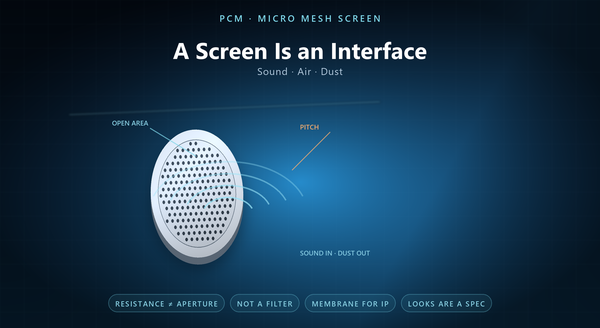
1. A Screen Is an Interface
Three jobs, and only one of them is about particles.
It passes something: sound, air, light. That makes open area a performance number rather than a filtration number.
It blocks something: dust, fingers, splash, a dropped paperclip. That is usually a coarser requirement than a filter’s, and it is often cosmetic as much as functional.
It presents something: the mesh is a visible surface, and its pattern is part of the product’s design language.
A screen that is optimised as a filter — as fine as possible — is a screen that muffles the speaker, blocks the microphone and looks like a solid disc. A screen is also the part most likely to be designed by three teams and approved by none. That is the design error this page is about. A screen designed as a hole is a screen that will be redesigned, a screen that muffles is one the acoustics team rejects after the mechanical team has approved it, and the three jobs conflict while the conflict is the design work.
2. Acoustic Resistance and Open Area
For an acoustic screen, the number that matters is acoustic resistance, and it is not the same as aperture.
A screen with a small aperture and a high open area can be acoustically transparent; a screen with a larger aperture and a low open area can be noticeably muffling. The resistance comes from the total hole area and from the thickness of the channel the air has to pass through, not from the hole size alone.
That gives two design levers that are independent in an etched part: reduce the aperture for dust, or reduce the open area for appearance, and each has its own acoustic cost.
A thin screen with small holes can be less resistive than a thick one with large holes, resistance rises with frequency so a screen tuned at one kilohertz may be wrong at ten, and open area is easy to compute and easy to mis-state because it is a ratio of areas rather than a count of holes. The practical rule is to start from the acoustic budget — how much attenuation the product can tolerate — and then choose the aperture and the open area together, rather than picking a mesh and measuring the loss.
3. What a Screen Can and Cannot Keep Out
A screen is a barrier, not a seal, and it should be specified as what it is.
It keeps out fingers, tools, lint and coarse dust. It keeps out splash reasonably well if it is backed by a hydrophobic membrane. It does not keep out fine dust, humidity or immersion, and a screen sold as waterproof is a screen plus a membrane.
A membrane behind a screen is a part in its own right with its own rating, a screen glued over a membrane can delaminate so the assembly method belongs on the drawing. A screen cannot be both the ingress protection and the aesthetic feature without a membrane behind it. The distinction matters commercially: The distinction matters commercially: a product team that believes the screen is the ingress protection will skip the membrane, and the first field failure will be a corroded speaker.
The right statement on a drawing is what the screen is for — “dust and finger guard, to be backed by a membrane for IPX7” — rather than a claim the screen cannot support.
4. How a Mesh Reads
An etched mesh is a visible pattern, and the pattern is judged at arm’s length before it is judged under a microscope.
Three cosmetic variables matter. Aperture and pitch set the visual density; a fine, dense pattern reads as a surface while a coarse one reads as holes. The land width between holes sets the contrast: a wide land catches light and outlines the pattern. And the edge treatment sets whether the mesh appears to end deliberately or to be cut off.
A pattern that is too regular can moire against a camera sensor, which is a separate specification. That is why a mesh that measures perfectly can still be rejected That is why a mesh that measures perfectly can still be rejected by an industrial designer, and why the appearance should be specified with a photograph or a sample rather than with numbers alone. A mesh that reads as a surface at 300 mm may read as holes at three metres, which is why viewing distance belongs in the specification; contrast is also a lighting property, so a mesh approved under office light can look wrong in sunlight, and a border that is too thin makes the mesh look cut while one that is too wide makes it look heavy.
5. Three Formats
Three formats cover most screens, and each has its own tooling consequence.
A flat disc is the simplest: a round mesh with an etched border, dropped into a bezel. It is the cheapest and the least dimensionally critical.
A formed dome is a mesh that is domed after etching to give it stiffness and a shape. Forming stretches the apertures slightly at the crown, so the pattern has to be designed for the stretch.
A flat screen in a curved bezel needs a compliant mounting, which is an assembly decision. An insert-moulded screen is a mesh overmoulded with a frame, An insert-moulded screen is a mesh overmoulded with a frame, which gives a sealed edge and a clean appearance; it needs a mesh that survives the moulding temperature and a frame design that does not crush the field. A domed screen also needs a forming allowance in the flat artwork or the pattern distorts at the crown, and an insert-moulded screen has a gate and a weld line problem that the mesh pattern can either hide or expose.
6. The Aperture-to-Thickness Wall
Etching a fine screen runs into the same physical wall as any fine aperture: the hole cannot be much finer than the sheet is thick, because a two-sided etch has to meet in the middle.
For a screen the wall has a second edge: the thickness also sets the acoustic channel length, so a thicker sheet is both harder to etch and more resistive acoustically.
A screen etched in a thick sheet also shows the hourglass at the edges under a loupe. That coupling is why screen designs converge on thin stock, That coupling is why screen designs converge on thin stock, and why a screen that needs stiffness gets it from a dome or a frame rather than from thickness. A screen that needs to be both fine and stiff is a screen that needs a frame, and the wall also sets the minimum land, which is what keeps the mesh from tearing in handling.
7. Clogging and Acoustic Drift
A screen clogs, and its acoustic performance drifts as it does.
The mechanism is the same as a filter’s — dust and oil lodge in the apertures — but the consequence is different: a clogged filter slows a flow, while a clogged screen muffles a speaker. The customer notices the sound before they notice the dust.
Two responses follow. A screen with a higher open area has more margin before the drift is audible. And a surface that sheds dust — a smoother etch, or a coating that is not tacky — stays acoustically stable longer.
The cleaning instruction is therefore part of the acoustic specification, not only the maintenance one. An acoustic drift of one decibel is inaudible while three is a complaint, and a screen cleaned with a solvent can lose a coating and gain a resonance.
8. Specifying and Testing
A drawing for an etched screen should state the aperture and pitch, the open area, the land width, the thickness, the format and any forming, the edge treatment, the finish and any coating, and the backing membrane if one is used.
Testing is threefold. Airflow or acoustic loss at a stated condition, measured on the screen in its housing rather than loose. A dust test, to show what the screen actually stops. And a cosmetic inspection against a photo or a boundary sample.
A cosmetic boundary sample is worth more than a paragraph of adjectives, and a dust test on a screen is usually a visual test that should be defined as one. A drawing should name the housing, because a screen measured loose is a different part. The recurring mistakes are a screen specified as a filter, The recurring mistakes are a screen specified as a filter, a waterproof claim made without a membrane, an open area quoted without the thickness that sets the channel, a dome formed without allowing for the stretch, and a cosmetic acceptance left to adjectives.