
microfluidic material selection
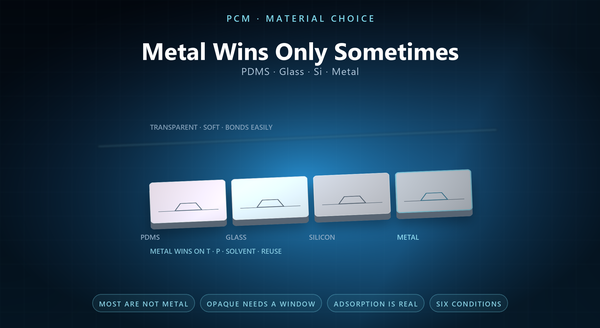
Photo chemical machining for microfluidic plate is a niche, and it is worth saying so at the start. Most microfluidic devices are made of PDMS, glass or silicon, and for most devices that is the right answer: those materials are transparent, they bond easily, and they are cheap at prototype volume. An etched metal plate competes on a different axis, and it wins only when the device has to survive something the polymers cannot.
1. Most Microfluidics Is Not Metal
A metal microfluidic plate is the exception rather than the rule, and a supplier who claims otherwise has not looked at the field.
PDMS dominates prototyping because it is cast from a mould, it is transparent, it seals reversibly to glass, and it is gas-permeable, which cell work often needs.
Glass dominates anything optical or chemically aggressive, because it is inert, transparent and can be etched or machined.
Silicon dominates anything that has to be a sensor, because the fabrication is lithographic and the electronics can be integrated.
Metal is chosen when none of those works — and the whole point of this page is to be clear about when that is.
2. Four Reasons Metal Wins
Four properties put metal ahead, and each one is a specific process condition rather than a general preference.
Temperature is the first. A polymer device softens or degrades well below the temperatures a metal plate tolerates, so anything that needs a hot process — a thermal cycle, a high-temperature reaction, a sterilisation by dry heat — pushes toward metal.
Pressure is the second. A bonded polymer device is limited by its bond strength, which is modest; a metal plate, welded or diffusion-bonded, holds pressures that would delaminate a PDMS stack.
Solvent compatibility is the third. PDMS swells in many organic solvents and is attacked by some; glass is inert but brittle; metal is both inert and tough.
Reuse is the fourth. A metal plate can be cleaned aggressively and used again, A metal plate can be bolted, which is a joint no polymer device has, and it is the only one of the four that can be mechanically disassembled and reassembled, A metal plate is also the only one of the four that can be mechanically disassembled and reassembled, and it tolerates a hot rinse a bonded polymer stack does not survive. Reuse is the fourth: a metal plate can be cleaned aggressively and used again, which matters for a device that is part of a production line rather than a study.
3. Four Reasons Metal Loses
Four disadvantages are just as real, and a page that lists only the advantages is a sales page.
Metal is also conductive, which is either a feature or a hazard. Optical access is the first and the biggest: metal is opaque. Optical access is the first and the biggest. Metal is opaque. Any device that has to be imaged from above, or that uses fluorescence, needs a window, and a window is a bonding step and an optical interface.
Adsorption is the second. A metal surface adsorbs proteins and small molecules, Adsorption is often the reason a metal device is rejected after a promising pressure test. Adsorption is the second: a metal surface adsorbs proteins and small molecules, and it can catalyse reactions at its surface; a passivated or coated surface reduces it, but does not eliminate it.
Bonding difficulty is the third. Two polymer surfaces bond by conformal contact; two metal surfaces need diffusion bonding, welding or an adhesive, each with its own equipment and constraints.
Cost at low volume is the fourth. A metal plate is also heavier, which matters for a handheld instrument. Cost at low volume is the fourth. A single etched plate is more expensive than a cast PDMS slab, and the crossover volume depends on the design.
4. The Comparison, Honestly
Four materials, four trade-off profiles.
PDMS: cheapest at prototype, transparent, gas-permeable, weak in solvent and pressure, and it leaches oligomers.
Glass: inert, transparent, bondable by anodic or fusion bonding, brittle and expensive to make deep channels in.
Silicon: high precision, integrable with electronics, expensive, opaque in the visible unless the device is thin, and brittle. A glass device and a metal device can share a channel design and differ entirely in cost, and a silicon device buys precision and pays for it in cost and opacity.
Metal: tough, tolerant of temperature and pressure and most solvents, reusable, opaque, and needing a mechanical bond.
A comparison table is only as good as the conditions listed beside it. There is no best row. There is no best row. There is a best row for a given set of conditions, which is why the conditions have to be written down before the material is chosen. The comparison also has a time axis, because a prototype and a production unit can want different materials; there is no best row, only a best row for a given set of conditions.
5. The Surface Is a Variable Too
Choosing metal does not end the surface question; it starts it.
Three surface properties matter for a microfluidic plate. Wettability sets how a liquid fills a channel and whether an air bubble forms; it can be changed by a coating but not by the etch alone.
Adsorption sets how much of the sample sticks to the wall, which matters at the low concentrations a microfluidic device usually handles.
Corrosion sets what the fluid picks up. A stainless plate in a chloride-bearing buffer will pit unless the grade is chosen for it, and a plate that pits releases ions into the flow.
A conductive wall in an electrophoretic device is a problem rather than a convenience. That is why a metal plate is usually passivated, That is why a metal plate is usually passivated, and sometimes coated — and why the coating, not the alloy, is often the surface the fluid actually sees. A passivated surface is less adsorptive than a bare one and a coated surface is less again, but a wetting treatment that is not qualified is a treatment that fails in the field, which is why a metal plate is usually passivated and often coated.
6. The Hybrid Answer
The most common way to get both is a hybrid: a metal plate with a glass window.
The metal carries the channels, the ports and the mechanical strength; the glass provides the optical access and an inert, smooth floor in the observation region.
The hybrid has its own constraints. The window has to be bonded to the metal, which is a dissimilar-material bond and one of the harder ones. The window’s material has to match the fluid’s chemistry. And the window is a second flatness problem in the same assembly.
A hybrid is usually the right answer for a device that needs both pressure and imaging, and it is worth designing as a hybrid from the start rather than adding a window later. A window also adds a thermal expansion mismatch that a thermal cycle will find, and a hybrid designed from the start has a bond land for the window while a retrofitted one does not.
7. When to Specify Metal
Six conditions point at metal, and a design that meets two or more of them is worth costing in metal.
The process runs above the softening point of the polymers under consideration. The device must hold a pressure that a bonded polymer stack cannot. The fluid attacks PDMS or the adhesive. The device must be cleaned and reused many times. The device has to be sterilised by heat. And the device is a fixed part of a machine rather than a consumable.
If none of those applies, a polymer or a glass device is probably cheaper and faster, and saying so is more useful than quoting. A design that meets none of the six is a design being sold the wrong process, and a conversation about material is cheaper than a quotation for the wrong one.
8. What the Drawing Should Say
A drawing for a metal microfluidic plate should state the alloy and surface treatment, the fluid chemistry it will see, the temperature and pressure it must hold, the optical requirements with the window material if any, the channel geometry with its measurement basis, the bond method, and the cleaning and reuse plan.
It should also state what the surface must not do: not adsorb the analyte, not release ions, not wet out in a way that traps bubbles.
A drawing that names the fluid lets the alloy be checked against it. The recurring mistakes are a metal plate specified for a transparent application, The recurring mistakes are a metal plate specified for a transparent application, A material specification for a fluidic plate is a surface specification as much as an alloy one, and a plate right in alloy but wrong at the surface fails quietly. The recurring mistakes are a metal plate specified for a transparent application, a grade chosen for corrosion resistance in the wrong environment, a window added after the plate was designed, a surface treatment left undefined, and a metal plate quoted for a device that a glass slide would have served.