
photochemical machining for pour over coffee filter
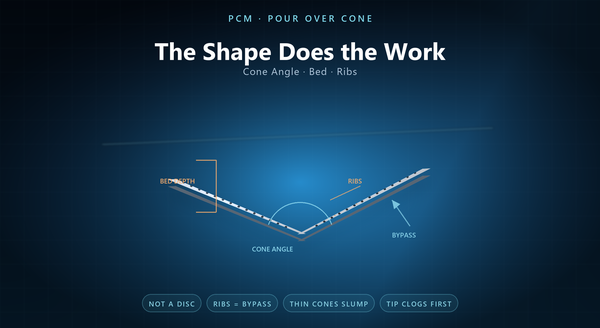
Photochemical machining for pour over coffee filter is mostly about a shape rather than a hole. A flat disc in a basket is a supported bed; a pour-over cone is an unsupported one, because the paper or metal itself holds the coffee. That single difference — the filter is the structure — is what makes cone angle, aperture distribution and ribs into design decisions rather than decoration.
1. A Cone Is Not a Disc
The same aperture field behaves differently depending on the shape it is in.
A disc lies on a basket, so the bed is supported and the flow is vertical. A cone has no basket: the filter wall holds the bed, the flow is partly down the slope, and the wall is in tension under the weight of wet grounds.
That is why a filter that works as a disc fails as a cone. The aperture is the same; the geometry is not.
The cone’s wall is also the seal, because a fold or a wrinkle is a leak path. For an etched cone, the consequence is that the flat artwork For an etched cone, the consequence is that the flat artwork has to be designed for a shape that will be formed, and the forming has to be planned for a pattern that will be stretched. A cone also has a seam or a formed joint, and that seam is the weakest line in the wall; a disc can be used flat while a cone has to keep what the forming gave it, so the forming step belongs in the development loop.
2. Cone Angle Sets Bed Depth
The angle of the cone is the primary variable, because it sets how deep the bed is at a given dose.
A narrow cone gives a deep bed for the same mass of coffee, which lengthens the path water takes and increases contact time. A wide cone gives a shallow, wide bed, which shortens the path and speeds the drawdown.
That is why cone angle and grind should be chosen together: a narrow cone with a fine grind is a recipe for a stall, and a wide cone with a coarse grind drains before it extracts.
A dose change on the same cone changes the bed depth, so one filter does not suit every recipe, and a deep bed holds water in the grounds after the pour, which is coffee that never reaches the cup. The angle also sets how much of the water sits above the bed at any moment, The angle also sets how much of the water sits above the bed at any moment, which is the pressure head that drives the flow. A bed that is too deep stalls and one that is too shallow channels because the water finds the thin path, and an angle fixed by the dripper is a constraint rather than a choice, so it should be checked before the filter is designed.
3. Aperture Along the Cone
A formed cone has a variation a disc does not: the surface near the apex is drawn in more than the surface at the rim.
Two consequences follow. A uniform flat pattern, once formed, is slightly denser at the tip, because the material there has been compressed rather than stretched. And a pattern designed as a cone’s developed surface has to account for that, or the tip will be finer than the rim.
A graded pattern also has to be inspectable, which means it must be measurable after forming. Whether that is desirable is a design question. Whether that is desirable is a design question. A finer tip slows the last of the drawdown, which some recipes want and others do not. What is not acceptable is for the grading to happen by accident. An etch uniform in the flat becomes a gradient in the formed part, and the tip is also where the flow is slowest, so a finer tip compounds: less area and less velocity.
4. Ribs Are Structure and Bypass
The ribs on a pour-over cone do two jobs, and they are often confused.
Structurally, a rib is a fold or a half-etched ridge that stiffens the wall, so a thin filter holds its shape while the bed is heavy.
Hydraulically, a rib is a gap: it holds the paper or the metal away from the dripper wall, which creates a path for air and for water that has already passed the bed.
That second job is why rib count and rib depth change the brew. More ribs mean more wall gap, which means more bypass and a faster drawdown. A rib that ends short of the rim leaves a dead zone at the cone’s top, and rib spacing matters as much as count because the gaps between ribs are where the paper can touch. A filter with generous ribs drains quickly even if its aperture is moderate. A rib that is only cosmetic costs stiffness without buying bypass, and rib depth is set by the dripper’s own ribs, so a filter that ignores them either blocks or floats.
5. Self-Support and Collapse
A thin etched cone has to stand up on its own, and that is a stiffness problem rather than an aperture one.
Three things decide it. The gauge sets the base stiffness. The ribs add local stiffness where they run. And the cone angle sets how much of the bed weight is carried in compression versus in bending — a steeper wall carries more in compression.
A cone that is too stiff is hard to seat, and a cone that does not seat leaks at the rim. A cone that is too thin for its angle will slump A cone that is too thin for its angle will slump when the bed is saturated, and a slumped cone closes the wall gap, which is a flow failure that looks like a clogged filter. A cone that holds its shape also holds a gap, and the gap is what keeps the brew moving; a stiffer gauge is harder to form, which is the trade the designer has to make.
6. Bypass and the Pour
Bypass is the water that goes around the bed rather than through it, and in a pour-over it is set by both the filter and the pouring.
A filter with deep ribs and a loose fit bypasses more. A pour that runs down the wall rather than into the bed bypasses more. Both are the same physical event and both taste the same: a weaker cup with more acidity and less body.
A bypass path that is too large makes a filter unusable with a fine grind at all. That is why a filter with a specified bypass behaviour should say so, That is why a filter with a specified bypass behaviour should say so, and why a very fast-draining etched cone is not automatically a better one. A filter that bypasses predictably is easier to brew with than one that does not, and a slow pour into the centre versus a fast pour down the wall are two different recipes on the same filter.
7. Cleaning a Cone
A cone collects its fouling at the tip, where the bed is deepest and the flow is slowest, and along the base of the ribs, where the coffee sits.
Two details matter for a metal cone. The tip is the hardest place to reach with a brush, and it is also the place where a stain becomes visible first. And the ribs hold a thin film that a rinse does not remove, which is why a metal cone benefits from a soak more than a flat disc does.
A metal cone is also visible when it is stained, which is a quality-perception problem. A cone that is cleaned only by rinsing A cone that is cleaned only by rinsing will build a film at the tip and eventually taste of it. A metal cone also holds heat differently from paper, which changes the temperature profile, and a rolled rim is easier to handle and harder to clean.
8. What the Drawing Should Say
A drawing for an etched pour-over cone should state the developed pattern with its aperture and pitch, the cone angle and the formed height, the rib pattern with its depth and count, the gauge and the formed stiffness target, the aperture grading if any, the food-contact finish, and the packing that keeps the cone from deforming.
It should also state whether the cone is meant to sit directly in a dripper or to be used as a liner, because that decides the rib depth and the bypass allowance.
A cone drawing should also give the flat blank size, because that sets the material cost. The recurring mistakes are a disc pattern reused as a cone, The recurring mistakes are a disc pattern reused as a cone, A drawing that names the dripper also names the rib depth and the bypass allowance, and a formed part needs a forming drawing as well as a flat one. The recurring mistakes are a disc pattern reused as a cone, a cone angle chosen without a grind, ribs specified for appearance only, a gauge chosen for etching rather than for stiffness, and a bypass behaviour that nobody wrote down.