

photo chemical machining for pour over coffee filter
Photo chemical machining for pour over coffee filter ends with a flat part, and the product is a cone. Everything between those two states is forming, and forming is where an etched filter is made or lost: the pattern is already fixed, the material has already been thinned where it was etched, and the geometry has to come out right in one or two operations. A blank formed hot behaves differently from one formed cold, which is a note for the drawing. This page is about that transition. The forming operation is where the part’s tolerances are finally set, because the etch cannot be adjusted afterwards, and a blank that has been etched cannot be re-cut, so the developed pattern is a one-shot design; a formed part also has to survive handling after forming.
1. Ete Then Form
The order is fixed: the sheet is etched flat and formed afterwards.
That order has consequences. The aperture field is opened while the material is still flat, so every hole is a notch in the blank before it is bent. The etched regions are thinner than the unetched ones, so the blank has a stiffness pattern built into it. And any forming that follows has to work with that pattern rather than against it.
Forming first and etching afterwards is possible in principle and awkward in practice, because a curved part is hard to coat with resist evenly and hard to expose.
2. The Developed Pattern
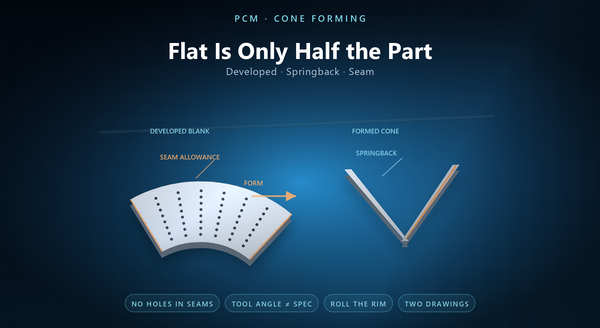
A cone is made from a flat blank that is not a rectangle. It is an annular sector: a piece of a ring, with two straight radial edges that will meet at the seam and two arcs that will become the rim and the tip.
Two numbers define it: the sector angle, which is set by the cone angle, and the radii, which are set by the cone’s height and rim diameter.
A developed pattern that ignores the seam allowance misses by the allowance. The blank also needs a seam allowance, The blank also needs a seam allowance, because the two radial edges have to overlap or butt. A sector computed for one cone angle will not form a different one, so the pattern and the angle are one decision, and the keep-out zones are as much a part of the drawing as the aperture field; aperture spacing near the tip is a forming decision too, because the tip is where the stretch is highest. And the aperture field must stop short of the seam allowance and short of the rim allowance, because a hole in a seam is a leak, and a hole in a rolled rim is a crack.
3. Springback
A formed cone does not stay where the tool put it.
Stainless springs back, so the finished cone angle is wider than the tool angle. How much depends on the gauge, the temper, the radius and the amount of stretch.
That is why a cone is designed with a tool angle that is not the spec angle, and why the difference has to be established by a trial rather than assumed from a table.
A cone that springs back more than allowed sits loose in the dripper. A part that is formed and then checked against the spec angle A part that is formed and then checked against the spec angle is a part that will be argued about, unless the springback allowance is written on the forming drawing. Springback also varies across a cone because the stretch is not uniform, so the wall is not a perfect cone; a trial with three tool angles is a cheap way to find the allowance for a new gauge.
4. The Seam
Three seams are common, and each has a consequence for the etch.
A seam left un-plated is a seam that will stain. A lap seam overlaps the two edges A lap seam overlaps the two edges and joins them by welding or by a mechanical fold. A seam is also where a leak test will fail first, if the test is done at all, and a seam zone left solid acts as a stiffening rib, which is a useful side effect. It needs an allowance and it creates a double thickness, which is a stiff ridge and a place where coffee can sit.
A butt seam brings the edges together and welds them. It is flatter and cleaner, and it needs a more accurate blank.
A welded seam of either kind puts heat into a thin section, and that heat can distort the cone and can damage a plating.
Whatever the seam, the rule is the same: no aperture in the seam zone. The etch artwork should show that zone explicitly.
5. The Rim
The rim is where the cone is handled and where it meets the dripper, and it is usually rolled.
A rolled rim does three things. It removes the sharp edge, which matters for a product that a hand touches. It stiffens the cone’s mouth, which helps it hold shape. And it creates a small reservoir lip that keeps a drip from running down the outside.
A rim rolled too tight cracks and one rolled too loose looks unfinished. Rolling is a second forming operation, Rolling is a second forming operation, and it needs its own allowance in the flat blank. A rim roll hides the blank’s edge, so a slightly ragged edge can be hidden or exposed, and a rolled rim is what makes a thin cone feel like a product rather than a shim. A rim that is rolled from an etched edge is a rim whose edge has been through a bend, so the etch quality there matters more than anywhere else on the part.
6. Ribs: Formed or Etched
A rib can be made two ways, and the choice changes the manufacturing sequence.
A formed rib is a fold pressed into the wall, which gives stiffness and a wall gap. It is a forming operation and it does not need the etch, but it does need a tool and it does thin the material at the fold.
A half-etched rib is a ridge left by etching away the surrounding material. It gives stiffness without a forming step and it holds its shape through the forming, but it consumes etch time and it leaves a step that can trap coffee.
A formed rib is also a place where the aperture field has to stop. Many cones use both: Many cones use both: a half-etched land pattern for the fine structure and a formed flute for the stiffness. A formed rib is cheaper per part at volume and needs a tool that only pays back at volume, while a half-etched rib holds its shape through forming, and a rib pattern can also be used to mark a fill line as a second job for the same etch.
7. Forming Defects and the Etch
Four forming defects are common on an etched cone, and the etch makes each of them more likely.
Wrinkles appear at the rim, where the material has to compress; an etched blank is thinner and buckles sooner.
Thinning appears at the tip, where the material has to stretch; an etched tip has less material to stretch.
Orange peel appears where the grain is coarse; a deep etch exposes more grain.
Cracking appears at an aperture that falls inside a bend radius; the hole is a stress raiser in the bend.
A blank outline that is too generous wrinkles and one that is too tight tears. All four are design problems, All four are design problems, and all four are cheaper to fix on the artwork than on the tool. A wrinkle at the rim is the defect most often blamed on the etch and most often caused by the blank outline, and a crack at an aperture in a bend is the one a customer reports first because it can be seen.
8. Two Drawings, Not One
A cone needs a forming drawing as well as a flat drawing, and the two have to agree.
The flat drawing shows the developed pattern, the seam allowance, the rim allowance, the aperture field with its keep-out zones and the blank outline.
The forming drawing shows the target cone angle, the tool angle after springback allowance, the seam type and location, the rim roll diameter, the rib pattern, and the acceptance: cone angle, height, rim diameter, seam integrity and the visual standard.
A forming drawing should also name the order of operations, because rolling before seaming is different from after. The recurring mistakes are a flat pattern designed as if it were the finished part, The recurring mistakes are a flat pattern designed as if it were the finished part, A forming drawing that does not exist is one the shop will invent. The recurring mistakes are a flat pattern designed as if it were the finished part, an aperture field that runs into the seam, no springback allowance on the tool, a rim allowance forgotten, and a forming drawing that does not exist.
