
oil filter mesh rating
Photochemical machining for oil filter mesh produces an aperture field, and the field only becomes a filter rating when a fluid flows through it. Two mesh screens with the same nominal aperture can behave very differently in engine oil and in hydraulic fluid, because what a mesh removes depends on the fluid’s viscosity, its flow rate and the particles it actually carries. This page is about that translation: from a hole size to a filtration claim.
1. A Mesh Is Chosen Per Fluid
A mesh is not a filter on its own; it is a filter in a circuit.
The same 40 µm field is a coarse strainer in a hydraulic line and a fine filter in a gearbox, because the particles that matter and the flow that carries them are different. A specification that names only the aperture has named the mesh but not the job.
A mesh is also the cheapest part in a circuit to change and the most expensive to get wrong. That is why the first question to a mesh supplier That is why the first question to a mesh supplier should be about the fluid, A mesh that is right for one machine can be wrong for another with the same oil, which is why the effect is described here rather than assumed. the flow and the cleanliness target, rather than about the micron number. A mesh is also a component that is judged twice, once in a bench test and again in a machine, and the second judgement is the one that matters.
2. Viscosity Changes Everything
Viscosity is the variable that most often explains why a mesh that works on a bench fails in a machine.
A cold engine oil can be two or three orders of magnitude more viscous than the same oil at operating temperature. The pressure drop across a mesh scales with viscosity, so a mesh that is comfortable when hot can go into bypass when cold.
A viscosity number without a temperature is half a number. That is why a screen is usually specified against a cold-start condition That is why a screen is usually specified against a cold-start condition The drop across a clean mesh is small and the drop across a blocked one is not, and the difference is the margin the bypass has to absorb. as well as a hot one, A cold-start bypass is a real event, not a theoretical one, and it is where a mesh sized only for the hot case spends its first minute of service; that is why a screen is usually specified against a cold-start condition as well as a hot one, and why a filter element often has a bypass valve: the mesh cannot be sized for both ends of the temperature range without one.
3. Three Kinds of Rating
Three ratings appear on mesh data, and they are not interchangeable.
A nominal rating is a number the supplier chooses, A nominal rating is also the number most often quoted in a catalogue, because it is the cheapest to produce and the easiest to compare. usually close to the aperture, and it says very little about what is actually removed.
An absolute rating is a stated particle size above which essentially all particles are retained, usually tied to a test method.
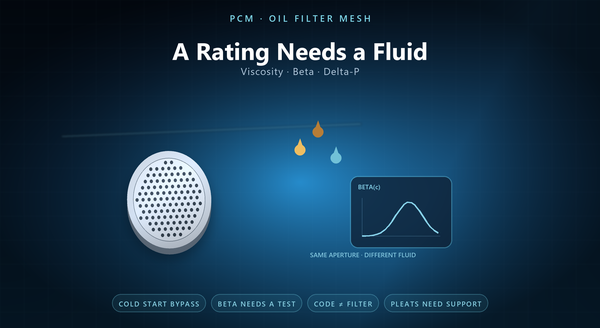
A beta ratio is the ratio of particles upstream to downstream at a stated size, measured in a multipass test. A beta curve also shows its slope, which tells how sensitive the element is to a size change. It is the most informative of the three, It is the most informative of the three, and it is the one that requires a test rather than a table. A beta ratio of 200 at 10 µm means a hundred times fewer particles above 10 µm downstream than upstream, which is a statement about performance rather than about geometry.
For an etched mesh, the aperture is precise, which makes a beta claim more defensible than it would be for a woven cloth — but the claim still has to be measured, not inferred from the aperture.
4. What a Cleanliness Code Can Say
Cleanliness codes — the ISO 4406 style counts — describe the fluid, not the filter.
A code says how many particles of a given size are present per volume. A mesh contributes to that number by removing some of them, and the element and the circuit together decide what the code becomes.
That is why a mesh supplier should not promise a cleanliness code for a machine; the honest statement is a beta ratio at a size, and the machine builder converts it.
A mesh sold with a code instead of a ratio is a mesh sold on someone else’s test. A builder who converts the ratio into a predicted code is a builder who understands the difference, and that is the conversation worth having.
5. Four Fluids, Four Behaviours
Four fluids cover most of the work, and each one shifts the mesh choice.
Engine oil is hot, oxidises, and carries soot; A soot-laden oil also changes the effective pore size, because the deposit builds on the mesh rather than in it, and that surface layer is what a beta test measures as a rising pressure drop. the mesh must resist clogging by a soft, sticky contaminant and must survive a cold start.
Hydraulic oil is the cleanest of the four and the most sensitive to particles, because clearances are small; the mesh is usually finer and the beta claim more important.
Fuel is low-viscosity and often contains water and wax; the mesh must pass a high flow at a low pressure drop and must not be blinded by a water layer.
Transmission fluid is intermediate, but it carries clutch material that is fibrous and bridges across apertures rather than passing through them. A fibrous contaminant builds a mat over the field, which changes the effective rating rather than simply blocking a few holes.
6. Pressure Drop and the Bypass
The pressure drop across a mesh is a design number, not an afterthought.
It rises with flow, with viscosity and with blockage, and the element is usually protected by a bypass valve that opens when the drop exceeds a set value. A bypass indicator is a cheap addition and a useful one. That valve protects the machine, That valve protects the machine, and it also means that a mesh which sits in bypass is not filtering at all. A bypass that is never inspected is a bypass that may have been open for months, which is a service question rather than a mesh question.
That is why the mesh’s clean pressure drop is specified against the bypass setting, A bypass that opens at a low setting protects the machine and abandons the filtration, and a bypass set too high turns the mesh into a strainer that is one cold morning away from collapse. with margin for a partly blocked condition, rather than against the pump’s maximum.
7. Pleating and Support
A flat mesh disc has a small area, and most oil filters need more area than a disc provides, so the mesh is pleated.
Pleating multiplies the area in a given envelope, which lowers the pressure drop and lengthens the service interval. A pleat is also a place where the mesh is bent, and a bend on an etched field is a place where a hole can become a crack. It also creates valleys where debris collects, and folds where the mesh is strained.
The support behind the pleats is as important as the pleats: A pleat count that is chosen for area alone ignores the valley depth, and a shallow valley holds debris where the flow cannot reach it. a pleat that is not supported collapses under differential pressure, and a collapsed pleat is a bypass path with no filtration.
8. What the Drawing Should Say
A drawing for an etched oil filter mesh should state the aperture with its measurement basis, the open area, the ligament, the fluid it is intended for, the flow and viscosity range, the target beta ratio with its test method, the clean pressure drop limit, the pleat or flat format, the support, and the cleanliness of the delivered part.
It should also state whether the mesh is expected to be cleaned or replaced, because that changes both the aperture choice and the finish.
A drawing that names the beta size also names the test method. The recurring mistakes are a mesh specified by micron number alone, The recurring mistakes are a mesh specified by micron number alone, The most useful sentence on an oil filter mesh drawing is often a single line naming the fluid, the flow and the beta target. A drawing that names the fluid and the beta target can be quoted without a specification meeting. The recurring mistakes are a mesh specified by micron number alone, a rating quoted as absolute without a method, a cleanliness code promised by a mesh supplier, a pressure drop quoted at operating temperature only, and a pleat designed without a support.