
pleat collapse filter
Photo chemical machining for oil filter mesh is usually discussed as a way to make a good filter, and the useful conversation happens after one fails. When an element comes back from the field, the mesh is the visible part and therefore the accused part, and in most teardowns the mesh is not the cause. This page is about the five ways an oil filter mesh actually fails, how each one presents, and what changes in the design when it does.
1. The Mesh Is Rarely the Cause
A mesh is one of six or seven components in an element, and the other components fail first more often than the mesh does.
An element has a media, a support, a seam or an end cap, an adhesive, a bypass valve and a housing. Each of those can fail, and several of them fail in a way that looks like a mesh failure: a collapsed pleat stops the flow, a seam leak passes unfiltered oil, an adhesive that fails sheds into the downstream.
The teardown discipline is therefore to look at all of them before blaming the aperture. A return that is blamed on the mesh is often a return that should be blamed on a bracket. A mesh that is accused is also a mesh that is easy to photograph, which is why a photograph is not evidence; the teardown discipline is to look at all of them before blaming the aperture.
2. Five Failure Modes
Five modes cover most oil filter mesh failures, and they are worth naming because each has a different fix.
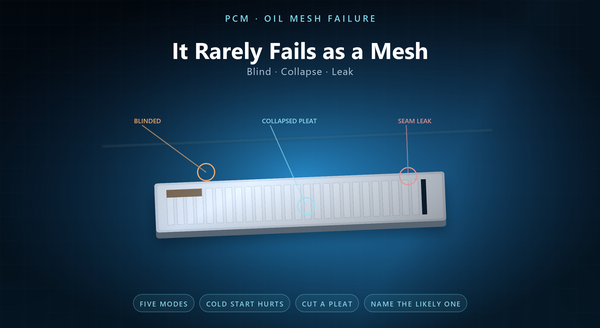
Blinding is a surface layer of contaminant that closes the field without entering it; the mesh is intact and the flow is gone.
Pleat collapse is a mechanical failure: the pleat folds over under differential pressure and closes the valley it was supposed to keep open.
Corrosion is a chemical failure: the mesh pits, usually at an edge or a fold, and eventually perforates.
Shedding is a materials failure: a coating, an adhesive or a plated layer leaves the surface and travels downstream.
A mode that is misnamed is a mode that will be treated with the wrong fix. A seam or end-cap leak is an assembly failure: A seam or end-cap leak is an assembly failure: A leak is also the only mode that leaves a clean upstream face and a dirty downstream one. A seam or end-cap leak is an assembly failure: oil bypasses the media entirely, and the element filters nothing while looking intact. Each mode has a different cost consequence too: blinding costs service intervals, collapse and leak cost the machine, corrosion and shedding cost the component downstream.
3. How Each One Presents
Each mode has a signature, and the signature is what makes a diagnosis possible.
Blinding shows as a rapid pressure drop rise with a normal-looking mesh, and it often comes with a service interval that was shortened without a design change.
Pleat collapse shows as a sudden drop rise and, on teardown, a folded or flattened pleat, usually near the inlet or the bypass.
Corrosion shows as discolouration, pitting at the fold, and a pressure drop that does not rise much because the mesh is failing open rather than closed.
Shedding shows as debris downstream and a clean-looking upstream face, which is why it is discovered by particle counting rather than by inspection.
A coarse mesh is also more tolerant of a dirty batch, which is why it survives longer in a neglected machine. A seam leak shows as a normal pressure drop with dirty downstream oil, A seam leak shows as a normal pressure drop with dirty downstream oil, and it is the mode most often missed because nothing looks wrong. A shedding event is also often intermittent, A corrosion that is caught early looks like a stain and is often dismissed. A shedding event is also often intermittent, which makes it look like a downstream problem rather than a filter one.
4. Cold Start Is the Accelerant
Three of the five modes are accelerated by the same event: a cold start.
Cold oil is viscous, so the differential pressure across the element is high before the oil warms. That high pressure is what collapses a pleat, folds a weak support, or opens a bypass that then stays open.
It is also the moment when a seam is stressed hardest, because the pressure acts on an area that is larger than the design case.
That is why a teardown should ask what the coldest start A bypass that is set too low opens on a normal cold morning, and that is a specification error rather than a failure. That is why a teardown should ask what the coldest start the element saw was, rather than only what the operating temperature was. A cold start in a cold climate is a different design case from a cold start in a warm one, and the difference is rarely written down.
5. Fine Mesh and Coarse Mesh Fail Differently
The aperture changes which mode dominates.
A fine mesh blinds faster, because a thin cake is enough to close a small aperture, and it is more sensitive to a fibrous contaminant that mats over the surface.
A coarse mesh blinds slowly but collapses more easily in relative terms, because a coarser field is a weaker lattice at the same gauge, and it lets larger debris reach the pleat valley where it packs.
That is why a fine element is usually pleated A coarse mesh also lets a fibre reach the valley, where it packs and cannot be washed out. That is why a fine element is usually pleated with more support and a coarse one with more depth. A fine mesh is also the one that shows a seam leak least clearly, because a small leak through a fine field is a small fraction of the total flow.
6. Diagnosis by Evidence
A teardown is an evidence exercise, and four checks cover most of it.
The pressure drop history tells whether the failure was gradual (blinding) or sudden (collapse or bypass).
The downstream oil tells whether the element passed what it should have held, which separates a leak or a shedding from a blinding.
A visual inspection of the inlet face separates caking from collapse.
A cut through a pleat shows whether the mesh itself is intact, corroded, or torn at the fold.
None of these is expensive, A photograph of the inlet face is worth more than a paragraph of description. None of these is expensive, and together they replace the argument about whether the mesh was good. A cut pleat is also the cheapest single test in the whole teardown, and it is the one most often skipped.
7. What Changes for Each Mode
Each mode points at a different design change, and applying the wrong one wastes a programme.
Blinding points at more area, a coarser aperture, or a surface that sheds the contaminant rather than holding it.
Pleat collapse points at a support, a shallower pleat, a thicker gauge, or a lower bypass setting.
Corrosion points at a grade or a coating, and at the water and acid the oil carries rather than at the etch.
Shedding points at a coating or adhesive that is compatible with the oil, and at a plated layer that is specified with an adhesion requirement.
A fix that is not recorded is a fix that will be re-diagnosed next year. A seam leak points at the seam design, A seam leak points at the seam design, A support that is added for collapse also changes the pressure drop, which may then need a new bypass setting. A seam leak points at the seam design, the end-cap bond, or the assembly process — and at the etch only if the aperture field was allowed to run into the seam zone. A change applied to the wrong mode is worse than no change, because it uses the one programme budget on a problem that was not there.
8. What the Specification Should Carry
A drawing for an etched oil filter mesh should carry what a teardown would want to know.
That means the aperture with its measurement basis, the open area and ligament, the gauge, the support and its open area, the pleat geometry, the seam zone that is deliberately left solid, the finish and its adhesion requirement, the clean pressure drop, and the bypass setting the element is designed against.
It should also say which failure mode is considered most likely for the application, because that tells the supplier which property to protect.
The recurring mistakes are a teardown that blames the mesh without cutting a pleat, A drawing that leaves the seam zone solid is a drawing that prevents one of the five modes outright. A specification that names the likely failure mode also tells the supplier where to spend the margin. The recurring mistakes are a teardown that blames the mesh without cutting a pleat, a pressure drop target set only at operating temperature, an aperture field that runs into the seam, a coating specified without an adhesion test, and no record of the coldest start the element saw.