
flex circuit shield
Photochemical machining for flex circuit is a sentence that needs a boundary drawn through it. A flexible circuit’s copper traces are made by PCB photolithography and plating, not by chemical machining; an etcher that offers to “etch the circuit” is either describing a different process or has misunderstood the job. What etching does make is the metal around the circuit — the stiffeners, the contact fingers, the shields and the heaters that turn a flexible ribbon into a component.
1. The Copper Is Not Etched This Way
A flex circuit is a laminate: a polyimide film, an adhesive, a copper foil that is imaged and etched by PCB processes, and a coverlay.
That copper etch is a photolithographic process, and the equipment, the chemistries and the tolerances are different from those used to cut a free-standing metal part. The two are related, and they are not the same service.
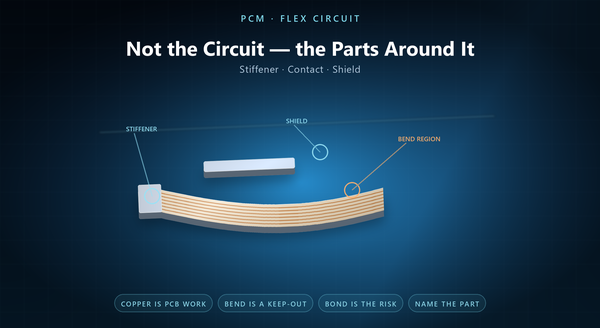
An etcher’s contribution is the parts that are not the circuit: a stainless stiffener behind a connector, a beryllium copper contact strip, a thin shield, or a foil heater. A part asked for by function is a part that can be quoted correctly. A flex circuit also has a bend region, A flex circuit also has a bend region, and that region is what makes the parts around it a design problem rather than a purchase. Those are free-standing metal parts, and they are etched the way any other thin part is. A customer who needs the copper etched should be sent to a PCB fabricator, and a customer who needs the stiffener should be sent here; confusing the two wastes a quotation round.
2. Stiffeners
A stiffener is the most common etched part in a flex assembly, and its job is to make a flexible region behave like a rigid one where a connector or a component needs it.
Three materials appear: stainless steel for a thin, stiff, cheap stiffener; beryllium copper or phosphor bronze where the stiffener also carries current; and a glass-reinforced epoxy where the requirement is thickness rather than stiffness.
The etched stiffener’s specifications are thickness, flatness, edge quality and the bond surface. The bond surface matters most: an adhesive bonds to a stiffener the way it bonds to anything, and a contaminated or oxidised surface is a delamination waiting to happen. A stiffener is also a heat path, which matters in a device where the flex carries both a heater and a temperature sensor. A stiffener that is too thick also changes A stiffener that is too thick also changes the assembly’s stiffness more than the design intended, which is a common cause of a connector that will not seat.
3. Contacts and Terminals
A flex circuit often ends in a row of contact fingers, and those fingers can be etched rather than plated up from the copper.
An etched contact strip is a separate metal part that is bonded or crimped to the flex, and it gives three things the copper cannot: a thicker wear surface, a spring rate that does not depend on the polyimide, and a contact geometry that can be formed.
The etched edge matters here for the same reason it matters on a connector: it is a taper rather than a square edge, so the contact area and the wipe have to be specified on that taper. A contact finger that is too narrow at its root is a finger that fatigues rather than wears. An etched finger also holds its position better than a plated-up one, which matters in a connector inserted by hand. And a plated etched finger needs And a plated etched finger needs And a plated etched finger needs its plating thickness specified at a stated location, because the edge and the face plate differently. A contact strip that is crimped rather than bonded has a mechanical tolerance the flex designer cannot see, which is why the attachment method belongs on the drawing.
4. Shields
A flex circuit that carries a high-speed signal often needs a local shield, and a thin etched metal shield is the usual answer.
The shield is a flat or formed part with an adhesive backing or a bond pad, and its function is to cover a region rather than to be a full enclosure. That changes the design: a local shield has open edges, and the open edges are where it leaks.
Three properties matter: the shield’s own continuity, its bond to the flex ground, and its thickness — a thin shield is easier to form and a thin shield is also a worse conductor at high frequency. A shield also adds thickness to a thin stack, which is a mechanical constraint in a phone rather than an electrical one. A shield that is bonded only at one edge A shield that is bonded only at one edge is an antenna rather than a shield, which is why the bond pattern is a design feature.
5. Foil Heaters
An etched foil heater is a resistive trace pattern on a thin metal foil, and it is one of the few places where the etched part is the active component.
The heater’s resistance is set by the trace geometry: width, length, thickness and the alloy’s resistivity. Etching gives a uniform width along a long path, which is what makes the heat uniform.
A heater that is etched on both sides of a polyimide heats twice as evenly and costs twice as much. Two constraints are worth stating. Two constraints are worth stating. The trace has to be wide enough to etch reliably at the foil’s thickness, and the heater has to be designed with the thermal path in mind, because an etched trace on a thin foil heats the foil and not necessarily the target. A heater also has to be terminated, and the termination is a second metal part or a solder joint that must survive the same temperature it produces.
6. What Must Not Be in the Bend
A flex circuit’s bend region is a designed feature, and several of the etched parts must stay out of it.
A stiffener in a bend stops the bend and concentrates stress at its edge, which is where a flex circuit cracks. A contact in a bend is a contact that will fatigue. A shield in a bend is a shield that will wrinkle and lift.
A bend line that is not marked is a bend line that will be chosen by the assembler. A square stiffener edge concentrates stress more than a radiused one. That is why the stiffener drawing should show That is why the stiffener drawing should show That is why the stiffener drawing should show the bend region as a keep-out, and why the flex designer and the part designer have to agree on where the bend line is before the parts are released. A flex circuit that cracks at a stiffener edge is a design failure that looks like a material failure.
7. Bonding and the Surface
An etched part in a flex assembly is almost always bonded, and the bond is the failure mode.
Three surface properties matter. Cleanliness: an etch residue that is not removed is a weak boundary layer. Roughness: an adhesive needs a key, and a very smooth etched surface can be too smooth. And oxidation: a stainless stiffener that has sat before bonding has an oxide that the adhesive does not like.
A shelf life on a bond surface is a real constraint, not a vendor habit. That is why a bonded stiffener is often That is why a bonded stiffener is often supplied with a specified surface treatment and a shelf life, and why the bonding process belongs on the drawing rather than in a work instruction. A bond that fails in test is cheap and a bond that fails in the field is not, which is why a peel test on a coupon belongs in the qualification.
8. What the Drawing Should Say
A drawing for a flex-circuit metal part should state which part it is — stiffener, contact, shield or heater — because the four have different specifications.
For a stiffener: alloy, thickness, flatness, bend keep-out and bond surface. For a contact: alloy, thickness, tip geometry, contact area, plating and its measurement location. For a shield: the covered region, the bond pattern, and continuity. For a heater: the trace geometry, the resistance at a stated temperature, and the termination.
A part that is specified as a material and a thickness, with no function named, is a part that will be made in the wrong version. Naming the part is the cheapest form of specification. The recurring mistakes are an etcher asked to make the circuit, The recurring mistakes are an etcher asked to make the circuit, A drawing that names which of the four parts it is saves the supplier from guessing the wrong specification. The recurring mistakes are an etcher asked to make the circuit, a stiffener designed without a bend keep-out, a bond surface specified as “clean”, a contact plated without a measurement location, and a heater designed without a thermal path.