
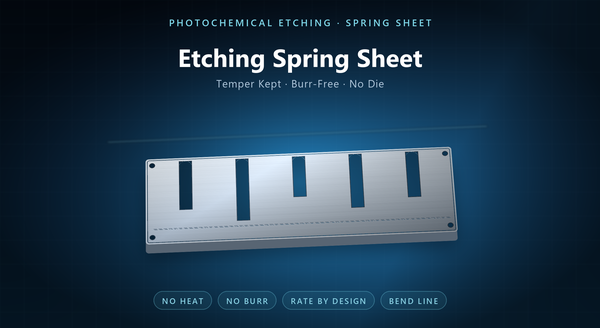
flat spring etching
Photochemical etching for spring sheet cuts flat springs, contact fingers, leaf springs and spring washers out of thin metal by dissolving the outline and the slots through a photoresist mask. The part is a spring, so the two things that matter are the material’s temper and the condition of the edge. Etching touches neither with force or heat: it removes metal chemically, so the strip arrives with the temper it was ordered in and the edge arrives without a burr. That combination is why the process holds a place in spring work that stamping does not fill.
1. What a Spring Sheet Is
A spring sheet is a flat spring: a piece of thin metal that deflects to store or apply force, rather than a coil or a wire form. The family includes cantilever contacts that press on a pad, leaf springs that preload a bearing or a connector, spring washers that take up clearance, and the flat arms inside a switch or a latch.
The geometry is usually a strip or a comb: a fixed end, a free end, and a slot or a cut that sets the working length. The force comes from the material, the width, the thickness and the free length, which makes the spring a set of dimensions rather than a shape.
That is also why the drawing has to state the function. Two parts with the same outline but a different temper, or a different edge condition, will behave differently in service. A spring sheet is also the cheapest way to get a compliant feature into a small assembly, which is why it appears in connectors, battery contacts and latches — and it is often the only compliant element, so its failure is the mechanism’s failure.
2. Why Etching Suits Spring Work
Three properties of etching line up with what a spring needs.
There is no heat. A stamped or laser-cut spring can pick up a heat-affected zone or a work-hardened edge, and both change how the spring behaves and how long it lasts. Etching is a room-temperature chemical process, so the temper the mill supplied is the temper the part keeps.
There is no force. Blanking shears the metal and leaves a shear band and a rolled burr; the burr is a stress raiser on exactly the edge that will carry the bending stress. Etching leaves a clean, rounded edge with no burr to initiate a crack.
The pattern is data. A new finger length, a new slot or a new spring rate is a new artwork rather than a new die, which suits the way spring designs are tuned. Etching also lets the spring carry its own mounting holes, locating slots and a retaining tab in the same step, so the spring and its frame are one part rather than an assembly. It even lets a spacer that sets the working height be etched into the same sheet.
3. Materials and Temper
Spring work uses a narrow set of materials, and the temper is part of the specification.
Stainless steel 301 and 302 in a spring temper are the workhorses: stiff, corrosion resistant, and available in thin strip. 17-7PH appears where higher strength is needed and a post-form age is acceptable.
Beryllium copper and phosphor bronze are chosen for conductivity, for a lower modulus, or for contact applications where the spring also carries current. They are ordered in a temper and they must return after deflection.
Carbon spring steel is the cheapest and the least forgiving: it rusts, it needs a finish, and it is usually chosen where the environment is benign and the cost matters.
Thickness is the strongest lever on spring rate, because stiffness scales with the cube of thickness. A tolerance on strip thickness is therefore a tolerance on the spring, and it is worth stating separately from the outline tolerance. The temper itself is written as a condition rather than a grade — half-hard, spring temper, or a stated tensile range.
4. Etch First, Form Second
Most spring sheets are etched flat and formed afterwards, and the sequence is not optional.
Etching first means the pattern is cut while the strip is flat and supported, so the slots and fingers come out true. Forming afterwards puts the bend into a part that already has its outline, which is the only way to keep the bend line where the drawing says. A half-etched bend line can also be added in the same artwork, which makes the fold predictable without a fixture.
Plating goes after forming, for the same reason it does on any spring: a formed film can crack at the bend, and a cracked film on a contact is a reliability problem rather than a cosmetic one.
The bend radius belongs on the drawing. A radius that is too tight for the temper will crack the outside of the bend, and no amount of edge quality will save it. A formed spring also needs a formed-state drawing, not only a flat one, because the bend line has to be located relative to the slots rather than found again on a curved surface.
5. Burr, Edge and Fatigue
A spring fails at its edge, because that is where the bending stress is highest and where a crack starts.
A burr on the tension side is the classic failure: it concentrates stress, it survives every inspection that measures only dimensions, and it shortens life in a way that shows up as a field return rather than a line reject.
Etching removes that failure mode by producing an edge without a rolled burr. The edge is not perfectly square — a two-sided etch leaves a slight profile — but it is smooth and continuous, which is what fatigue wants.
The acceptance should still be written as a condition: no burr above a stated limit, no notch, no step at the slot end. A rounded slot end matters as much as the edge, because a sharp internal corner is a crack starter in its own right, and it is the second place a spring fails after the free edge.
6. Tolerances and Spring Rate
Three tolerances decide whether the spring behaves as designed: thickness, width and free length.
Thickness comes from the strip, so it is a material callout with a tolerance class rather than a cut callout. Width comes from the etch, and it is the dimension that sets the rate along with thickness. Free length comes from the slot position, and it sets the deflection at a given force.
A spring rate tolerance is usually expressed as a force at a deflection, and it should be checked on a sample rather than inferred from dimensions. Two parts that meet every dimensional callout can still differ in rate if the temper varies across the strip.
Hole positions and mounting features are ordinary cut tolerances; they matter for assembly rather than for the spring itself. A rate tolerance of ten percent is common on a spring drawing, and it is met by controlling thickness and width rather than by tightening the outline.
7. Prototype to Volume
Etching has no tooling, so a spring can be cut for a first article or a design iteration in days. For spring work that is the main advantage: the rate is tuned by changing a length or a width, and each change is a new file.
At volume the route changes. A fixed spring at high quantity is cheaper stamped or fine-blanked, and the die can form in the same stroke. Etching stays competitive where the spring is thin, where the pattern is fine, or where the quantity does not justify a die.
A hybrid is common: etch the prototypes, then move the frozen design to a die. The handover should be written down, because an etched and a stamped spring are not identical — the edge condition and the residual stress differ, and a spring qualified on one may not meet its rate on the other. A die also fixes the edge condition for the life of the tool, which is an advantage once the design is frozen.
8. Inspection and Order Notes
Inspection covers the outline, the slot and finger dimensions, the edge condition, the flatness of the unformed part, and the force at a stated deflection where the spring is critical.
The functional check is a deflection test: measure the force at the working deflection, and check that the spring returns without a permanent set.
An order should state the alloy and temper, the thickness and its tolerance, the pattern with slot and finger dimensions, the bend radius and formed shape, the edge acceptance, the plating, and the packing that keeps thin springs flat.
The recurring mistakes are a temper left to the supplier, a thickness tolerance omitted, a sharp slot end, and a formed spring specified without a bend radius. A spring drawing that omits the temper and the edge limit has left out the two variables that decide its life.