
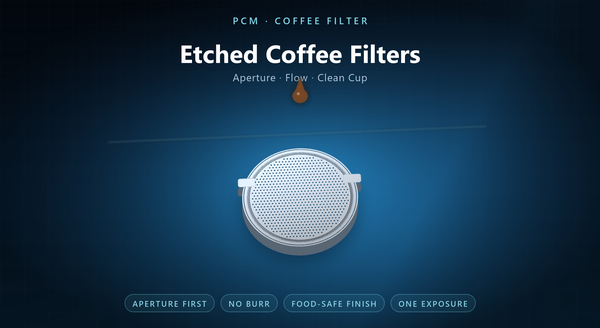
etched coffee filter disc
Photochemical machining for coffee filter mesh is the making of the filter plate — the perforated disc, cone or screen that holds the coffee bed — by imaging an aperture pattern in a resist and dissolving the metal through it. The route matters to a brewer for one reason: the aperture is a data value rather than a weave, so every hole in the field is the same hole, and the flow through the bed does not change from one unit to the next. This page is about what the process does to a filter, not about which filter to buy.
1. What the Process Does to a Filter
A metal coffee filter is a field of small apertures in a thin sheet, plus whatever rim, cone or tab the brew method needs. PCM produces both in one operation, from one artwork.
The aperture field sets the flow. The rim or cone sets how the filter sits in the brewer and how it is handled. Because both come off the same tool, the field is registered to the rim, which is what keeps the bed centred and the flow symmetric.
That is different from a woven screen, where the cloth is made first and then cut and framed: the cloth carries its own aperture, and the frame has to be added around it. Thin stainless sheet is the usual starting point — thin enough to etch a fine aperture, stiff enough to hold a bed of coffee.
2. Why Aperture Consistency Decides the Cup
Espresso and pour-over are both extraction problems, and extraction depends on how evenly water crosses the bed.
If some apertures are wider than others, water takes the easy path. The result is channelling: some of the bed is over-extracted, some is under-extracted, and the cup tastes both sour and bitter at once. It also shows up visibly, as a fast blond stream and a slow dark one from the same basket. A field with a uniform aperture spreads the flow, so the whole bed contributes.
Consistency also decides how much fine material passes. A hole that is slightly too large lets grit through; the cup turns silty and the texture is wrong. A hole that is uniform does not, which is why a fine etched disc can hold a bed that a coarser woven screen would let through.
PCM addresses both because the aperture is defined by the artwork: the same file that makes one hole makes all of them, and a revision changes them all together. A filter field with a uniform aperture also makes the brewer repeatable, which matters more behind a counter than in a kitchen.
3. How the Aperture Is Etched
The sheet is coated with resist on both faces, exposed through a phototool and developed, then etched from both sides until the cavities meet.
The wall that results is an hourglass rather than a cylinder: wider at both surfaces, narrowest at mid-thickness. That profile is the signature of a two-sided etch, and it has a practical consequence — the aperture is specified with a measurement face, because the entry, the waist and the exit are three different diameters.
For a coffee filter the waist is the flow-limiting section. A filter quoted at a given aperture is really quoted at a waist, whether or not the drawing says so.
The resist also sets the limit: the smallest aperture the process can hold is the smallest image the coating can carry, not the smallest hole the chemistry can open. The mask carries the size and the etch time carries the depth of the cut, and the two are set separately.
4. Material and the Clean Cup
Stainless steel — 304 and 316L — is the standard choice. It resists the acids in coffee, it does not hold odour, and it survives the dishwasher cycle that a reusable filter is expected to take.
Two post-etch steps matter for a food-contact part. Passivation removes embedded etch residue and restores the passive film, so the surface that meets the brew is chemically clean. Cleaning removes the resist and any handling contamination before packing. Where the filter also sees chlorinated or hard water, 316L is the safer grade and not much harder to etch.
Both should be specified rather than assumed. “Etched stainless” is not the same statement as “passivated and cleaned for food contact”, and only the second one belongs on a filter.
PCM also leaves no oil, no oxide scale and no heat tint, which is a quieter advantage: there is nothing on the surface for the brew to pick up. Passivation is not a coating; it restores the alloy’s own oxide, which is why it cannot wear off in service.
5. Formats and Integral Features
The process makes the plate, and the plate takes several shapes.
A flat disc sits in a basket or a portafilter. A cone is formed from a flat blank after etching, which is why the flat pattern has to be developed with the forming in mind — the field is drawn in the developed projection, not the formed one. A basket or a cylinder is a formed part with an etched field.
Integral features are where PCM earns its place: a rim that stiffens the disc, tabs that locate it in the brewer, a rolled edge, a laser-welded seam on a cylinder, or a half-etched ring that marks the fill line.
Each of those would be a separate part or a separate operation with a woven cloth. On an etched plate they are lines in the same file, produced in the same etch. Tabs are usually folded after etching, and the bend line can itself be half-etched so the fold lands where the drawing says.
6. Etched, Woven or Laser Cut
Three routes make a metal coffee filter, and they differ in what they control.
Woven mesh is a cloth. It is cheap per area and available in standard apertures, but its aperture is set by the weave, its cut edge frays unless finished, and the cloth has to be framed to hold a shape. It also traps coffee oils in the interstices of the weave, which is a cleaning problem an etched plate does not have.
Laser cutting makes the aperture serially. It is the right tool for a short run, a one-off or a mixed pattern, but it leaves a heat-affected edge and a taper that is set by the beam, and the per-hole time grows with the hole count. On a field of hundreds of tiny holes in thin foil, the heat also accumulates across the plate, which is a distortion problem rather than a hole problem.
PCM makes the whole field in one exposure. It suits a filter with many small apertures, a fine aperture, or integral features in the plate, and it holds the aperture across the field because the field is imaged at once.
The choice is therefore about the aperture count and the aperture size more than about the material.
7. Volume, Design Freeze and Revisions
A filter design is rarely frozen on the first try: the aperture is tuned against a grind, a basket and a taste, and each change is a new artwork rather than a new tool.
That is why the process suits the development phase. A prototype can be etched from a revised file in days, and the same file runs for production, so the filter that was tasted at ten pieces is the filter that ships at ten thousand. A tasting round that changes the aperture is a change to a number in the file, so it can run in a week rather than a tooling cycle.
At high volume with a coarse aperture, stamping becomes competitive, and a die can form and perforate in one stroke. PCM stays competitive when the aperture is fine, the field is dense, or the design is still moving — and a die needs the design frozen, which is the opposite of what a development programme does.
8. Inspection and Order Notes
Inspection covers aperture on a stated face, open area, the position of the field within the rim, flatness of the flat blank, burr, and the surface condition after passivation and cleaning.
The functional check is a flow test: time a fixed volume of water through the filter, or measure the flow at a stated head. Two filters that pass the same aperture check can still differ in flow if the waist differs, so the test should be run at the temperature the brewer actually uses — viscosity changes the number.
An order should state the alloy and thickness, the aperture with its tolerance and measurement face, the open area or the pitch, the format (disc, cone, basket) with its rim and tabs, the forming allowance for a cone or basket, the passivation and cleaning requirement, and the food-contact documentation the buyer needs.
The recurring mistakes are an aperture quoted without a measurement face, a flat pattern drawn without forming allowance, a food-contact claim made without passivation, and a burr limit that was never written down.