
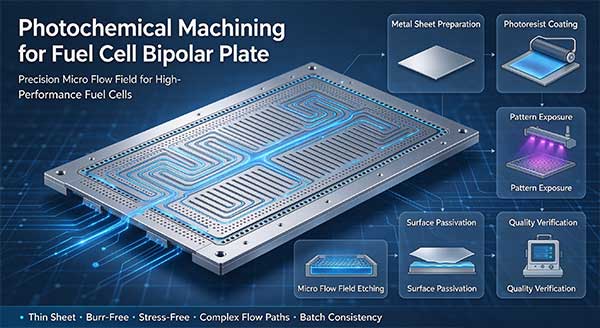
fuel cell bipolar plate
Photochemical machining (PCM), also known as photo etching, is a high-precision subtractive manufacturing method widely used to fabricate fuel cell bipolar plates. This non-contact metal processing technique uses photoresist and chemical corrosion to etch intricate flow channel patterns on thin metal sheets without mechanical force.
Fuel cell bipolar plates are core components inside hydrogen fuel cell stacks. They distribute hydrogen and oxygen, conduct electricity, transfer heat, and prevent gas cross-leakage. Traditional stamping or laser cutting often brings burrs, material deformation, and high mold costs, especially for ultra-thin metal substrates. Photochemical machining solves these pain points perfectly.
PCM works well on stainless steel, titanium, and nickel alloys commonly selected for bipolar plates. It can produce complex, repeatable flow channel designs with consistent depth and sharp edges. One key advantage is that the flatness of thin sheets remains intact, with no mechanical stress during processing. Tight dimensional tolerances are achievable even for high-volume production.
For fuel cell R&D and small batch prototyping, photochemical machining avoids expensive custom dies, greatly shortening lead time. Design revisions only require updated CAD files, which makes it ideal for iterating flow channel structures to improve fuel cell efficiency. Mass production is also available once the design is finalized.
The finished bipolar plates made by photochemical machining feature clean, burr-free flow paths. The uniform surface helps with subsequent coating treatments like gold or PVD coating to enhance corrosion resistance and electrical conductivity. These PCM bipolar plates are widely applied in automotive hydrogen fuel cells, stationary power generation and portable fuel cell systems.
Our photochemical machining service supports custom bipolar plate sizes, channel depths and patterns according to customer drawings. We strictly control flatness, channel dimension and surface quality to meet fuel cell industry standards.