
shield fence photo etching
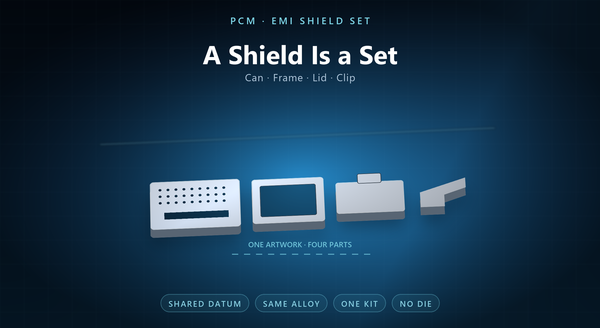
Photochemical machining for metal EMI shield is usually described part by part, but a shield on a board is rarely one part. It is a set: a can or a cover, a lid or a second can, a fence that encloses a section, clips that hold the lid, and sometimes a gasket or a contact finger strip. What PCM changes is not that it can make any one of those — it is that all of them can come off one artwork, registered to each other, and arrive as one kit.
1. A Shield Is Usually a Set
Open a board with a shield and count the parts. There is the cover that goes over the RF section, the frame it sits on, the lid that closes a can after rework, and the clips or tabs that hold the assembly closed.
Each of those has its own drawing, its own tolerance and its own supplier in a conventional programme. Each interface between them is a place where a millimetre of drift becomes an assembly problem.
PCM does not change the physics of shielding. It changes the number of drawings, because the can, the frame and the lid can all be nested on one sheet and etched from one file. A set designed as a set is also cheaper to assemble than a box plus a lid, because the interfaces are drawn rather than negotiated, and the parts usually share an alloy, which simplifies plating and solder.
2. The Four Parts of a Shield Set
A cover is a formed shell with an etched pattern — vents, access windows, a connector cut-out — and a flange that seats on the board.
A frame, or fence, is a flat band, often half-etched or folded, that stands on the board and receives the cover. Its outline is what the cover has to fit.
A lid is a flat plate that closes a can, usually with a small tab that a tool lifts. The gasket, where present, is usually a purchased part and is not etched.
A clip or a finger strip is the compliant element that keeps contact; it is a spring, and it is usually etched from the same sheet as the frame so that both are the same alloy and the same thickness. Each of the four has its own failure mode: the cover bends, the frame lifts, the lid loses its tab, the clip loses its force, and a set drawing that names all four can be quoted in one line.
3. Why Machining Them as a Set Pays
Three things follow from one file.
The first is registration. If the cover’s outline and the frame’s inner edge are drawn in the same artwork, they fit by construction rather than by tolerance. That is the difference between a shield that snaps on and one that is coaxed on.
The second is alloy consistency. A clip etched from a different coil than its frame can behave differently after forming, and the difference shows up as contact force. One sheet removes the variable.
The third is the kit. A set is also how a rework kit is supplied: a lid and a frame in one bag. A set that is packed as a set is a set that is assembled in one operation; a set that arrives as four bags is a set that is sorted, and sorting is where mistakes happen. The set also shares a plating batch, which keeps colour and solderability consistent, and a kit is how a contract manufacturer wants to receive it: one bag, one part number, one line on the pick list.
4. Registration and Stacked Tolerance
A shield set has a tolerance chain even when every part is in specification.
The board has a keep-out, the frame sits inside it, the cover sits on the frame, and the lid clips onto the cover. Four parts, three interfaces, and the accumulated clearance decides whether the assembly closes.
Etching from one artwork collapses part of that chain: the frame outline and the cover outline are one drawing, so their relative position is exact. What remains is the board tolerance and the forming tolerance, which is a much shorter chain. A set can also be made self-locating, with tabs on the frame and slots in the cover, which removes a fixture from the assembly line.
That is worth stating on a drawing, because it changes the acceptance: The remaining chain is short enough that the set can be accepted on a functional fit. That is worth stating on a drawing, because it changes the acceptance: a set can be accepted on the fit of the set rather than on the dimensions of each part.
5. Material and Plating
A shield is a conductor first, so the alloy is chosen for conductivity, stiffness and solderability rather than for strength.
Tin-plated steel is the classic can material: cheap, stiff, solderable and magnetic. Stainless is used where corrosion matters, but it is harder to solder and it is a poorer conductor than copper alloys. Copper alloys — brass and beryllium copper — are used for frames and clips where contact resistance matters.
Plating is where a set gets complicated: a tin-plated can and a nickel-plated frame are two processes, and if they are on one drawing the drawing has to say so per part, not per set. Solderability is the second plating issue: a nickel frame may need a different flux from a tin can, and a set that mixes plated and unplated parts has to be packed separately and joined at assembly.
Plating also changes the fit. A tin can and a stainless frame in one set is a galvanic pair, and the plating is what separates them. Plating also changes the fit. A tin layer of a few microns closes a clearance that was drawn tight, which is why a set should be dimensioned before plating and specified after it.
6. Forming and Assembly Order
Etching makes the flat parts; forming makes the can and the frame stand up.
The sequence matters because a formed part cannot be etched afterwards without losing registration to the set. The standard order is: etch flat, form, plate, then assemble.
The clips are formed last and least, usually a single bend, because their contact force is sensitive to how much they are worked. A clip that has been bent twice is a clip with a different spring rate. Forming also consumes panel space, because a can needs a developed blank larger than its footprint, and the lid is usually the part re-made most often, so spares are worth etching on the same panel.
Where a lid has to be removed for rework, A half-etched fold line is also how a lid hinge is made without a hinge. Where a lid has to be removed for rework, the design usually includes a small etched tab or a half-etched fold line, so the tool that opens it does not damage the can.
7. Cost and Delivery of a Set
A set is cheap to tool and awkward to manage, and the cost is mostly in the management.
There is no die for any part, so a revision of the can does not obsolete a frame. That is the practical advantage in a programme that is still changing, which is most programmes at the prototype stage.
The cost sits in panel utilisation and in kit packing: A revision also costs less, because only the part that changed needs a new panel position. The cost sits in panel utilisation and in kit packing: a set with five parts needs five positions on the sheet and one bag at the end, and the bag is a line item.
Delivery follows the same logic. A set quoted as a set has one lead time; a set quoted as five parts has five, and the assembly waits for the slowest. Quoting a set per part is a habit from die-based programmes, where each part had its own tool and its own schedule.
8. Inspection and Order Notes
Inspection of a set covers the fit between parts as well as each part: the cover on the frame, the lid on the can, the clip force at its working deflection.
Dimensional inspection still applies per part, A fit check should be run after plating, because plating is what closes the clearance. Dimensional inspection still applies per part, but the acceptance criterion for a set should be written as a fit check with a stated clearance, because that is what the assembly feels.
An order should state the alloy and thickness per part, the plating per part, the forming and assembly sequence, the fit clearances before and after plating, the kit packing and the marking that identifies which part is which.
The recurring mistakes are a set drawn as separate parts with no shared datum, A set also needs a marking scheme, because four similar steel parts in one bag are four parts that can be swapped. The recurring mistakes are a set drawn as separate parts with no shared datum, a plating callout written per set instead of per part, a clip specified without its working deflection, and a kit packed loose so that the assembly has to sort it.