
etched filter mesh
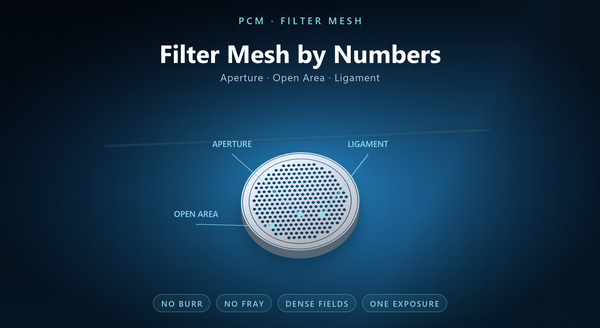
Photochemical machining for metal filter mesh is the making of a perforated screen — the plate, disc, cone or tube that lets a fluid through and holds something back — by imaging an aperture field in a resist and dissolving the metal through it. The process is not the interesting part; the arithmetic between three numbers is. Aperture, open area and ligament cannot be chosen independently, and most filter problems that reach a supplier are really a drawing in which two of the three were fixed and the third was left to chance.
1. A Filter Mesh Is a Set of Numbers
A metal filter screen is described by three numbers, and everything else follows from them.
The aperture is the opening that lets the fluid through and holds the particle back. The open area is the fraction of the plate that is open. The ligament is the width of metal left between openings.
Those three are linked. At a fixed aperture, more open area means a narrower ligament and a weaker plate. At a fixed open area, a finer aperture means more holes, a smaller ligament and a longer etch. At a fixed ligament, a wider aperture means a coarser screen with less open area.
A drawing that states all three is a design. A drawing that states two is a request for the supplier to choose the third, which is how filters end up either too weak or too restrictive. Those three are also the three that the buyer and the etcher end up arguing about, which is why they belong on the drawing rather than in a conversation.
2. Open Area and Flow
Flow through a screen is driven by open area at the operating viscosity, and that sentence carries two traps.
The first trap is that open area is not the same as aperture. A screen with 50 µm holes and 30 percent open area passes more fluid than one with 20 µm holes and 30 percent open area, because the flow through a short orifice scales with its area rather than its diameter alone.
The second trap is that the operating viscosity is not the viscosity on the datasheet. Oil at a cold start is thick; fuel at a cold start is thin. A screen sized on a nominal viscosity will be over-restrictive in one case and under-filtering in the other.
That is why a filter specification should carry a flow or a pressure drop at a stated fluid and temperature, and not only a hole size. A very short orifice also has an entrance effect, so a thin screen can pass more than its open area alone would imply.
3. Aperture Against Thickness
The etch has a limit, and the limit is the ratio of aperture to thickness.
A thin plate etches a fine aperture cleanly: the cavity meets in the middle while the resist is still intact, and the wall stays close to the drawn shape. A thick plate in the same aperture etches slowly, and the wall becomes a pronounced hourglass, which is a taper rather than a cylinder.
That has two consequences for a filter drawing. The first is that the aperture has to be specified with a measurement face — entry, waist and exit are three diameters, and the waist is what limits flow. The second is that a screen that needs a fine aperture should be made from thin stock, and a screen that needs stiffness should accept a coarser aperture.
The compromise is usually a thin perforated plate backed by a coarser support, rather than one thick plate trying to do both. A screen etched from stock that is too thick shows a taper that a flow model will not predict unless the model is told about it.
4. Media, Material and Compatibility
Four fluids dominate: air, oil, water and fuel, and each loads the material differently.
Oil is the easiest for stainless and the hardest for anything that corrodes; 304 covers most of it and 316 covers the rest. Water, especially chlorinated or saline, pushes toward 316. Fuel is a solvents problem as much as a corrosion one, and the material has to be compatible with what is in the fuel rather than with the fuel alone.
Air is the case where cleanliness matters most, because a screen in an air path sheds directly into what it is protecting.
Copper and brass appear where conductivity matters or where a specific surface finish is wanted; aluminium where weight dominates and the fluid is benign.
The material choice also fixes the finish: a stainless screen can be passivated, a brass screen blackened, an aluminium screen anodised, and each of those changes the aperture slightly. The fluid also decides how much finishing is needed: a screen in a water circuit is usually passivated, and one in clean fuel may need nothing beyond a rinse.
5. Formats and Integral Features
The screen is a plate, and a plate can be flat or formed.
A flat disc sits in a housing or a bowl. A cone or a basket is formed from a flat blank, so the pattern has to be drawn in the developed projection. A tube or a cylinder is formed and seamed, and the seam is a specification of its own.
Integral features are where PCM pays for itself: a rim that stiffens the disc and seats it, tabs that locate it, a half-etched groove for an O-ring, a fold line for a pleat support, or a part number that survives cleaning.
On a woven cloth each of those is a separate part or a separate operation; on an etched plate they are lines in the same file and come out in the same etch. A tube is the hardest format of the three, because the pattern has to be developed onto a cylinder and the seam has to be leak-free.
6. Cleanliness, Burr and Shedding
A filter that sheds is worse than no filter, and that is why burr and cleanliness dominate the acceptance of a metal screen.
Etching leaves no burr by nature, because there is no cutting edge to roll the metal over. What it can leave is residue: resist, etch salts, handling contamination. Those are removed by stripping, rinsing and, on stainless, passivation — and each of those steps should be named in the order rather than assumed.
A woven screen has a different failure: its cut edge frays, and a frayed wire is a particle. That is why woven filters are usually framed with the edge captured, and why an etched screen is often chosen precisely because its edge cannot unravel.
The acceptance should state the condition: no loose material, no protrusion above a stated limit, and a defined clean. A screen that is cleaned in place also needs a surface that does not trap residue, which is an argument for a smooth etched wall over a weave.
7. PCM, Woven Mesh and Laser
Three routes, and the decision is driven by aperture count and aperture size rather than by material.
Woven mesh is a cloth with an aperture set by the weave. It is cheap per area, it drapes, and it is the right answer for a large simple basket at a coarse aperture. It needs a frame, and its edge needs finishing.
Laser cuts serially: right for a short run, a one-off, or a mixed pattern, but it leaves a heat-affected edge, a beam taper, and a per-hole time that grows with the count. On a thin plate with hundreds of small holes, heat also accumulates across the plate.
PCM images the whole field at once. It wins when the aperture is fine, the field is dense, or the plate carries integral features; it is not the cheapest route for a coarse screen with few holes.
A common combination is a laser-trimmed woven cloth for the bulk area and an etched plate for the precision aperture zone, each process doing what it does best. Cost per part follows the hole count for a laser and the panel for etching, which is why the crossover tends to sit at high hole counts.
8. Specifying and Inspecting
A filter drawing should carry the alloy and thickness, the aperture with its tolerance and measurement face, the open area or the pitch, the minimum ligament, the format with its rim and tabs, the forming allowance for a cone or a tube, the finish, and the cleanliness requirement.
Inspection covers aperture at several points, open area, ligament, the position of the field within the rim, flatness, and the edge condition.
The functional checks are two: a flow or pressure-drop test at a stated fluid and temperature, and where retention matters, a bubble-point or particle-challenge test. Both are worth specifying because a screen can pass every dimensional check and still fail to filter or fail to flow.
The recurring mistakes are an open area callout with no ligament, A specification that names the fluid, the temperature and the retained particle can be quoted without a meeting. The recurring mistakes are an open area callout with no ligament, an aperture quoted with no measurement face, a machined viscosity used for a cold-start case, and a cleanliness requirement that appears only at incoming inspection.