

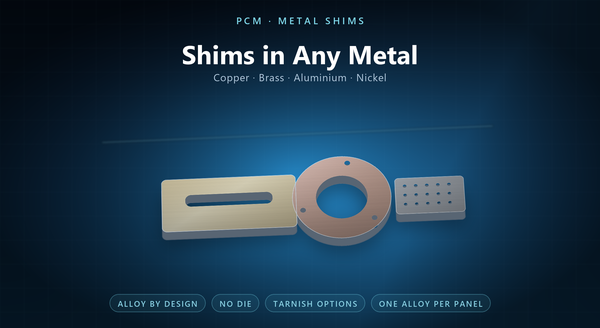
etched metal shims
Photochemical machining for metal shims is usually discussed as if the metal were always stainless, and that is a mistake: a shim’s job may be to conduct heat, to carry current, to be soft enough to conform, or to be light enough not to matter, and each of those asks for a different alloy. PCM can machine them all, but it does not machine them identically — etch rate, undercut, edge, resist adhesion and post-treatment all move with the metal.
1. A Shim Is Not Always Stainless
Stainless is the default because it is stiff, available in accurate thin strip and does not rust. But it is a poor conductor, it is comparatively hard, and it is heavier than aluminium.
A thermal shim wants conductivity, so it is copper or aluminium. An electrical contact shim wants conductivity plus spring, so it is beryllium copper or phosphor bronze. A shim that must crush and conform wants a soft temper. A shim in a weight-critical assembly wants aluminium, or titanium where strength per weight matters more than cost.
A shim in a food line is stainless because it must be cleanable; a shim in a battery stack is nickel because the surface has to survive the electrolyte. The material is therefore a design decision, and the etching consequence of that decision is what this page is about. The choice also sets the finish: a metal that tarnishes needs one protection step and a metal that oxidises needs a different one, so the material and the finish are picked together.
2. Copper and Brass
Copper etches quickly and cleanly, which makes it a favourite for fine apertures and thin shims. Its etch rate is high, so the process window is narrow: a small change in time or temperature moves the depth more than it would on stainless.
Brass behaves more predictably than pure copper and blackens well, which is why brass shims appear where a dark, non-reflective surface is wanted — optical spacers, aperture plates, decorative gaskets.
Both are soft. A thin copper shim is easy to bend during handling and easy to distort in a fixture, so flatness is a packing problem as much as a process one.
Copper is also the metal that shows a scratch most clearly, which makes handling a visible cost. Both also tarnish. A copper or brass shim that must stay bright needs a passivation, a chromate or a coating, and that step has to be specified rather than discovered after the first shipment. Brass also holds a fine slot well, which is why aperture plates are often brass, and copper is the better conductor of the two and the worse to keep bright.
3. Aluminium
Aluminium is chosen for weight, and it behaves differently in every stage of the process.
It etches quickly and isotropically, so the undercut is relatively large and the achievable tolerance is a little wider than on stainless. It also forms a natural oxide within minutes, which changes how the resist adheres and how the etchant starts.
Thin aluminium is soft and scratches easily, so handling marks are the most common defect rather than dimension errors.
Aluminium’s low melting point is irrelevant here, because the process never gets hot. Finishing is the other difference: aluminium cannot be blackened by the oxide route used on stainless, so it is anodised or coated, and the oxide thickness has to be allowed for in any aperture or step that matters. Anodising also grows the part, so an anodised aluminium shim is not the same size as the etched one it came from.
4. Nickel, Titanium and Carbon Steel
Three less common shim materials, each with a reason.
Nickel etches well and is used for corrosion resistance and for battery and fuel-cell contacts where its surface chemistry matters. It is heavier than it looks and it work-hardens, so the temper of the strip is worth stating.
Titanium is chosen for strength per weight and for corrosion, but it etches more slowly and less predictably than stainless, and its oxide makes adhesion harder. It is a material to qualify rather than to assume.
Carbon steel is the cheap option: it etches fast, it is stiff, and it rusts. A carbon steel shim needs a protective finish, and the finish is often the reason the part fails if it was not specified. Titanium also takes a different etchant, so a shop that etches stainless every day may not etch titanium at all, and nickel is the one metal here usually chosen for its surface rather than its bulk.
5. How the Metal Changes the Etch
A shop that etches several alloys keeps them apart, because cross-contamination of the bath is a real risk. Five properties move from alloy to alloy, and each has a practical consequence.
Rate sets the process window: a fast-etching metal leaves less margin for time and temperature error, so the depth tolerance is wider or the control has to be tighter.
Anisotropy sets the wall: a metal that etches isotropically produces a larger undercut and a more pronounced profile, which changes the aperture at the measuring face.
Grain sets the edge: a coarse grain etches to a rougher edge than a fine one, which matters on a shim whose edge is a sealing face.
Adhesion sets the resolution: an oxide-forming or oily metal needs a different preparation before the resist goes down, or fine features lift.
Thickness tolerance sets what the process cannot fix: no etch can make a strip more uniform than the mill supplied it. The practical consequence is that an etch recipe is alloy-specific, so a first article in a new alloy is a qualification rather than a formality.
6. Thickness, Flatness and Heat
Shims are thin, and thin metal behaves differently across alloys.
Thermal expansion matters where a shim sits between materials at temperature: an aluminium shim grows more than a steel one, and a stack that is tight at assembly can be tight or loose when hot. That is a design issue, but it is worth stating on the drawing because the etcher will be asked about it.
Flatness is mostly a stress question, and etching is good at it: no force is applied, so a shim comes out as flat as its strip. The handling and packing then decide whether it stays flat, and soft metals need more of both.
A copper shim between aluminium and steel is a galvanic couple waiting to happen, and the finish is what prevents it. Magnetic response is the third: 430 stainless and carbon steel respond to a magnet, Magnetic response is the third: 430 stainless and carbon steel respond to a magnet, 304 barely does, and copper, brass, aluminium and titanium do not. Where a sensor sits near the shim, that matters. Where a sensor sits near the shim, that matters, and where the shim is also a conductor, resistance decides the argument and copper wins it over stainless by a wide margin.
7. Mixed Kits and Volume
A shim kit — several thicknesses, several materials, one assembly — is where PCM is at its most useful, because a kit is by definition a small quantity of many variants.
The practical rule is one alloy per panel. Mixing metals on one sheet is possible in principle but puts the etch rate in conflict: the fast metal is over-etched while the slow one is still cutting. A kit is therefore run as a set of panels, one per alloy, and packed as a set.
At volume, each material has its own crossover. Aluminium and carbon steel become stampable early because they are cheap and coarse; copper and brass stay on etching longer because the parts are fine; titanium rarely leaves etching because the volumes are small. A kit is also where packing becomes a specification, and panel size differs by material because a soft metal needs a wider border to survive handling.
8. Inspection and Order Notes
Inspection covers the outline and holes, the thickness with its mill certificate, flatness, edge condition, and the finish where one is specified.
Two alloys in one kit should be two line items on the purchase order, not one. For a multi-material kit, inspection also covers the packing: For a multi-material kit, inspection also covers the packing: a kit that is right per part but mixed in the bag is a kit that fails at assembly.
An order should state the alloy and temper by designation rather than by colour, the thickness and its tolerance, the pattern, the finish and whether it is required or optional, the flatness limit, and the packing for a kit.
The recurring mistakes are a shim ordered as “brass” with no grade, a copper part specified without a tarnish protection, an aluminium part toleranced as if it were steel, and a kit packed loose. A material certificate should travel with any shim whose function depends on the alloy, because the colour of the metal is not a specification, and for a kit the packing list and the bag have to agree.
