
micro pore filter etching
Photochemical machining for microporous filter screen is the same chemistry as any other etched screen, applied in a regime where the numbers stop behaving linearly. A 5 mm hole and a 300 µm hole are both just holes; a 20 µm pore in a 50 µm sheet is a different problem, because the wall is now a substantial fraction of the pore and the etch has to open something that is nearly as deep as it is wide. At that ratio the process stops being a cutting operation and starts being a controlled breakthrough. The process window shrinks at the same time, because a small pore has to be opened before the resist fails somewhere else on the panel. This page is about that regime: what changes, what the drawing has to say, and how the part is proven.
1. What Microporous Changes
Three things change when the pore gets small.
The first is the ratio of depth to width. At 300 µm in a 100 µm sheet the ratio is generous; at 20 µm in the same sheet the pore is a tunnel, and the two-sided etch has to meet in the middle before the resist gives up.
The second is that the pore is no longer a single number. A nominal 20 µm screen has a distribution, and the largest pore in that distribution is what lets a particle through. The mean is a manufacturing statistic; the maximum is a filtration specification.
The third is that the surface matters as much as the hole. A pore that is 20 µm wide and 2 µm rough is a pore that is ten percent roughness. At this scale, the wall roughness, the edge and the cleanliness of the surface are a significant fraction of the pore, and they change both flow and retention.
2. The Aspect-Ratio Wall
Every etched screen meets an aspect-ratio wall, and a microporous one lives against it.
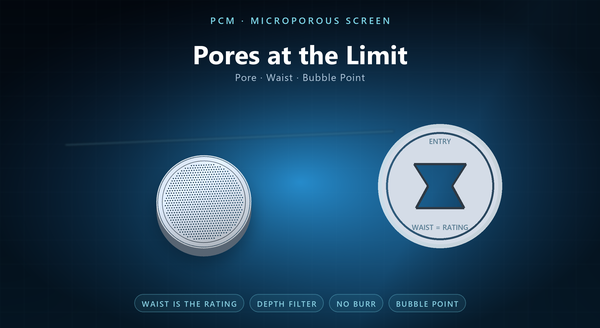
The etch removes metal from both faces at a rate set by the chemistry. The cavity deepens until it meets its mirror, and while it is deepening it also widens. The result is that a pore has a waist, and the waist is smaller than the entry.
That has two consequences. The first is that the waist is the filtration aperture: it is the narrowest section and therefore the one that stops a particle. A drawing that calls out the entry diameter has specified the wrong number.
The second is that the waist can be widened by etching longer, which is how a screen that is “a little too fine” gets reworked. That is also how a screen that is a little too coarse gets scrapped, because there is no way to close a pore.
The practical limit is therefore not a single minimum pore size; it is a curve of pore size against thickness. A supplier who quotes one minimum without asking the gauge has not described the limit. A useful way to test a supplier is to ask what changes when the sheet goes from 50 to 100 µm.
3. Distribution, Not Mean
A microporous screen is bought on its maximum pore, not its average.
The reason is that retention is a weakest-link property: a filter that holds 99 percent of 20 µm particles and passes one is a filter whose rating is set by that one pore. The mean pore size says something about flow and very little about retention.
Distribution is set by the imaging and the etch. Imaging sets where the pores are; the etch sets how much each one grows. A uniform field with a uniform etch gives a tight distribution, and the largest pore is close to the mean. A field with a local density change etches unevenly, and that unevenness shows up in the tail first.
Two measurement routes describe the distribution. Optical measurement counts and sizes pores over a field, which gives a distribution but only on the entry face. A bubble-point or porometry test measures the largest flow path, which is what retention actually depends on.
4. Absolute and Nominal Rating
The trade distinguishes an absolute rating, which no pore exceeds, from a nominal rating, which most pores meet.
An absolute-rated screen is a claim about the tail of the distribution, and it has to be proven by a challenge test rather than by a pore count. That is why an absolute rating usually comes with a stated test method: a bubble point at a stated fluid, or a particle challenge at a stated size.
A nominal rating is a claim about the typical pore and is much easier to support with a measurement and a sampling plan.
For an etched screen the honest position is usually that the pore distribution can be held to a band, and the absolute claim belongs to the test rather than to the drawing. A drawing should say which of the two is being bought. A drawing that says “absolute 20 µm” and names no test is a drawing that cannot be accepted or rejected.
5. Open Area at Micro Scale
Open area works against the web at this scale, and the trade is sharper than it is for a coarse screen.
At 20 µm pores on a 40 µm pitch the open area is around 20 percent and the ligament is 20 µm — thinner than many sheets, which makes the web the fragile part rather than the hole.
That is why microporous screens are often specified in thin foil and supported on a coarser substrate. The microporous layer does the filtration and the substrate does the structure, and neither is asked to do both.
The support also changes the flow: a fine screen on a coarse one behaves like the series of two resistances, and the flow is governed by the tighter of the two. The support also protects the fine layer from handling, which at this gauge is half of its survival. A web that thin also limits the panel size, because a large thin screen sags under its own weight when it is handled.
6. Clogging and Capacity
A microporous screen clogs differently from a coarse one, and the pore shape matters.
A straight cylindrical pore blinds at its surface, because the first particle that arrives sits on the entry and stays there. An hourglass pore is a depth filter in miniature: particles can lodge in the taper before the waist, so the screen holds more before it blinds.
That is a genuine advantage of the etched profile, and it is worth stating, because it is often presented as a defect. The same taper that makes the waist the rating also gives the screen some capacity.
Capacity is measured rather than assumed: a load test with a stated challenge and a stated end point. A screen that blinds in the first minute and one that holds for hours can have the same pore. Two screens with the same pore can differ in capacity by a factor, depending on the taper and the surface.
7. Cleanability and Shedding
A microporous screen that is cleaned and reused has two extra requirements.
The first is that the pore must be reachable by the cleaning fluid. A backflush works if the flow can reverse through the waist; a pore that has blinded at the entry may not be re-opened by backflushing alone.
The second is that the screen must not shed. Etching leaves no burr, but the handling, the cleaning and any ultrasonic step can loosen a particle from an edge, and at this pore size a single particle is a visible defect.
Both are reasons to specify the finish: passivation for stainless, a defined rinse, and a packing that does not abrade the surface. Ultrasonic cleaning helps a blind pore and hurts a fragile web, which is why the cleaning method is part of the specification.
8. Proving Retention
A microporous screen is proven, not measured.
Three tests cover the ground. A bubble-point test wets the screen, applies gas pressure from one side and records the pressure at which the first bubble passes; that pressure converts to a largest-pore estimate. A porometry test does the same across a range of pressures and returns a distribution. A particle challenge passes a suspension of known size and counts what gets through.
The drawing should name which test is the acceptance, at which fluid, and at which challenge size. Without that, “20 µm” is a drawing number rather than a filtration claim.
An order should also state the alloy and thickness, the pore with its tolerance and measurement face, the maximum pore or the rating method, the pitch and ligament, the support arrangement if any, the finish, and the packing.
The recurring mistakes are a pore specified at the entry face, an absolute claim with no test behind it, an open-area target that leaves no ligament, and a cleanliness requirement that was never written.