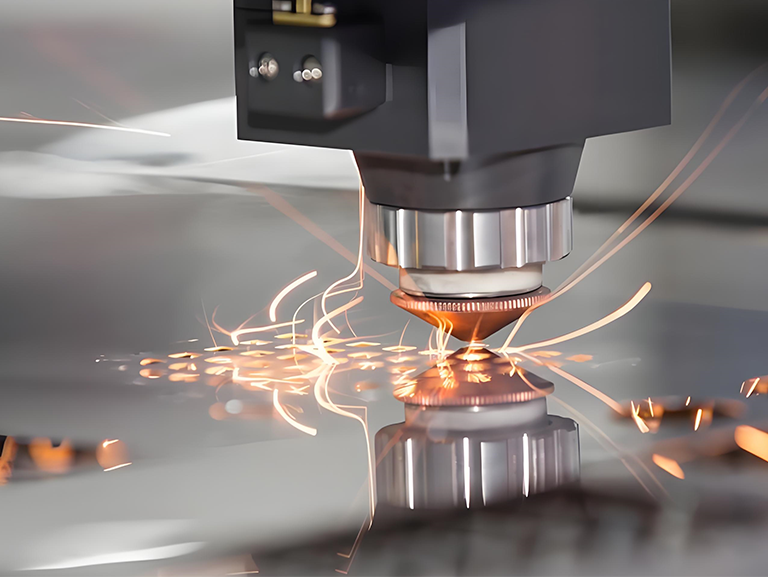
Laser cutting of metal sheets is a widely used subtractive manufacturing process in modern fabrication, offering exceptional precision for creating complex shapes from flat metal stock. As of 2026, the technology—particularly fiber laser systems—dominates industrial sheet metal processing due to major advances in speed, efficiency, and material handling.
How Laser Cutting Works for Metal Sheets
Laser cutting directs a high-powered, focused beam of light onto the metal surface. The intense energy rapidly heats the material to its melting or vaporization point. A high-pressure assist gas (oxygen for mild steel to enhance exothermic reaction, or nitrogen for stainless steel and aluminum to produce clean, oxide-free edges) blows away the molten metal, creating a narrow cut (kerf) with minimal heat-affected zone (HAZ).
Key steps include:
Beam generation — Modern systems use fiber lasers (wavelength ~1.06 μm), which deliver superior energy absorption in metals compared to older CO2 lasers (~10.6 μm).
Focusing — Optics concentrate the beam to a spot diameter of 0.05–0.15 mm.
CNC motion — The head moves (or the table moves) along programmed paths from CAD files.
Assist gas — Removes debris and controls edge quality.
For sheet metal (typically 0.5–25 mm thick), the process produces clean, burr-free edges with high repeatability.
Fiber lasers have largely replaced CO2 lasers for metal work because of 3–5× better absorption on metals, 20–40% electrical-to-optical efficiency (vs. 5–10% for CO2), and lower maintenance (no mirrors or gas refills). In 2026, fiber lasers represent ~99% of new metal-cutting installations.
Key Equipment and Parameters
A typical industrial fiber laser cutting machine for sheet metal includes:
Laser source — IPG, Raycus, nLight, or Trumpf fiber lasers, 1.5–30 kW (common: 6–12 kW for versatile shops).
Cutting head — Autofocus with capacitive height sensing for consistent focal position.
Table — Single or shuttle (exchange) tables, sizes 1.5×3 m to 2×6 m or larger.
CNC controller — With nesting software to maximize sheet utilization (often 90%+ material efficiency).
Assist gas system — High-pressure nitrogen (up to 25–30 bar) for clean cuts.
Critical cutting parameters (adjusted per material/thickness):
Power — Higher for thicker sheets (e.g., 6 kW for 20 mm steel).
Speed — 1–30 m/min depending on thickness (fastest on thin sheets).
Focal position — Adjusted relative to surface.
Gas pressure & type — Oxygen for faster mild steel cuts; nitrogen for non-oxidized edges.
Nozzle diameter — 1.0–3.0 mm.
Typical maximum thicknesses (2026 fiber lasers, approximate, nitrogen assist unless noted):
Mild steel: 25–30 mm (oxygen assist reaches higher).
Stainless steel: 20–25 mm.
Aluminum: 20–25 mm.
Brass/copper: 10–15 mm (reflective materials need higher power).
Higher-power machines (20–30 kW) push limits further for thick plates, though edge quality drops above ~20 mm.
Advantages of Laser Cutting Metal Sheets
Laser cutting excels for sheet metal due to these strengths:
Unmatched precision and accuracy — Tolerances ±0.05–0.1 mm common; narrow kerf (0.1–0.3 mm) enables intricate geometries, small holes (down to material thickness), and tight nesting.
Superior edge quality — Smooth, burr-free finishes (Ra <6.3 μm possible); minimal HAZ reduces distortion/warping.
High speed on thin/medium sheets — 10–20× faster than waterjet; fiber lasers cut 1 mm stainless at >100 m/min.
Material efficiency — Minimal waste; advanced nesting software maximizes sheet usage.
Versatility — Handles mild steel, stainless, aluminum, titanium, brass, copper (fiber excels on reflectives).
Automation-friendly — CNC integration, lights-out operation, low labor needs.
No tool wear — Beam never dulls; consistent results over long runs.
Complex shapes without tooling — Ideal for prototypes to medium production; no dies needed vs. stamping.
Energy efficiency — Fiber systems use less power per cut than older tech.
On-demand production — Reduces inventory; supports lean manufacturing.
These make laser cutting the go-to for automotive panels, electronics enclosures, appliances, signage, and custom fabrication.
Disadvantages and Limitations
Despite dominance, laser cutting has constraints:
High initial cost — Machines range $50,000 (entry-level) to $500,000+ for high-power industrial units.
Thickness limitations — Best for <25 mm; beyond this, plasma or oxy-fuel is often cheaper/faster.
Reflective materials challenges — Copper/brass can reflect beam (though fiber handles better than CO2).
Fumes and particles — Requires strong extraction/HEPA filtration (especially stainless steel produces hexavalent chromium).
Energy consumption — High during operation (though fiber is more efficient).
Heat effects — Possible discoloration, hardening, or minor distortion on very thin/heat-sensitive alloys if parameters aren't optimized.
Operator skill needed — Parameter tuning, maintenance, and safety training required.
Not ideal for very thick plates — Kerf tapers on thick cuts; slower than plasma for >30 mm.
For thick materials or budget operations, plasma, waterjet, or punching may complement or replace laser.
Applications and Future Outlook
Laser-cut metal sheets appear in automotive (chassis parts, body panels), aerospace (brackets, frames), electronics (enclosures), medical devices, furniture, architecture (facades, railings), and machinery. In 2026, integration with AI for real-time parameter adjustment, automated material handling, and hybrid processes (laser + bending) continues to grow.
Laser cutting of metal sheets balances speed, precision, and flexibility better than alternatives for most thin-to-medium applications. As fiber technology advances and costs decrease, it remains the cornerstone of modern sheet metal fabrication.
Contact: Andy_Lai
Phone: +8613144801682
E-mail: info@lasercutoem.com
Add: 208, Building B, Fushengda, No. 6, Hongkan Road, Yanchuan Community, Yanluo Street, Bao'an District, Shenzhen, China