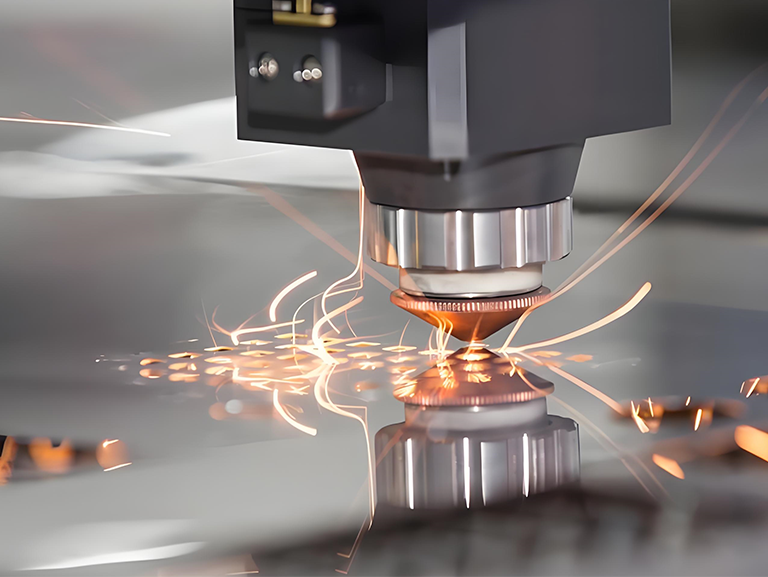
Laser Engraving Processing and Chemical Etching Processing are two common material surface processing technologies, with significant differences in principles, processes, effects, applicability, advantages, and disadvantages. Laser Engraving Processing falls under physical processing, primarily using high-energy laser beams to apply thermal effects on material surfaces, achieving melting, vaporization, or material removal. In contrast, Chemical Etching Processing is a chemical reaction process that selectively dissolves unprotected areas through reactions between etching solutions and materials, forming desired patterns or structures. The differences will be elaborated in detail from multiple perspectives below.
First, in terms of processing principles, the core of laser engraving is the thermal effect of the laser beam. The high-density energy beam from the laser focuses on the material surface, instantly raising the local temperature above the melting or boiling point, causing material melting, vaporization, or evaporation, thereby removing material or altering surface morphology. This is a non-contact physical denaturation process, often involving phase changes, such as direct transition from solid to gas. The depth and effect of laser engraving can be precisely controlled by adjusting laser power, scanning speed, and focal length, suitable for creating grooves, raised marks, or color changes. Comparatively, chemical etching relies on chemical reactions. The process involves coating the material surface with photoresist or protective film, removing the protection in areas to be etched via exposure and development, then immersing or spraying the material with etching solution (acidic or alkaline), where the solution reacts with exposed areas, dissolving and removing them to form concave-convex or hollow structures. This is an isotropic chemical dissolution, with reaction rates influenced by solution concentration, temperature, and time.
Second, the process flows differ markedly. Laser engraving uses numerical control systems to guide laser head movement, with high automation, typically including pattern design, program import, laser focusing, and surface scanning. No masks or chemicals are needed, operation is simple, and parameters can be adjusted in real time. Post-processing, the surface is clean without additional cleaning. Chemical etching involves multiple steps: surface cleaning, resist coating, exposure and development, etching reaction, residual resist removal, and neutralization cleaning. The etching stage requires strict control of solution ratio and immersion time to avoid over-etching or undercutting. The process is complex, requires waste liquid handling, and demands high environmental control.
Processing effects and precision are key distinctions. Laser engraving achieves extremely high precision, reaching micron or even nanometer levels, with small spot sizes, sharp edges, no undercutting, and smooth burr-free surfaces. Depth is controllable, from shallow marks to hundreds of microns deep, ideal for fine patterns and high resolution. It induces no mechanical stress, avoiding deformation, suitable for brittle or elastic materials. Chemical etching offers high precision, especially with photolithography, achieving 0.01 mm line widths, but prone to undercutting, leading to blunt edges and lower pattern fidelity. Depth is flexible but uniformity affected by solution flow and reaction rates, making large-area depth control challenging. Chemical etching yields more natural surfaces with uniform textures but may increase roughness.
In material applicability and scope, laser engraving is more versatile, suitable for nearly all metals and non-metals like stainless steel, aluminum alloys, plastics, wood, leather, glass, and ceramics. It excels on thin sheets, curved surfaces, or complex shapes, integrating marking, cutting, and engraving. Chemical etching primarily suits metals, especially thin sheets like stainless steel, copper, and aluminum, for precision parts, but poor for non-metals, requiring specific solutions. Laser suits small-batch customization and high precision, while chemical etching favors large-volume complex concave or hollow structures.
Regarding advantages and disadvantages, laser engraving excels in non-contact, pollution-free, fast speed, high precision, and environmental friendliness. No chemical waste, high energy efficiency, minimal material waste, and permanent wear-resistant marks resisting corrosion and heat. Drawbacks include high initial equipment cost, lower efficiency on thick materials with power limits, and smoke requiring ventilation. Chemical etching advantages include lower cost (especially large-volume), flexible depth, potential for coloration or multi-layer effects, and uniform large-area processing. Significant drawbacks: severe environmental pollution (strong acid/alkali waste difficult to handle), health risks to operators, inferior precision and uniformity to laser, undercutting distortion, and lengthy multi-step cycles.
In practical applications, choices depend on needs. Laser engraving is widely used in electronic product identification, automotive part marking, craft personalization, medical device traceability, and aerospace precision marking, ensuring visibility in harsh environments. Chemical etching is common in printed circuit boards, metal signs, filters, precision gaskets, and decorative panels, especially for deep etching or hollow batch parts like phone casings or instrument panels.
Additionally, in environmental and safety aspects, laser engraving is superior, requiring no chemicals, avoiding waste and toxicity, aligning with green manufacturing. Chemical etching, though low-cost, adds waste handling burdens and may release harmful gases.
In summary, laser engraving dominates modern manufacturing with high precision, flexibility, and eco-friendliness, especially for high-value fine products. Chemical etching retains role in large-scale metal parts due to cost and volume advantages. They complement rather than replace each other based on requirements. As technology advances, laser costs decline, expanding its scope. Understanding these differences optimizes process selection, enhancing efficiency and quality.
Contact: Andy_Lai
Phone: +8613144801682
E-mail: info@lasercutoem.com
Add: 208, Building B, Fushengda, No. 6, Hongkan Road, Yanchuan Community, Yanluo Street, Bao'an District, Shenzhen, China