High-precision laser engraving services primarily focused on metal materials utilize fiber lasers as the core equipment. This technology employs a 1064nm wavelength laser beam with high energy density focused on the metal surface, achieving annealing marking, deep engraving, color changes, or surface removal effects. It offers micron-level precision and is suitable for materials such as stainless steel, aluminum alloys, titanium alloys, copper, and tool steel. Advantages include non-contact processing, no consumables, and corrosion-resistant markings, making it widely used in aerospace, medical devices, automotive parts, electronic products, and precision instrument identification.
The entire processing workflow, from customer requirement confirmation to final product delivery, emphasizes precise control and quality assurance to ensure marking durability, clarity, and repeatability.
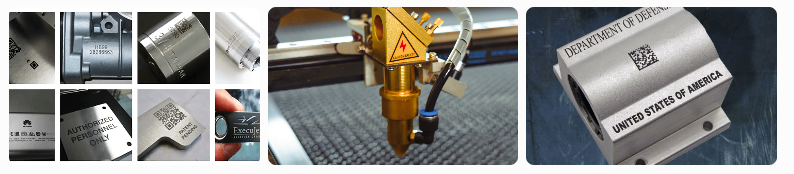
The process begins with the customer consultation and requirement confirmation stage. Customers submit engraving requirements, including pattern designs (such as QR codes, serial numbers, logos, or complex graphics), marking depth (shallow marks from 0.01mm to deep engravings over 0.5mm), contrast requirements (black annealing or white etching), material specifications (e.g., stainless steel 304/316, anodized aluminum, titanium alloy surfaces), and batch quantities. The processing side evaluates the laser absorption characteristics of the materials—for instance, stainless steel easily achieves high-contrast black annealing, aluminum alloys require control of the heat-affected zone to avoid deformation, and titanium alloys can produce colorful oxidation effects. Durability needs are also confirmed, such as resistance to high temperatures, chemical corrosion, or anti-counterfeiting traceability. Quotations are calculated based on design complexity, material pretreatment difficulty, processing time, and precision requirements, with discussions on tolerance standards (e.g., positional accuracy ±0.01mm). This stage also involves signing agreements to clarify delivery timelines and quality acceptance criteria.
Next comes the design preparation stage. Customers provide vector files (such as DXF or AI formats) or bitmaps; for high-precision requirements, vector formats are prioritized to ensure sharp edges without jagged artifacts. If customers lack files, designs can be recreated using professional software based on descriptions. During design, paths are optimized to reduce jumps, improving efficiency and precision—for example, employing minimized idle travel filling strategies. For QR codes or data matrix codes, module sizes must meet reading standards, and grayscale images are used for depth control to achieve 3D relief effects. Metal processing often involves annealing mode (low power, high speed for oxidation color changes) or etching mode (high power for material removal). After completion, simulation is performed to predict the heat-affected zone and marking effects, especially for thin-walled parts to prevent deformation. Material preparation is critical: metal surfaces undergo thorough cleaning to remove oil, oxide layers, or coating residues using alcohol or ultrasonic cleaning, ensuring uniform laser energy absorption. For certain aluminum alloys or copper materials, pre-spraying marking agents may enhance contrast.
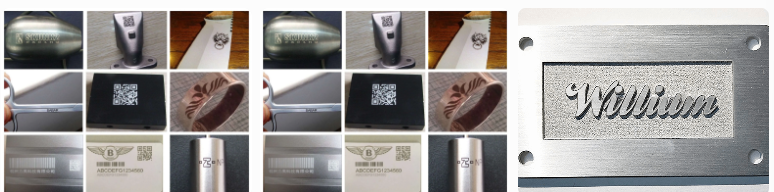
The third stage is parameter setting and test processing, the core of high-precision work. Fiber laser parameters include power (20W-100W or higher), frequency (20-100kHz), scanning speed (1000-10000mm/s), pulse width, focal distance, and scan passes. Optimization varies by metal: stainless steel annealing uses medium power, low speed, and high frequency for deep black effects; aluminum alloy etching requires high power and multiple scans to remove the oxide layer, exposing the silver-white base; titanium alloys produce colors by controlling pulse energy. Equipment features high-precision galvo systems and auto-focusing, ensuring focal deviation less than 0.01mm. Assist gases (such as nitrogen or compressed air) blow away slag and reduce oxidation. After setting, small sample tests are mandatory on the same batch material, marking multiple parameter combinations and measuring depth (using micrometers or laser confocal microscopes), contrast (with densitometers), and edge sharpness. If issues like excessive heat-affected zones, blurred markings, or uneven colors occur, adjustments are made promptly—such as lowering frequency to reduce heat buildup or increasing defocus for softer edges. Tests also verify durability, like wipe tests or salt spray simulations. This stage often requires multiple iterations until precision and effects meet standards, preventing batch defects.
The formal processing stage follows. Cleaned metal workpieces are fixed on high-precision tables using fixtures or vacuum adsorption to prevent displacement; for curved surfaces, rotary or multi-axis systems are employed. Equipment is started, with the laser head following optimized paths for high-speed scanning. Pulsed laser instantly melts or vaporizes the surface, creating permanent markings. The process is monitored continuously for temperature and fumes, with exhaust systems maintaining a clean environment. For large batches, automated loading/unloading or assembly lines can be integrated. Deep engraving requires multi-layer scans to gradually remove material, avoiding cracks from single excessive passes. In high-precision processing, positional repeatability relies on galvo calibration and software compensation, with marking speeds reaching thousands of millimeters per second. The non-contact nature ensures no mechanical stress, ideal for delicate thin parts.
After processing comes the post-treatment stage. Workpieces are removed, and residues cleared with compressed air or lint-free cloths. Annealed markings typically need no further treatment for high corrosion resistance; etched markings may undergo passivation to restore anti-corrosion layers or ultrasonic cleaning to remove loose particles. Certain applications require edge polishing or protective coatings. The heat-affected zone is checked for minimization, ensuring no micro-cracks.
Finally, the quality inspection and delivery stage. Optical microscopes, 3D profilometers, or coordinate measuring machines inspect marking dimensions, depth uniformity, positional accuracy, and readability (e.g., 100% QR code scan success rate). Durability tests include friction, corrosion, and high-temperature simulations. Qualified products receive anti-scratch packaging, with inspection reports and traceability data attached. Delivery includes effect photos and maintenance recommendations.
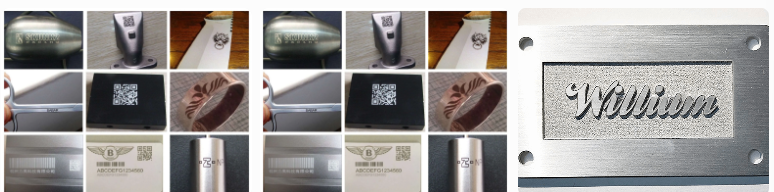
High-precision laser engraving focused on metals achieves micron-level permanent markings, meeting industrial-grade durability requirements. Full workflow control from requirements to delivery ensures high repeatability and zero defects. With equipment advancements, such as integrated AI path optimization and online monitoring, efficiency and precision are further enhanced. This technology not only improves product traceability and aesthetics but also drives innovation in precision manufacturing.
Contact: Andy_Lai
Phone: +8613144801682
E-mail: info@lasercutoem.com
Add: 208, Building B, Fushengda, No. 6, Hongkan Road, Yanchuan Community, Yanluo Street, Bao'an District, Shenzhen, China